Sculpture would be the embodiment of places that, opening a neighborhood and guarding it, gather around them something of freedom that grants a home to all things and to men a dwelling among things (Heidegger 1979).
Observations on the Unfinished in Art
The Marchiondi Spagliardi Institute, designed by Vittoriano Viganò, was built between 1953 and 1957. The church, theater, and sports center were never built from the original plan, but only the buildings for classrooms and laboratories, the dining room, and the administrative offices, which allowed the institute to operate for more than twenty years. Despite the fact that the construction of the complex does not fully correspond to the plan, the architecture presents itself as a finished work, «a ‘small modern world’, the successful attempt to build for a community not only the house but a small city» (Portoghesi 2021).
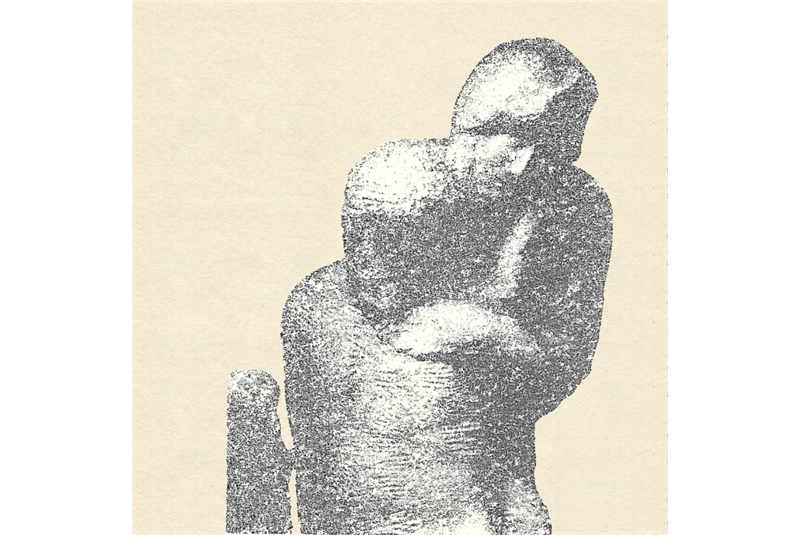
The condition of non-finiteness of architecture is determined by the interruption of an artistic process, which returns an unfinished work. However, the transmission of the meaning of a work does not seem to be inextricably linked to its formal finiteness. Consider, for example, Michelangelo’s Pietà Rondanini: the image of the Pietà, although sculpted in rough strokes, is very clear and with it the meaning of the work. The incomplete elaboration and the fragmentary composition do not detract from the power of the transmission of meaning, but rather amplify the story, emphasizing the expressiveness.
According to G.C. Argan, «the unfinished of many parts» gives the work a lyrical height that the artist «achieves through extreme torment documented by the pentimenti and destructions left in sight [...]. And here the value is given precisely by its being presented as a fragment: almost a thought that can only be expressed in broken phrases and for truncated accents, for sudden rhythmic attacks that just as suddenly die out.»
On the basis of this reasoning, in a similar way, it is believed that the unbuilt parts of the Marchiondi Spagliardi do not detract from the completeness of the architecture, described by Portoghesi (2021) as «a masterpiece, […] a building capable of telling its reason for being through its form and – fundamental thing – to speak to us convincingly about how architecture can contribute to improving the life of man».
The unfinished is considered a value, a condition that can focus attention on the creative process, to reflect in the flesh - in its making - on the expressiveness of a work, leaving room for freedom on its experience. And always thinking of the Rondanini, precisely because it is left hanging, the unfinished work is able to tell in the edges, in the neglected furrows, the way the artist worked, invisible in other (re-)finished works. On the other hand, this condition translates into a quality that places it on a more general level of meaning than any other Pietà: the abstraction of the figure, as a process of reduction to the essential of the form, is a principle capable of leading to a character of generality, recognizable and shared by the members of a community, which arouses a feeling[1]. In this way, a work acquires a character of historical continuity, that is capable of transcending the particular historical moment of its production to express a continuous value of modernity. A significant form becomes stable communication of a value over time, and in this way it assumes an infinity that is its quality of non-finiteness taken to the limit.
These reasonings are all the more significant if we consider the design of a monument, a work not designed for a practical purpose, whose presence reminds man of a need: to remember something.
Composition Principles
The value of author’s unfinishedness represents the general theme of the monument’s narrative; at the same time, as a particular testimony, it is intended to refer to the specific architecture of the Marchiondi Spagliardi. The intention is to understand in the design the passage from general to particular and to return the two levels of meaning distinct; therefore, the reasoning behind the composition is based on principles of abstraction and analogy.
The general character is sought in the application of a principle of abstraction by reporting in the form of some essential features, able to comprehend and summarize the unfinished in a broad sense[2].
A possible representation can be a path, intended as a translation into spatial properties of the temporal dimension[3], a fragment of time along which different events follow one another, also translated into spaces.
With the will to express a deep bond with architecture, the reasons for the composition of the Marchiondi are sought, the rules for the arrangement of volumes and the combination of the elements of the construction, up to the geometric figure, regulatory module of uniformity as well as of variation of the ratios. The design of the monument proceeds according to a relationship of analogy of principles.
In the Marchiondi Spagliardi Institute, great importance is attached to the formal articulation of the school complex, significant of the proper meaning of architecture[4]; in the alternation of the different buildings dedicated to the necessary functions, in the voids generated by the distance between them that become green spaces, in the continuous variation contained in a measured whole, the common life of educators and educators is carried out and expressed[5].
Finally, the analogical procedure is mediated, once again, by a strong will of abstraction: on the one hand to avoid a formal re-proposal, on the other hand to seek a reduction to the essential[6].
Free Dimension
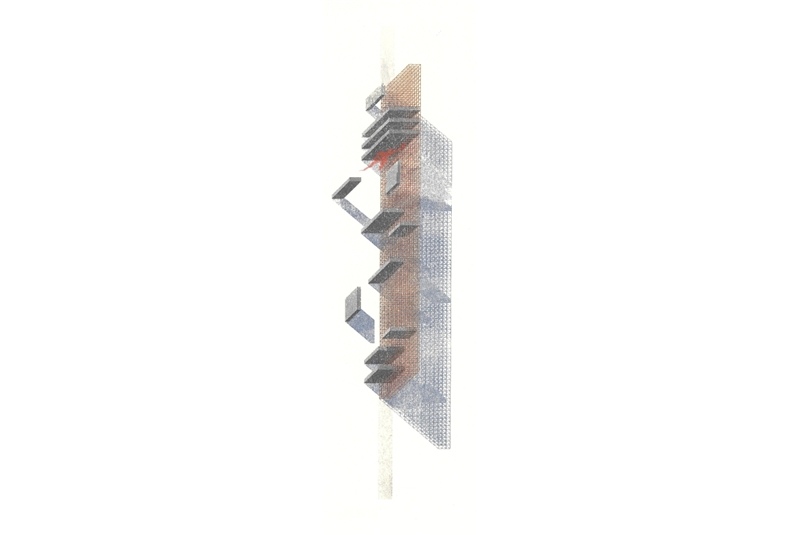
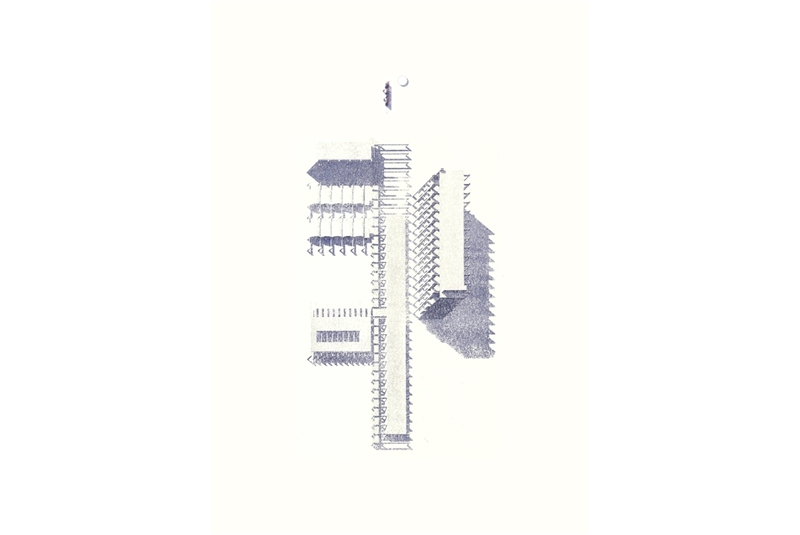
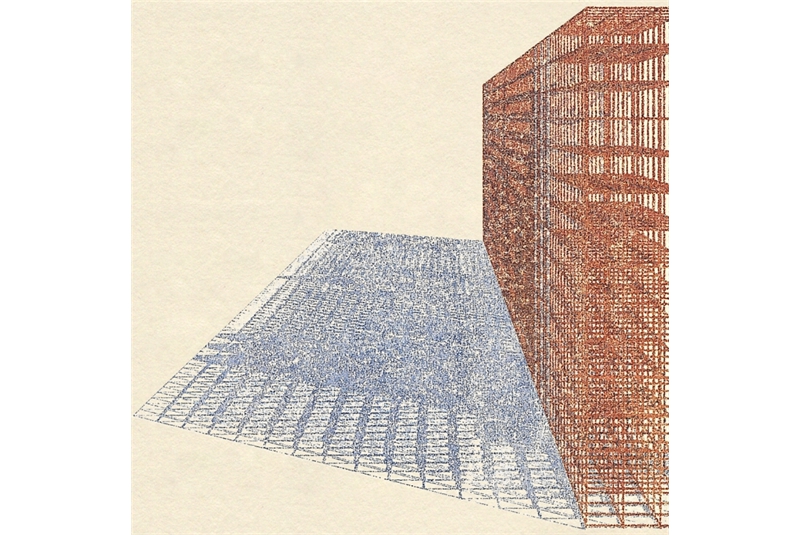
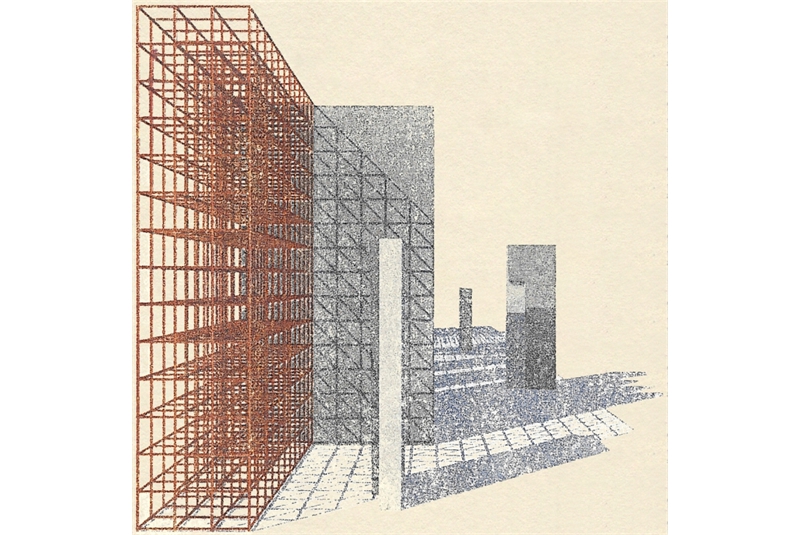
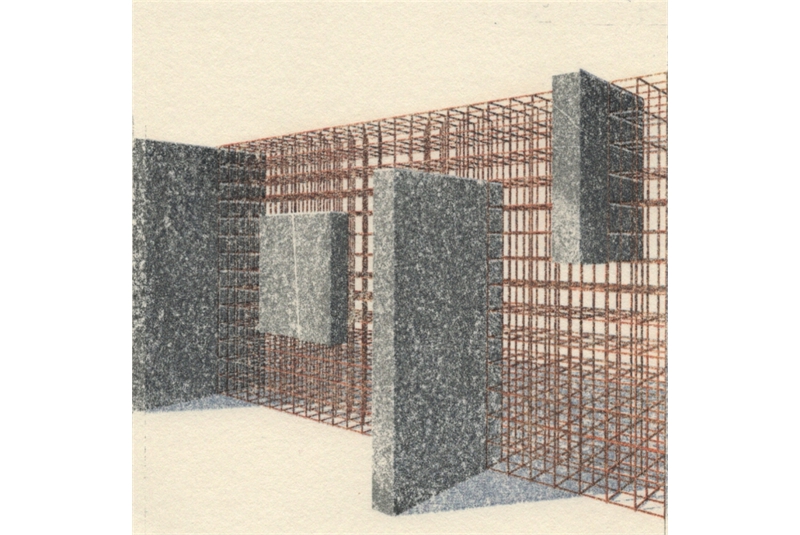
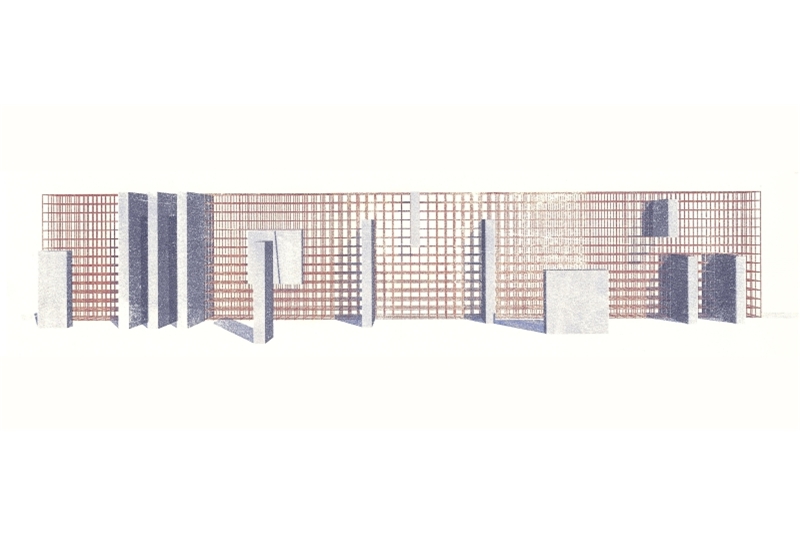
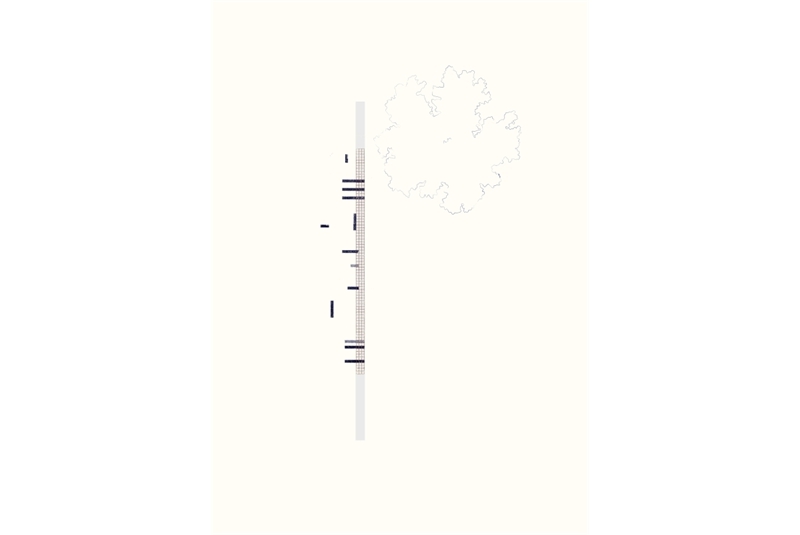
In the monument, a linear element defines a path that orders the alternating arrangement of the parts, the full and the empty of the composition. Similarly, to the reference architecture, a direction is traced, a road that becomes an element of relationships between different places. The path is concretized by this linear element built in steel rods, to form the spatial grid, a visible volume[7]. The grid accompanies the visitor’s pace, whose gaze observes the surrounding environment through the metal mesh. Along the path, solid volumes are arranged close and far, transversal or parallel to the grid, to define a succession capable of giving shape to spaces evocative of different experiences, events along the path.
The proportions of the monument are related to the human scale (modulor) and the solid volumes in their arrangement and sizing define internal spaces, in continuity with the exterior[8].
The monument is placed in continuity with the Marchiondi architecture, along the linear path, the ordering element of the entire composition, as its continuation. When the end of the covered road is reached, it is possible to see the monument, arranged to mark the extension of the path. It is in this relationship of continuity, wanting to make the monument the recognizable continuation of the Marchiondi, and at the same time of alterity, since it is an abstract construction of the idea of the consequentiality of space, that a sense of non-finiteness is expressed.
In the construction of the Marchiondi Institute, the building system makes the whole unitary and characterizes each part as an independently defined element. The portal becomes a support for the roofs of the buildings and an interval of the empty spaces; in its different articulations, it is a source of variation throughout the project. It is an elementary part that, by virtue of its repetition, becomes strongly identifiable with the entire building[9].
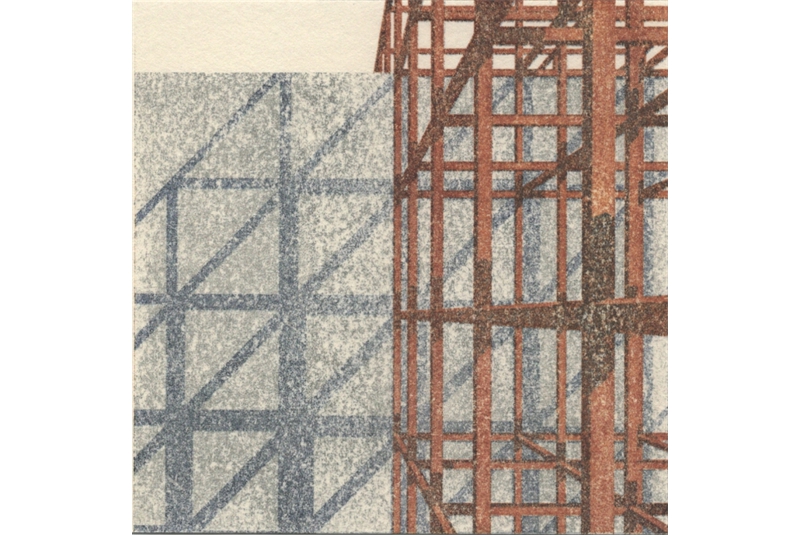
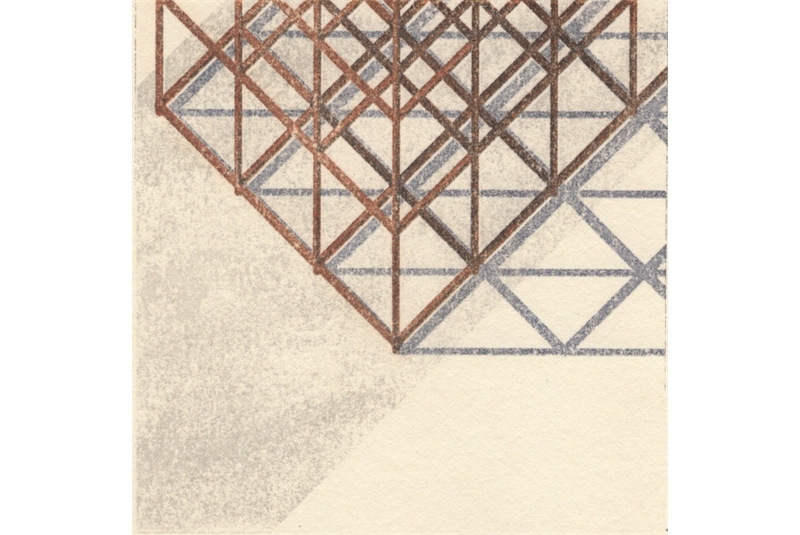
An analogous principle of combination and repetition generates variation in the project and represents the logic capable of ordering the plastic tension, the energy that characterizes and becomes identifiable with the work. The contrast between the void included in the reticular element and the full of the stone solids, embedded or arranged in relation to it (Figs. 8 and 9), underlines a first hierarchy between the elements. In the arrangement of the solids, a second hierarchy can be found, based on a “significant order of distinct individual places” (Norberg-Schulz 1979), which scan the path in defined moments. An expressiveness analogous to that of the Marchiondi is sought, where «the protagonist becomes the space as a humanized void through rhythm, color, proportions, capable of overwhelming any closure of the volumetric envelope» (Portoghesi 2021).
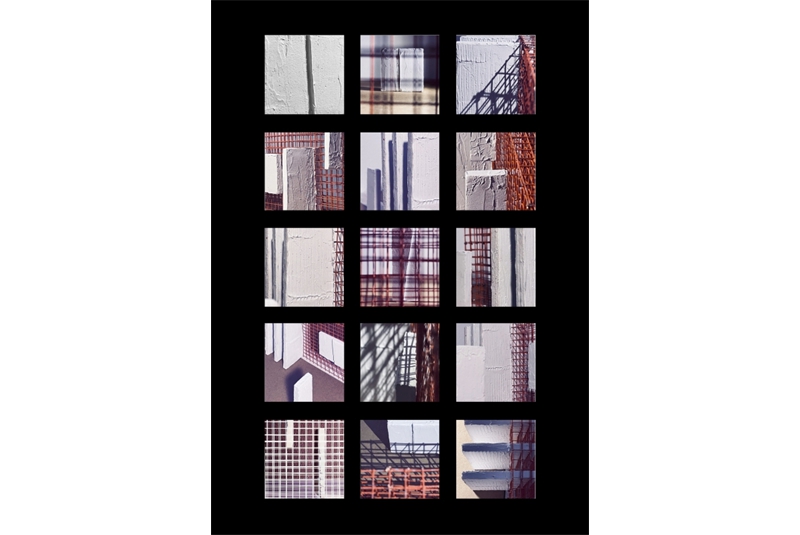
The sculptural quality of the monument is first appreciable in the use of the rough material; secondly, the marks of the work are recognized on the surface of the volumes. The bare surface of the exposed concrete, the marks impressed by the formwork, the aggregates not perfectly sunk, the oxidation of the mesh at the joints are recognized: these are details that enrich the plasticity of the element and tell its story. Like semi-finished blocks, abandoned in the quarry, manifestation of a working process, in some points left in suspense.
Finally, some subtractions are made, which model the pure volumes by giving them chiaroscuro and geometric correspondences.
In this way, the expression is originated from the specific character of the material and, as stated by Vittoriano Viganò (1982), «the way of treating space, as it can be seen from the reading of the Marchiondi Institute, [...] probably comes from: [...] the trust in the beauty and nobility of every material, even the humble ones» a quality that always in the author’s opinion, belongs to that poetics of «Brutalism: as a direct, explicit fact, not spatial and material fiction».
Note on representation
The continuous reflection on the artistic process, a parallel theme to the investigation of the unfinished, has deeply inspired the methods of representation of the project. The drawings are constructed according to an assembly procedure, using a solvent printing technique. This technique neglects precision in detail, making it possible to transfer an essential image, of immediate communication. The image vibrates, enriching itself with each new impression of an additional level of depth.
The photographs frame fragments of the composition, points to focus on; the frames tell the story of the action of walking through the monument through individual moments.
Notes
[1]«It is necessary to start from scratch, from simplicity, from the essentiality of things. Also from abstraction, because abstraction for modern Western culture means generality, the possibility of enunciating concepts and ideas with greater essentiality» quote by Arturo Martini published in Neri R. (2020) – “La modernità del classico”. In: Il filo di un pensiero: scritti, appunti, lezioni. CLEAN, Naples, p. 29.
[2]A principle of abstraction that operates a «reduction of the phenomena of nature to some essential traits that do not belong to any of those phenomena, but include and represent them all» (Monestiroli 2002, p. 118).
[3]«Nevertheless, man has succeeded in building time, translating fundamental temporal structures into spatial properties. Life is primarily movement, and as such it has direction and rhythm. The path is therefore a basic existential symbol, which concretizes the dimension of time» (Norberg-Schulz 1979, p. 56).
[4]«The principle of proportion is the general principle on which architecture is founded; it is understood as a system of relationships between the parts, revealing the meaning of the building» (Monestiroli 2002, p. 17).
[5]«Convinced that in architecture the forms must make it possible to recognize the general sense of the elements, just as in the temple, where the skill of the sculptor consists in defining the exact expression of such elements» (Monestiroli 2002 p. 91).
[6]According to that procedure of "monumental simplification" of which Giorgio Grassi speaks in the essay La costruzione logica dell’architettura (Padova, 1967), understood as «a process that leads to the knowledge of the essential quality of the work, a quality that lasts over time, a quality that makes the work monumental» (Monestiroli 2010, p. 13).
[7]«A volume is wrapped in a surface, a surface that is divided according to the generating and guiding lines of the volume, highlighting the individuality of this volume» (Le Corbusier 2013, p. 23).
[8] «Space as such and not the sum of surfaces - it is never finished, it is a continuum - the interior is a fragment of space, of a larger space - and hence the economy of the elements, of the constructive items», quote by Vittoriano Viganò published in Pedio R. (1969) – “Itinerario di Vittoriano Viganò: il Marchiondi a Milano”. Architettura. Cronache e storia, 166, 231.
[9]The principle of repetition of the essential element, the constructive element, which makes the architecture of the Marchiondi Spagliardi Institute unitary, is assumed in the project as a tool for ordering the composition of the monument, which allows us to detect the variations that occur along its development, and enrich the path with always different places. «In a work based on the uniformity of the elements, the subtlest shades of our inventiveness have the space they need to express themselves» (Tessenow 2003, p. 94).
ARGAN G.C. (1970) – Storia dell’arte italiana. Vol. 3. Sansoni, Florence, pp. 69-78.
DORFLES G. (1959) – “L’Istituto Marchiondi Spagliardi a Milano”. Edilizia moderna, 67, 35-46.
GRAF F. e TEDESCHI L. (edited by) (2009) – L’Istituto Marchiondi Spagliardi di Vittoriano Viganò. Mendrisio Academy press, Mendrisio.
HEIDEGGER M. (1979) – L’arte e lo spazio. Il Melangolo, Genoa.
LE CORBUSIER (2013) – Verso una Architettura. Longanesi, Milan.
MONESTIROLI A. (2010) – La ragione degli edifici: la Scuola di Milano e oltre. Marinotti, Milan.
MONESTIROLI A. (2002) – La metopa e il triglifo: nove lezioni di architettura. Laterza, Bari.
NERI R. (2020) – Il filo di un pensiero: scritti, appunti, lezioni. CLEAN, Naples.
NORBERG-SCHULZ C. (1979) – Genius loci: paesaggio ambiente architettura. Electa, Milan.
PEDIO R. (1969) – “Itinerario di Vittoriano Viganò: il Marchiondi a Milano”. Architettura. Cronache e storia, 166, 230-231.
PEDIO R. (1969) – “‘Brutalismo’ in funzione di libertà: Il nuovo Istituto Marchiondi a Milano”. Architettura. Cronache e storia, 40, 683-689.
PORTOGHESI P. (2021) – “Istituto Marchiondi Spagliardi”. In: M. Biragh e A. Granato (a cura di), L’architettura di Milano. Hoepli, Milano, pp. 394-399.
STOCCHI A. (1999) – Vittoriano Viganò: Etica brutalista. Testo & immagine, Venaria (TO).
TESSENOW H. (2003) – Osservazioni elementari sul costruire. Franco Angeli, Milan.
VIGANÒ V. (1956) – “Un Istituto per trecento ragazzi”. Domus, 318, 4.
VIGANÒ V. (1992) – A come architettura: Vittoriano Vigano. Electa, Milan.
ZEVI B. (1982) – “Il nuovo Marchiondi di Milano. Capolavoro del brutalismo di Vittoriano Viganò”. L’architettura. Cronache e storia, 199.