The very etymon of the words monument/memorial evokes the boundaries within which this reflection develops, both as a theoretical speculation and as a verification of the project, with its unambiguous reference to the wider theme of memory.
Monument, from mònere, to make known, «pertains to anything that serves to commemorate a great event or illustrious personality, and is used especially for buildings»[1]; Memorial, a from memorialem, pertains to memory, often implies librum or its diminutive libellum, refers to a piece of writing or an explanatory and detailed note accompanying an instance.[2]
Among the exercises on the theme of the monument/memorial – which reveal the history of architecture and art – this is certainly not the place for outlining the close and non-forced relation existing between the form and the thought that creates it, between a building and the society it interprets, between architecture and the values it chooses to convey in order to build memory[3]. However, the act of remembering, implied by both terms, has always relied on signs and symbols, words and representations, and through a positive and balanced dialogue between architecture and art it can make concrete and visible to everyone that which is no longer visible or concrete, and can give shape to something that not only links the present to the past but also becomes a place where thinking of a past event reverberates as much in the present as in the future.
It is with this attitude of mind that we have began to question ourselves on the significance of the theme of the monument/memorial in our time, and to think about how the memory of that journey interrupted just a few miles off the coast of Lampedusa on 3 October of ten years ago can be interpreted through close dialogue between art and architecture. All this while being harshly aware that the memory we chose to interpret would not end with that tragedy but would be an echo of all the journeys of the many people who in their lives never had the good fortune to reach another shore, and would be a witness to all the journeys and events of which the Mediterranean sea has always been and still is the setting, for different reasons and with different outcomes[4] Sometimes, the sea is benevolent and willing to accompany those who make it to reach the other shore.
For this reason we have chosen not to forget these tragedies which take place at sea and to remember them through the lively and bright hope of the Percorso della Pace. This Path, inaugurated in Lampedusa in 2021 as part Snapshots from the borders connects twelve symbolic places on the island – from Mimmo Paladino’s Porta d’Europa to Arnaldo Pomodoro’s Obelisco Cassodoro – to design a collective place, a new square, a place of life, meeting, reception and dialogue in the town of Lampedusa.
It is a secular Thirteenth Station that draws its evocative power from reference to the Gospel. Freed from its Catholic meaning, it preserves the sacredness of the gesture of deposition. The body is forcibly displaced and thus experiences separation from its homeland and hopes to be received into a new embrace, and thus crosses the Mediterranean and reaches a shore, in a landing that is only one moment in a lifetime.
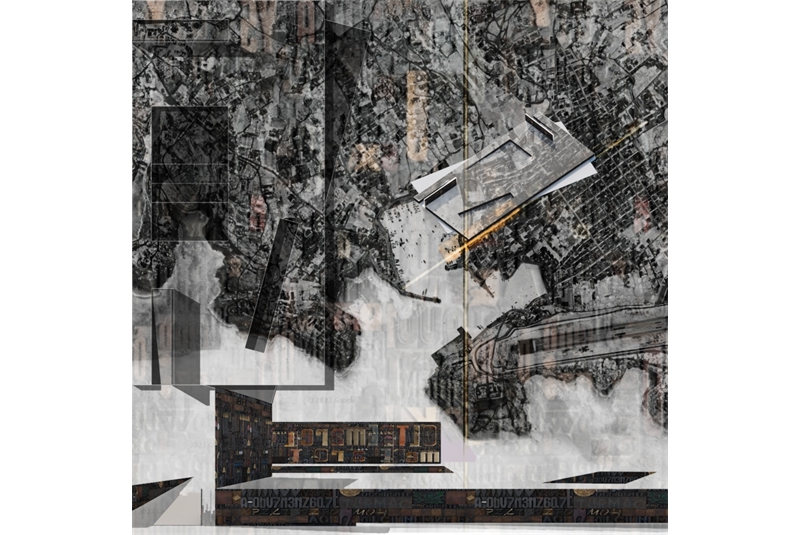
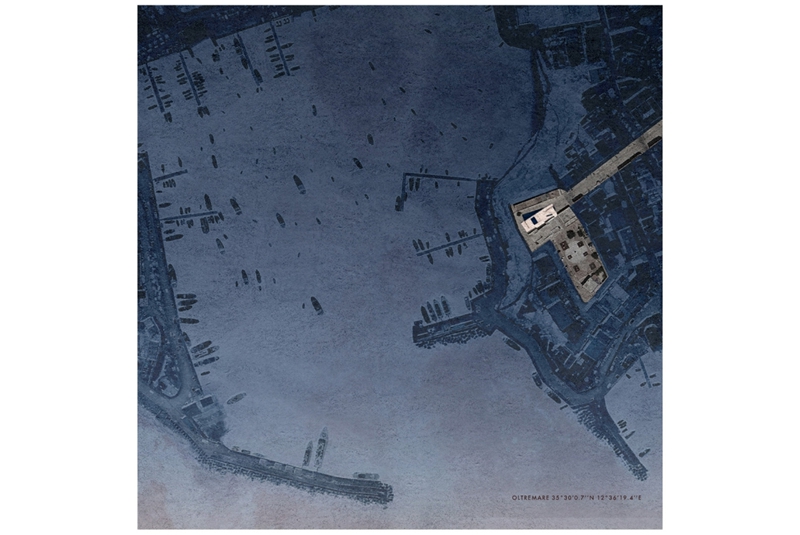
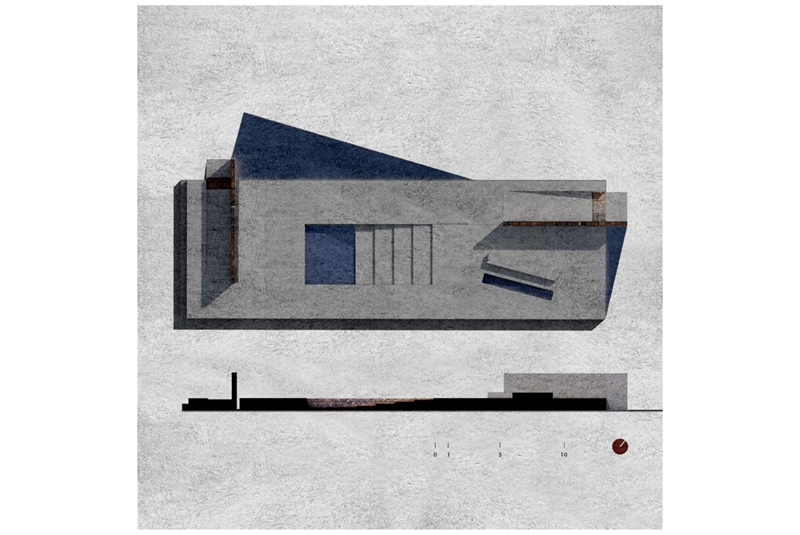
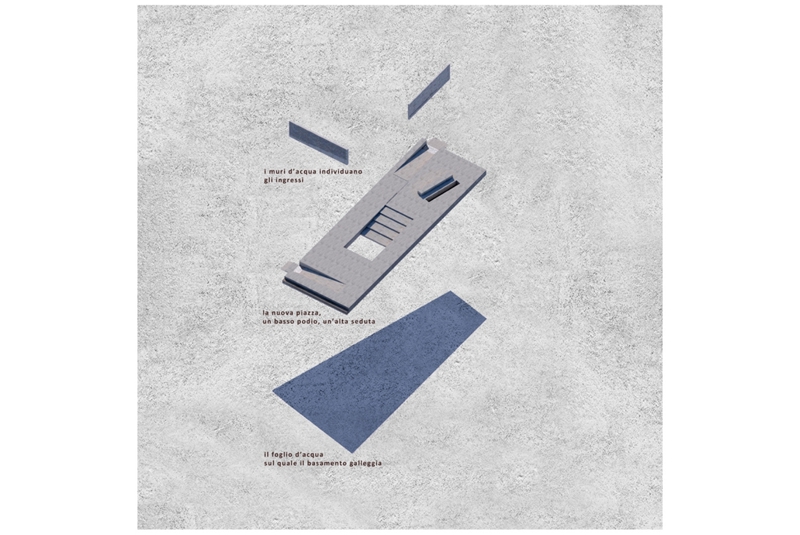
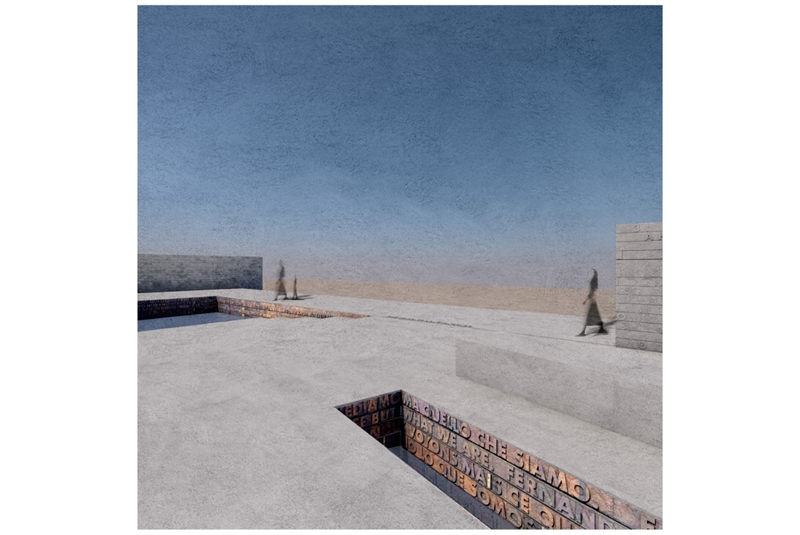
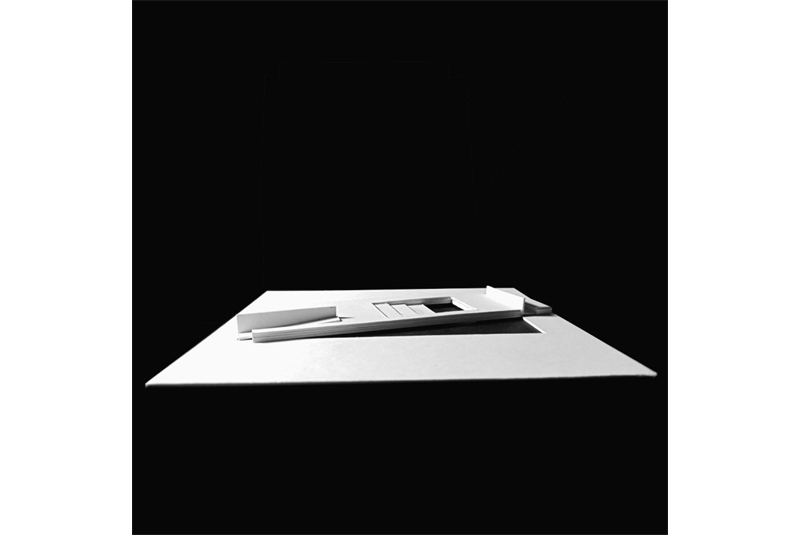
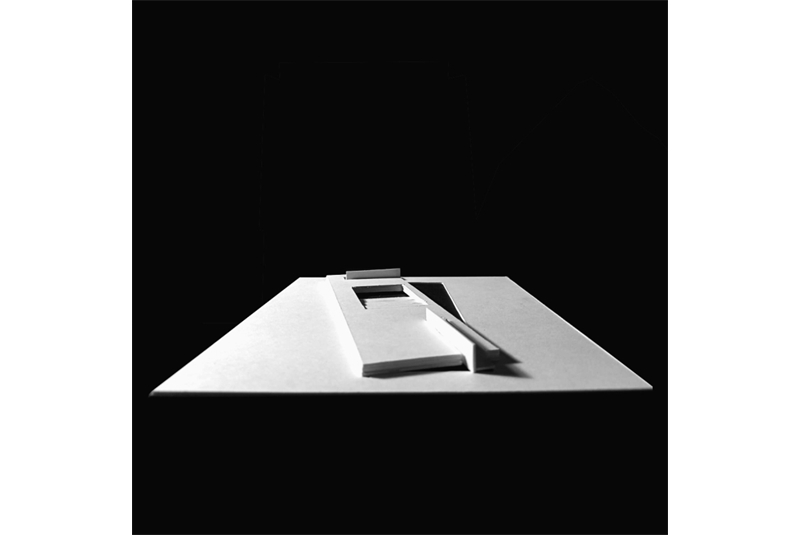
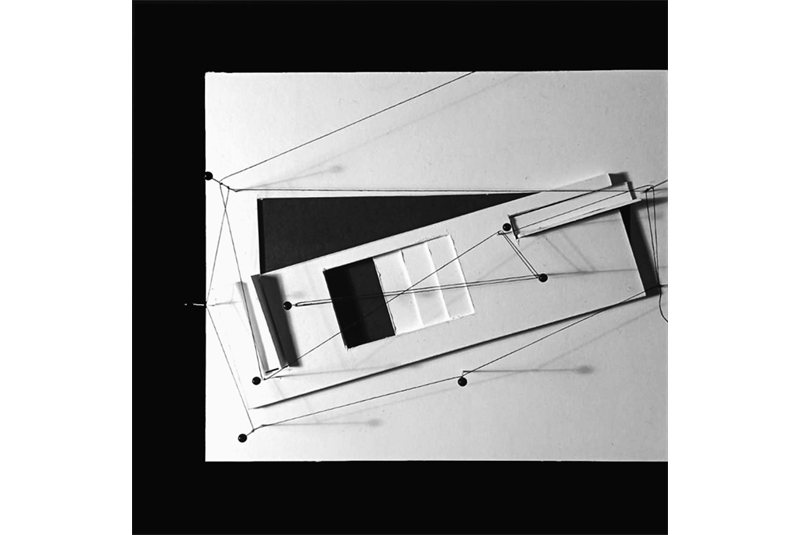
At the end of the axis of Via Roma, Lampedusa’s main street which runs at higher elevation towards the Favaloro pier – an artificial place that sooths the water of the city’s New Port, where newly disembarked migrants are gathered – a low stone podium is found that rests on a thin sheet of water.
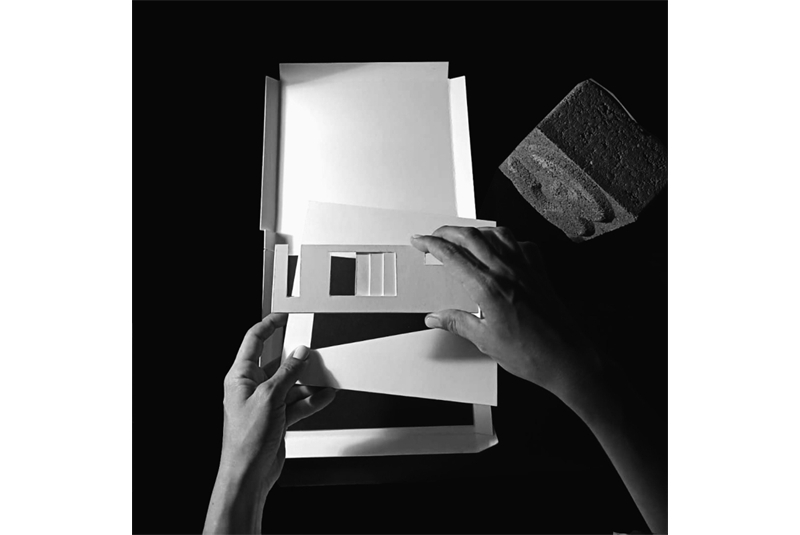
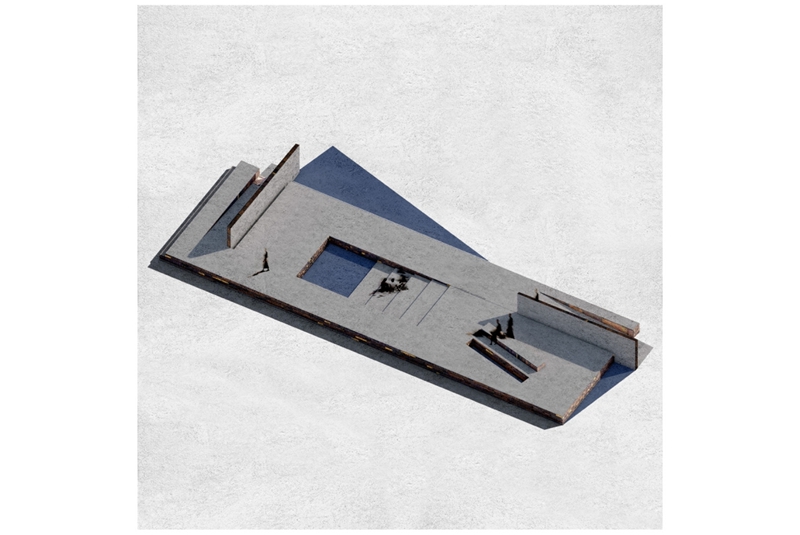
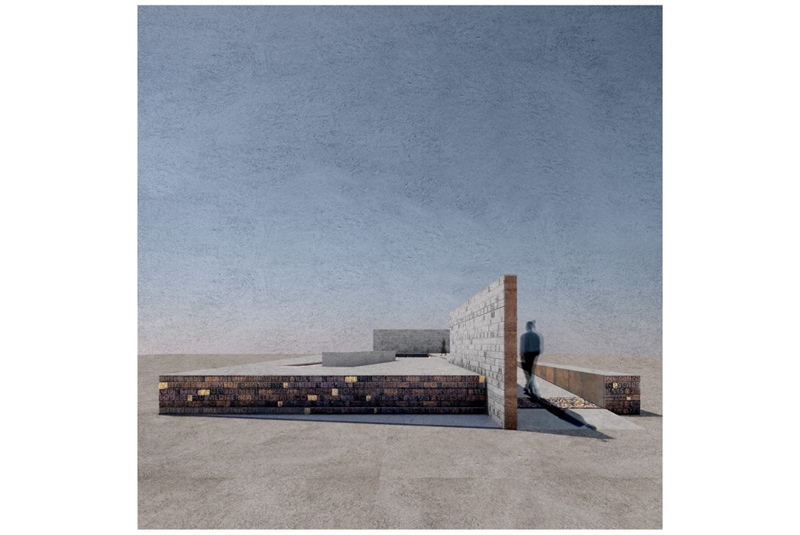
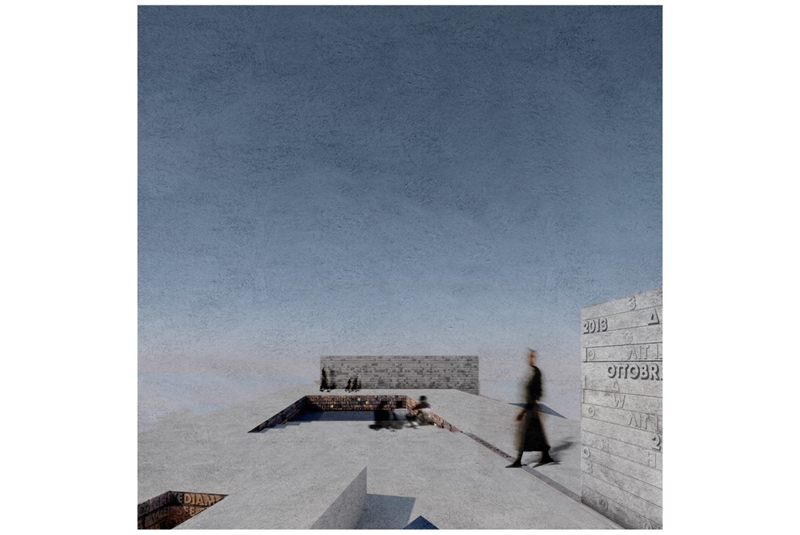
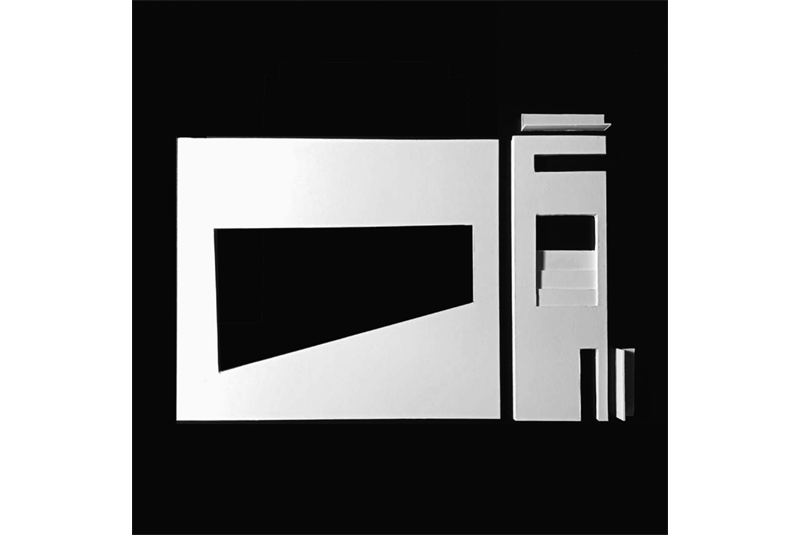
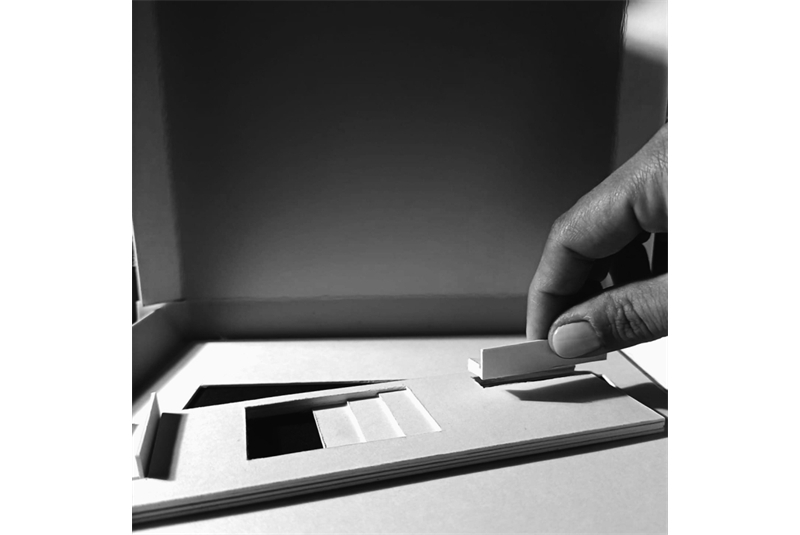
A low podium, like a high seat, draws the shape of a wide raft within the wider and shapeless belvedere, in a continuum with the built-up city, thus confirming its direction. The flat surface shelves towards a small arena that punctures it to host city events, or sinks into a long, narrow gash in the ground, and also becomes a seat, by subtraction. The solid surface, although punctured, still floats on that sheet of water which rotates until resting parallel to the embrace of the harbour.
A low podium that gets lived in. It welcomes those who pass through it, those who choose to stop in it, those who, almost unwillingly, decide to come together and build memory in it: this is what makes the podium exist. The height of the podium is conquered by ramps that are defined or concealed by as many blades, vertical surfaces dotted with graphic symbols and signs evoking the potential of innumerable combinations of words. In the very genetics of memorial, the word breaks down into its elementary parts and inhabits these vertical elements that, like a room without a roof, furnish this safe space on land stretching out towards the sea and defines its measure. They are liquid surfaces, with decorated cross-sections, which rise just as waves do, and feed the Mare Nostrum[5] on which the podium rests.
A low podium as a contemporary Piano ad uso collettivo and knows and shares and has the flavour of Giò Pomodoro’s work. Since 1977 the artist had organised a triangular portion of the urban fabric of Ales (Sardinia) into a space where human life can unfold and collective memory be built; in Giò Pomodoro’s interpretation, as well as that of Gino Valle in Udine – to commemorate the Resistance and deportation – and that of Aldo Rossi – in Milan for the monument to Sandro Pertini and in Segrate for commemorating the Partisans – the monument in memory of Antonio Gramsci became an opportunity to envisage and build a space to be crossed and lived in, « not only to preserve the memory but also to transform mourning into works for humankind» (Rizzi, 2014), conceived « as a quiet square [..] , a place where to meet [...]» (Rossi, 1988).
The letters and signs that churn in the waves and scatter throughout the steady flow of water, gradually gather as they reach the plinth section. Along its perimeter - about 80 linear metres - the signs begin to chase each other in an orderly manner, forming an uninterrupted frieze where they join together in words, and words in sentences, and sentences in stories.
«What is the Mediterranean?» – one reads as one reaches the new square, either from Via Roma or from the transversal path that connects it to another public space, a children’s playground hosting sculptor Lucio Olivieri’s Insieme. «A thousand things at once» – one continues to read, to walk, and their eyes continue to move, and together with the eyes, their bodies also continue to move in space, a space that before the proposed intervention had no dimensions or definition but now identifies, just as if it were an atrium, the entrance to the building of Museo archeologico delle Isole Pelagie e il Museo della fiducia e del dialogo del Mediterraneo. « Not one landscape, but landscapes without number.» The text runs, pierces the damp blade, the letters fall to the ground, meet the sloping surface of the ramp and follow it to return in the blade cross-section.
«Not one sea, but a succession of seas. Not one civilisation, but a number of civilisations, superimposed one on top of the other. To travel in the Mediterranean region is to find the Roman world in Lebanon, prehistory in Sardinia, Greek cities in Sicily, the Arab presence in Spain, and Turkish Islam in Yugoslavia. It is to reach far back in time […].» the cultural complexity that has always enlivened the Mediterranean and which is enshrined here in the building that stands in front of the sea, becomes almost a written invitation, a caption. «It is to encounter ancient things that still live on in juxtaposition with the ultra-modern […].» A moment of rest, a long seat carved into the plinth overlooks the harbour, goes beyond the built-in city leans out to the open sea. «It is to plunge into the archaism of insular societies, and at the same time to wonder at the extreme youthfulness of very old cities which are exposed to all the winds of culture and profit and which for centuries have kept watch over the sea and lived on its resources. Back at the starting point, ready to board the raft or land in Lampedusa.
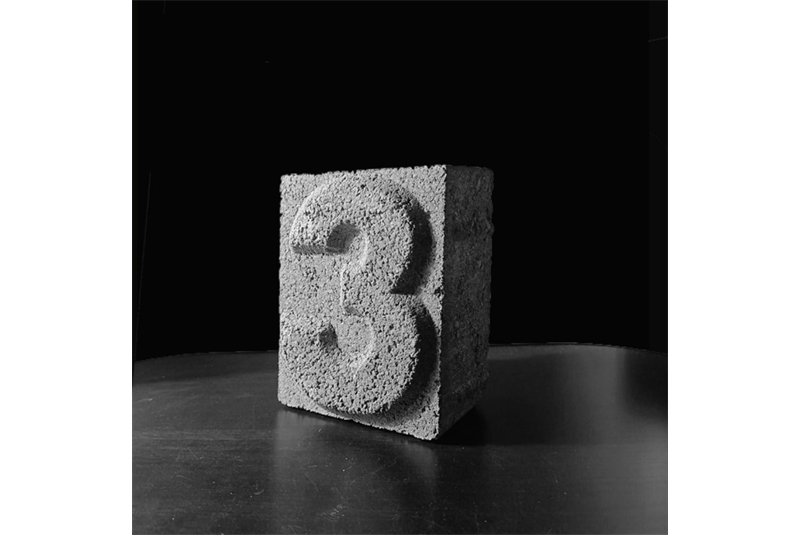
Che cos’è il Mediterraneo? What is the Mediterranean?, and again Qu’est-ce que la Méditerranée?, ¿Qué es el Mediterráneo?, Τι είναι η Μεσόγειος; ما هو البحر المتوسط؟ . The question opening this long reflection by Fernand Braudel, chosen to narrate this sea which is a means that separates and also, at the same time, a device that unites, resonates in all the languages that populate the Mediterranean, that are spoken and heard across it, from our Italian to the English of Malta, from the French of former colonies in Northern Africa to the Spanish of the Iberian peninsula, to Turkish, Greek and even Arabic, languages and customs that over the centuries, as Braudel pointed out, have contributed to define the complex stratigraphic cross-section of the culture of this part of the world. Latin letters, so precious to Giorgio Milani who employs them in his works – compositions of movable typefaces or, as in this case, albeit with a variation on the theme, tozzetto tiles, self-blocking polished concrete blocks with alphabets impressed on them – are conceived and designed by the artist for a series of public works, the Poetari, which inhabit squares and streets all over the world. As per the artist’s design, the individual blocks used, all 14 cm in height but different in length, occupy the minimum space needed for each individual letter, punctuation mark, spacing between one compound word and the next, and they follow one another and stack up to define the height of the new 84 cm raised square, which geometrically takes up pre-existing alignments and through them seeks a dialogue with the existing city.
In Lampedusa, the tesserae designed by Milani and produced by Paver follow one another over the new square, where they are made precious by a bronze sheet that is modelled on the alphabet in the same way as a mask is modelled on the face of a dead person – from left to right, as the Greek letters designed purposedly, according to the same principle. Similarly, the symbols representing the sounds and meanings of the Arabic translation of the text invite to move in the opposite direction, as the Arabic language requires. The encounter takes place in the words and physicality of the people who, conversely, move from right to left with both their eyes and bodies.
Therefore, the cross-section is the place of the written text; the outside is ideally the space of the sea, while the inside is the place of the life of humankind and their thoughts and actions. «Travel is the traveller. What we see isn't what we see but what we are» wrote Fernando Pessoa in The Book of Disquiet and to this we add a reflection, once again on travelling, from Mestiere di vivere, by Cesare Pavese, which seems an appropriate conclusion for this journey, a hope, an act of taking courage: «What world lies beyond | this sea I do not know, but every sea | has another shore, and I shall reach it.»
The short series of high steps in the arena takes you to the coordinates of the Belvedere - 35°30'01.7“N 12°36’19.4”E – set into the horizontal plane of the square. Numbers and letters are positioned as in Giorgio Milani’s best-known Poetario: here in Lampedusa, letters and numbers gaze at the sky, as usual, while leaning towards the sea.
Notes
[1] Monument = Latin MONUMENTUM from MONERE to remember, to make known, anything that serves to recall a great event or illustrious personality, used especially for buildings; from the Etymological Dictionary.
[2] Definition from the Etymological Dictionary.
[3] From obelisks to columns to triumphal arches, the architectural elements erected in cities have conveyed - through a narrative made up of images - the deeds of emperors and heroes. In more recent times - if we think of the post-war Italian context - it is mourning that has become the object of memory, a massive loss that needs to be recounted through memorials and shrines, often in the landscape of the sites where the tragedies occurred. Mourning the victims of conflicts or celebrating them? Between the Great War and World War II, numerous competitions invited architects and artists to interpret this theme, witnessing how the relation between form and meaning was evolving in those few years, with forms that were sometimes exploited for propaganda. The theme of the monument/memorial has continued to been investigated after World War II, to commemorate the struggle of the partisans and condemn the holocaust, up to the present day, to condemn conflicts and attacks.
[4] Since it is a communication and trade route, the Mediterranean has often been a theatre of wars and journeys. The oldest shipwrecks are often recounted by archaeology or by literature. The Mediterranean is the setting for stories, from Odysseus' voyage to the battles narrated by Ariosto and set in Lampedusa, or the stories of Prospero and Miranda staged by Shakespeare.
[5] This the name the Romans used for the Mediterranean; the Navy and Air Force used it for the rescue operation at sea carried out to save the migrants who from the days following 3 October to the end of the year, tried to cross the Strait of Sicily from the Libyan coast to reach Italy or Malta.
Bibliography
BRAUDEL F. (1987) – Il mediterraneo. Lo spazio, la storia, gli uomini, le tradizioni. Bompiani, Milan.
CAMARRONE D. (2014) – Lampaduza. Sellerio, Palermo.
CARRARO M. and SAVORRA M. (edited by) (2014) – Pietre Ignee cadute dal cielo. I monumenti della Grande Guerra. Ateneo Veneto, Venice.
CROSET P. (1989) – Gino Valle, progetti e architettura. Electa, Milan.
ENIA D. (2017) – Appunti per un naufragio. Sellerio, Palermo.
FERLENGA A. (edited by) (1999) – Aldo Rossi. Tutte le opere. Electa, Milan.
PONTIGGIA E., GALBIATI M. and GAZZOLA E. (2021). Giorgio Milani. La scrittura come enigma (Catalogo della mostra: Piacenza, 25 ottobre 2020 - 6 gennaio 2021 - ex Chiesa di Sant’Agostino). Gli Ori, Pistoia.
PESSOA F. (1986) – Il libro dell’inquietudine. Feltrinelli, Milan.
PAVESE C. (1952) – Il mestiere di vivere. Einaudi Turin.
POMODORO G. (1977) – Piano d’uso collettivo a Gramsci- Ales 1977. (Mostra organizzata dal Comune di Venezia). Marsilio, Venice.
SANSÒ C. (edited by) (2018) – Renato Rizzi, Lampedusa. La Cattedrale di Solomon. Clean Edizioni, Naples.