Luigi Vietti: an eccentric journey through twentieth-century history
There are certain architects who, due to various reasons and circumstances, are only marginally remembered in the dominant narratives of Italian historiography of the 20th century. The book by Paola Veronica Dell’Aira and Enrico Prandi fits within the context of studies that are filling one of these gaps, concerning the figure of Luigi Vietti.
As Franco Purini notes in his Preface, this historiographical oversight stems from a number of aspects related to Vietti's unconventional character: he did not belong to the academic world, did not make explicit any ideological affiliation, and was not included among the members of what Purini calls the architectural aristocracy. Academic culture was often seen in opposition to professional practice, and those who engaged in the professional dimension of building were to some extent sidelined. An exploration into the work and thoughts of Vietti is vital in reconstituting the landscape of a century filled with heterodox paths that have left behind high-quality traces.
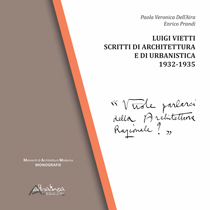
Vietti's writings, which are the subject of this study, were published in Architettura, L’Economia Nazionale, Il Secolo XIX, and Il Messaggero between 1932 and 1935. Thus, as Prandi points out[1], in a brief time span between the participation in the CIAM of 1930 in Brussels and the corollaries of the topics discussed at the VI Triennale of 1936. The themes are indeed consistent with the main topics of discussion: the existenzminimum, rational architecture, and the functional city. But before the anthology section, essays by Dell’Aira and Prandi provide the context to understand the arguments presented in these articles.
Vietti trained in Rationalism, was an active voice in MIAR, attended CIAM, and took on institutional roles. He participated in the first and second Exposition of Rational Architecture in Rome (1928 and 1931). In 1935, he entered the competition for the New Auditorium in Rome, and in collaboration with Antonio Carminati, Pietro Lingeri, Marcello Nizzoli, Mario Sironi, and Giuseppe Terragni, he participated in both phases of the competition for the Palazzo del Littorio on Via dell’Impero in 1934: here, one can already discern that heterodox attitude that distinguishes him from the proposal commonly attributed to Terragni, countering a linear approach with the proposal of the large curved facade plan. He also designed the Casa Littoria in Oleggio with Ignazio Gardella (1934), the Casa del Fascio in Rapallo (1937), the Seaside Establishment in Santa Margherita Ligure (1932), the Restaurant alla Foce (1936), and various subsequent hotels in Portofino, San Fruttuoso, and Genoa.
Then came the opportunity of the Plan for the E42, for which he was appointed alongside Marcello Piacentini, Giuseppe Pagano, Luigi Piccinato, and Ettore Rossi. And Vietti made a masterstroke: he chose to handle a sector excluded from Piacentini's oversight, which nevertheless covered an area equivalent to a quarter of the entire intervention. This granted him the freedom to invent a piece of the city, the Amusement Park, and his designs are fantastic, showcasing planets, roller coasters, and a large statue wherein one could enter to explore the human body, always a great fascination for Vietti.
Roberto Secchi remarks: «His architectures starkly avoid not only all rhetoric and monumentality but also the strict rigor of many of his colleagues or the intellectualism of much contemporary architecture, testifying to the joy of a generous surrender to playful forms in harmony with the environment they belong to»[2].
Vietti's inclination towards amusement becomes evident, a theme that will reappear from 1962 in the designs for the Costa Smeralda. The opportunity provided by the Aga Khan is apt for blending rationalism and spontaneity. Vietti is respectful but not mimetic, after all the location does not have a well-established built environment. He photographs traditional architectures in Sardinia and he aligns his projects with the morphological lines of the territory. Along with Michele Busiri Vici and Jacques Couelle, he crafts the story of a landscape as if it had always been inhabited, even though it only came to be in the 1960s. The experience of the Costa Smeralda is a critical juncture, costing Vietti a silent condemnation in the politically committed period of the post-war era. He was accused of snobbery, but as Dell’Aira writes «Vietti never ceased to believe that there are serious or less serious themes and programs for a project»[3]. Hence, his decisions, deemed opportunistic at the time, now need reevaluation, understanding their deeper impetus: a rejection of understanding his tasks in an overly cerebral, strict, or abstract manner, and a desire to venture into realms that allowed him the freedom to roam imaginatively.
His talent emerges, as Purini also notes in the Preface: an untamed, unrestrained talent, enabling him to perceive reality as a «metamorphic field», directing him to engage specifically with the context in which he operates, interpreting places «as a combination of historical and topological-environmental elements activated precisely through his design process, identifying their implicit potential»[4].
Where and when did Vietti learn to act so harmoniously with the landscape and the people inhabiting it? This book provides an answer: his approach stems from an imprinting, starting from what he learns right after graduation as an Inspector for the Monuments of Liguria for the Superintendency of Fine Arts and appointed for the application of the Panoramic Protection Law. Vietti discovers a teeming nature in a geologically and morphologically challenging territory, posing construction challenges and fueling the development of a predominantly technical-engineering interest. Moreover, the themes emerging during the 1936 Triennale resonate with him: Vietti aligns with Pagano’s perspective, expressed in Architettura rurale italiana, wherein «the knowledge of functional laws and artistic respect for our grand and little-known heritage of genuine and honest rural architecture will perhaps shield us from academic relapses, immunize us against pompous rhetoric, and above all, will instill in us the pride of knowing the true indigenous tradition of Italian architecture: clear, logical, linear, both morally and formally very close to contemporary taste»[5].
In this perspective, among Vietti's articles published in the book, there is a particularly striking interest in the reports published in 1933 and 1935 in the Messaggero and the SecoloXIX journals, titled Viaggio architettonico al nord sul 10 e 15 meridiano (Architectural Journey to the North on the 10th and 15th Meridians) and Romanzo delle verità architettoniche (Novel of Architectural Truths). These articles reflect on two expeditions towards Northern Europe and Southern Italy. The two destinations tend to short-circuit, as while Vietti heads north, for example to visit the Weissenhof district in Stuttgart, he finds there a «ray of Mediterranean light»[6] and, to confirm this, he publishes the famous postcard with the caption «the Weissenhofsiedlung with Arabs to demonstrate that rational constructions have a Mediterranean origin that is anti-German»[7].
In particular, in the Romanzo delle verità architettoniche, there are reflections that shed light on the mature design choices of Vietti. The title itself is an oxymoron: it's a novel, but it deals with truths. Vietti speaks of real landscapes but seems immediately to declare his intention to grant himself poetic licenses. He establishes image parallels between the serial traditional constructions of Salemi and the houses in Dessau by Walter Gropius, or between a villa by Le Corbusier in Pessac and a house on the road to Pompeii: «our people», he writes, inspired with its «human measure, practical organization, economy of means, the global rationalist movement». Every unexpected event becomes an occasion to fantasize about design ideas. Heading towards the Ionian Sea, he describes road circulation, showcasing his irony when he writes about the donkeys: «The donkey, an eminently revolutionary type, chooses its grazing ground and will never fit into any organized arrangement[…]». The donkey encroaches on roads and slows automobile speed, and from this anecdote, Vietti's mind departs to imagine a project: separate the roads for cars from those for quadrupeds, arranging a cycle path and an unpaved road for mules[8].
Crossing the Sila plateau, Vietti writes as if he is sketching, verbalizing the imaginative process with an engaging language: «If I were to paint the Ionian plains in the scorching summer, I would do so as follows: a brown expanse of earth, marked by parallel lines. I would then leave a void, above which I would craft a gradient dome with ever-deepening shades of blue. In the void, I would position a bubbling strip of bluish-violet to represent the sea». He showcases talent as a writer too, having a keen sense of consonance and a musical flow to his sentences: «Along the road, walls of prickly pears parade by. Tangles of animalistic trunks and spiny paddles that catalyze water vapor to adorn themselves with purple crowns of juicy fruits».
He commits himself personally, initiating a process of Einfühlung, a term frequently overused in contemporary theories but entirely relevant to the mechanisms that Vietti employs through his writing. As readers, we find ourselves in the position of journeying with him and understanding his psychic processes: «I accept the colt Sauro from the host. I set off, imbued with a sense of freshness, a novelty granted by the young horse that connects me with the life of the earth, the trees, and the springs». He sharpens all his senses: sight, hearing, smell, touch. He is so attentive that he measures the flowers: «Spring seeds the woods with colossal violets, with flowers I have measured up to 3 cm in length [...]. Streams sing amidst cushions of moss [...]. The abundant presence of Sila's red pines saturates the air with its resinous scent». And the customs of the people who inhabit these places intrigue him as much as the spaces themselves; he describes the procession of the Ecce Homo in Mesoraca that «hastily descends amid the clergy and women dressed in the most spontaneous colors [...]. The Ecce Homo passes proudly, carried aloft on a litter [...]. The people, overtaken by emotion, shout, scream, clap, and sob. [...] An old local woman offers me an oak branch, and I realize I'm moved!». His pioneering attitude, the same with which he will confront the uncharted territory of the Costa Smeralda, ignites him: «The Sila, although traversed by ancient mule tracks, gives a sense of discovery to those who venture through it»[9]. And Vietti envisions constructing interconnected urban centers there, harnessing the waters to produce energy, creating channels for land reclamation, promoting the area for tourism, establishing a university, a sanatorium center, and so on[10].
From Vietti the writer, much can be discerned about Vietti the architect, and the same goes for Vietti the illustrator. In 2021, Dell’Aira and Prandi curated another book, titled Luigi Vietti: Osteopaese[11], in which his surrealist-inspired drawings, created between 1966 and 1977, are published. This imaginary land made of bones protruding from the landscape inevitably reminds us of the granitic formations of the Costa Smeralda, as if they were the bones of giants. Consequently, the intricate plans devised for those locations, like the one for the Hotel Cervo (1962-1963), resemble x-ray plates of gigantic bodies sprawled across the landscape[12]. In the drawings for Osteopaese, Vietti’s non-authoritarian mark and his productive irony emerge: «Anything but detachment. It's immense dedication, concreteness, and affection for whatever presents itself to be done, at that moment, in that place, for that cause, for that commission [...]»[13].
Gustave Thibon, the farmer philosopher, was as distrustful of -isms as he was attached to reality. His figure is chosen by Dell’Aira to introduce topics dear to Vietti[14]. Similarly, in 1950, Carlo Ludovico Ragghianti, while organizing the exhibition of Frank Lloyd Wright at Palazzo Strozzi, wrote to Bruno Zevi: «think of the events, without mentioning all the nonsense -isms, but organize something truly significant for the entire country»[15]. Ragghianti wanted to avoid sectoral divisions that constrain thought and create factions, choosing instead to address the plurality of reality. Many of his generation felt the same way, and so did Vietti, who shunned all specialization and found, in the openness to the multitude of things, the spark to ignite the design process. Dell’Aira concludes her essay: «Did he digress? Yes, he did. Was he talking about something else? The else is the true essence of our matter. [...] There are few architectural designs in Vietti’s writings, but there is an abundance of architecture»[16].
Maria Clara Ghia[1] Prandi E. (2022). Luigi Vietti, una breve ma intensa opera editoriale di divulgazione del Moderno. In Dell’Aira P. V., Prandi E., Luigi Vietti. Scritti di architettura e urbanistica 1932-1935, Altralinea, Firenze, 39.
[2] Secchi R. (1997). Introduzione. in P. V. Dell’Aira, Luigi Vietti, Progetti e realizzazioni degli anni ’30, Alinea, Firenze, 9 (translation by the author).
[3] Dell’Aira P. V. (2022). Dove l’architettura ci porta. In Dell’Aira, Prandi, op. cit., 22 (translation by the author).
[4] Purini F. (2022). Un messaggio da lontano, in Dell’Aira, Prandi, op. cit., 8 (translation by the author).
[5] Pagano G., Guarniero D. (1936). Architettura rurale italiana, Quaderni della Triennale, Hoepli editore, Milano, 6 (translation by the author).
[6] Vietti L. (1933), Viaggio architettonico al nord sul 10 e 15 meridiano. Il Secolo XIX, 29 marzo – Anno XI (translation by the author).
[7] Ivi, 3 (translation by the author).
[8] L. Vietti (1935). Romanzo delle verità architettoniche. Verso il Mare Jonio. Il Messaggero, 27 febbraio – Anno XIII (translation by the author).
[9] L. Vietti (1935). Romanzo delle verità architettoniche. La Sila come è. Il Messaggero, 8 marzo – Anno XIII (translation by the author).
[10] L. Vietti (1935). Romanzo delle verità architettoniche. La Sila come potrà essere. Il Messaggero, 23 marzo – Anno XIII.
[11] Dell’Aira P. V., Prandi E. (2021). Luigi Vietti. Osteopaese, Timìa, Roma.
[12] Posocco, P. (2019). Luigi Vietti e l’avventura della Costa Smeralda. FAMagazine. Ricerche E Progetti sull’architettura E La Città, (48/49), 59–72. https://doi.org/10.12838/fam/issn2039-0491/n48/49-2019/287
[13] Dell’Aira P. V. (2021). Architetto inventore. In Dell’Aira, Prandi, op. cit., 55 (translation by the author).
[14] Dell’Aira P. V. (2022). op. cit., 17.
[15] Lettera di Carlo Ludovico Ragghianti, Firenze, 20 dicembre 1950. Fondazione Ragghianti, Archivio, Lucca, cit. in Ghia M.C. (2022) Due maestri italiani: Ragghianti e Zevi in corrispondenza. AntiThesi. Giornale di Critica dell’Architettura, 20 agosto (translation by the author).
[16] Dell’Aira P. V. (2022). op. cit., 35 (translation by the author).
Book features
Author: Paola Veronica
Dell'Aira, Enrico Prandi
Title: Luigi Vietti.
Scritti di Architettura e Urbanistica 1932-1935
Language: italiano
Publisher: AltraLinea,
Firenze
Characteristic: 21,5x21,5
cm, 184 pages, paperback, b/w
ISBN: 9791280178657
Year: 2022