The art of making entities
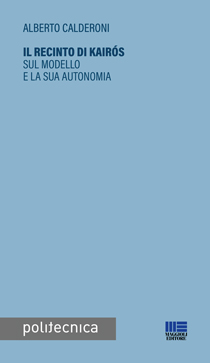
Reading Il recinto di Kairós. Sul modello e la sua autonomia means returning to reflect on the profound issues of the discipline of architecture, understood here (without confusion) as art. Indeed, scrolling through the pages of the book we can appreciate the great effort made by the author in systematising certain reflections accumulated over time around the model of architecture. These reflections are the ones that daily question who are passionate pedagogues but also those who practice the art of building with dedication and consistency.
The essay opens with a quotation from the art critic Germano Celant, who reflects on the model of architecture by systematizing a set of words such as «desire», «research», «prediction», «utopia»[1], which anticipate the themes of the question contained in the Premessa: what is still the need to learn to think and design through models «that might appear [...] outdated and above all [...] replaceable d'emblée by more preforming, economical and easily shared practices?»[2] .
The author, as he states in the book's incipit, does not pretend to give an unequivocal answer to the question but, addressing students, researchers and architects, attempts to outline a reflection around models starting from the quality of time that marks their production. Models of architecture are understood as «precipitous enclosures [...] in which are condensed the energies that have been spent in their conception and realisation, and the traces of the slow time spent in living the experience of making»[3]; that time that the Greeks defined with the word kairós. Models, in the words of the writer, are «physical entities [...] - and at the same time - enclosures of experiences»[4].
After the Premessa, the book continues with three paragraphs entitled Definizioni, Il modello come cosa and Il Frammento to close (before the bibliography and indexes) with the chapter Immagini, a text followed by a photographic sequence of architectural models: a visual synthesis of the essay's theses.
The Definizioni allow the reader to approach the central theme of the book through the terms used in the narrative; the word «model» is preferred to the words «maquette» and «plastic» for its ambiguity of meaning: «the model can be paradigm, icastic representation [...] an autonomous, abstract object, manifestation through which to be inspired»[5]. In choosing the second meaning, the author understands the model as «a broad class of hypotheses [...] ideal, of [...] intuitive and creative origin [...]»[6].
The model is thus understood «not as a means of representing or figuring out architecture [...], but [...] as an autonomous product by the architect -actor agent- synaesthetically immersed in the dynamics of creative work»[7]. Formal autonomy is thus, for the author, the character that distinguishes the model of architecture. This passage, in a parallelism with the plastic art of sculpture, could evoke an aphorism by the artist Alberto Giacometti who attributes to the “sculpted thing” the quality of being an «independent object [...], like organic beings»[8].
The model (as an autonomous entity) is considered in the essay to be the product of the architect's manual “doing”, in other words “experimenting by doing”. A definition that refers to the deepest sense of doing architecture, that is, to its manièra; from the old French «that which is made by hands»[9]. In this line of thought of the author it is possible to trace the foundations of the Bauhaus didactics of the early 20th century; didactics that the historian Argan defined as: «the first concrete position of a theory of art, as the science of a particular human doing, against all aesthetic idealism»[10]. According to the author, that typical doing of the craftsman[11] produces those things with which «we can be physically involved [...], that is [...] in entities and with entities [...] we become physical bodies»[12].
The model, in the words of Alberto Calderoni, is thus an “entity” or the «conceptual equivalent of the Greek pragma»[13] as defined by Remo Bodei (quoted by the author). This definition is the central issue of the essay as only «through thinking, building, and experiencing models - real entities [...] - we focus on reality outside ourselves [...]»[14]. Models of architecture are described as «physical entities, pregnant and dense, deep and open»[15].
The author of the essay guides us towards the open, allusive
and lingering dimension of the model that does not claim to assert but
is instead capable of generating emotions and multiple approximations.
If at the Bauhaus the experimentation of ideas took place through the
activity of drawing and modeling on an equal basis[16], here the author declares the predominance
of the model over the graphic sign. Architectural models, in addition
to evoking multiple possibilities of action, maintain their supremacy
over drawing as they are capable of manifesting themselves through
surfaces understood as «the first point of contact in reality
between things and us»[17].
For the author, the most expressive surfaces that make up
models are undoubtedly the fragments; understood here as portions of a
more complex unity that on the one hand demand their completion but on
the other deny it as autonomous parts capable of speaking for themselves[18].
In this vision of Calderoni one can undoubtedly trace the
“aesthetics of the fragment”; aesthetics that characterizes
our way of seeing things, in other words, the tradition inherited from
the avant-gardes of the early 20th century which, by deflating the
naturalist figure[19],
recomposed images for abstract (autonomous) signs without diminishing
the «efficacy of the subject»[20] represented.
The author therefore prefers fragment-models for their ability to be activators and «the cause of the imaginative process and the formation of new images [...]. The fragment is an artefact whose aesthetic fluidity guarantees its autonomy»[21].
The fluidity quoted by the author (which refers to a liquid context of Bauman's memory) leads us to reflect on the infinite possibilities of recomposition of fragments carrying in nuce multiple meanings, possibilities that must necessarily relate to our aesthetic taste[22] formed through all the artistic disciplines. Within this framework, architecture fully belongs to the domain of the arts in which, as the author states, techniques «contaminate and merge with the intention of constructing imagined landscapes that can be perceived synaesthetically»[23].
The twelve images that conclude the essay therefore relate to selected “model-fragments” from different architectural cultures: a demonstration of the theses made in the previous pages. The models of architecture portrayed in the photographs emphasise their being a “lingering thing”, evocative and non-descriptive. In the black-and-white images, in fact, we realize that material variation goes hand in hand with formal research (according to Michelangelo's principle of putting and taking away[24]), but each fragment nevertheless appears as a laceration of infinite paths that can be followed from the urban to the architectural scale. The massiveness of Takero Shimazaki Architects' fragments and the bas-relief façades of Architecture Research Unit with Network in Architecture (NIA) contrast with the tectonics of Anne Holtrop, Nicolai Bo Andersen and Studio Mumbai.
The images of the models that complete the essay lead the reader to two paths: close the book and reflect on the theses already skimmed or go back and retrieve some paragraphs and notes. Alberto Calderoni's book can be read horizontally and vertically as a model of architecture that is “crossable” in both directions[25]. In fact, the reader can choose whether to continue the narration by proceeding with the succession of paragraphs, horizontally, or to enter into the depths of each chapter by dwelling on the notes that, like fragments of a model, allude to other reflections.
In an age without kairós (the quality time of the Greeks), returning to talk about the value of doing entities slowly (of producing-learning with the hands) brings us back to the world of art in contrast to the technology that, according to Rudolf Arnheim, brings «visual confusion [...] or excessive complexity»[26] , especially in the learning phases of artistic disciplines.
Alberto Calderoni's book, like a model of architecture, is an object to be experienced as capable of returning to the fundamental questions of the discipline; those questions linked to the archaic use of the hand as an irreplaceable means of making entities.
Alessandro Brunelli
[1]Celant G. (1987) – “Il progetto è un oggetto”. Rassegna, 32, p.76
[2]Calderoni A. (2023) – Il recinto di kairós. Sul modello e la sua autonomia, Maggioli Editore, Santarcangelo di Romagna, p.12.
[3]Ivi, pp.12-13.
[4]Ibidem.
[5]Calderoni A. (2023) – Il recinto di kairós. Sul modello e la sua autonomia, op. cit., p. 21.
[6]Ivi, p. 22.
[7]Ivi, p. 24.
[8]Giacometti A. (2001) – “Taccuini e fogli sparsi”. In: Alberto Giacometti. Scritti, Abscondita, Milano, p. 150.
[9]Brunelli A. (2023) – “Manièra”. In: Arrighi L., Canepa E., Lepratti C., Moretti B., Servente D. (edited by) Decimo Forum ProArch Le parole e le forme. Book of Papers, p. 756, Genova, 16-17-18 novembre 2023.
[10]Argan, G. C. (2010) – Walter Gropius e la Bauhaus, Einaudi, Torino, p. 31.
[11]Cfr. Calderoni A. (2016) – Appunti dal visivile, Lettera Ventidue, Siracusa, pp. 137-139.
[12]Böhme G. (2010) – Atmosfere, estasi messe in scena. L'estetica come teoria generale della percezione, Marinotti, Milano, p. 239.
[13]Bodei, R. (2010) – La vita delle cose, Laterza, Bari, p. 13.
[14]Calderoni A. (2023) – Il recinto di kairós. Sul modello e la sua autonomia, op. cit., p. 34.
[15]Ibidem.
[16]Cfr. Argan, G. C. (2010) – Walter Gropius e la Bauhaus, op. cit, pp. 31-84.
[17]Calderoni A. (2023) – Il recinto di kairós. Sul modello e la sua autonomia, op. cit., p. 39.
[18]Cfr. Ivi, p. 54.
[19] Anselmi A. (2019) – “Arte e figure della modernità”, In: Brunelli A., Intuizioni sulla forma architettonica. Alessandro Anselmi dopo il GRAU, Quodlibet, Macerata, p. 146.
[20] Arbheim R. (2017) – Arte e percezione visiva, Feltrinelli, Milano, p. 121.
[21]Calderoni A. (2023) – Il recinto di kairós. Sul modello e la sua autonomia, op. cit., pp. 55-56.
[22]Anselmi A. (1997) – Una didattica fondativa per la “Formazione del gusto”. Groma, 1/2, giugno , p. 22.
[23]Ivi, p. 52.
[24]Cfr. Eisenman P. (2009) – La base formale dell’architettura moderna, Pendragon, Bologna, p. 81.
[25]Calderoni A. (2023) – Il recinto di kairós. Sul modello e la sua autonomia, op. cit., p. 24.
[26]Arbheim R. (2017) – Arte e percezione visiva, op. cit., p. 176.
Book features
Author: Alberto Calderoni
Title: Il recinto di
Kairós
Subtitle: Sul
modello e la sua autonomia
Language: Italian
Publisher: Maggioli
Editore
Serie: Politecnica
Characteristics: 11x19
cm,
84 pages, paperback, b/w
ISBN: 8891662163
Year: 2023