Design of Places
The construction of the city is a topic of great interest within the current debate, and this is true not only in words but also in deeds – if we think of the numerous opportunities that our cities have offered in recent years – but it is also true that the topic appears to be increasingly distant from Composition, which not by chance is followed by two adjectives, Architectural and Urban. The field is left free to sociological, environmental, urban planning and economic issues, which are also important, but often marginalising the quality and architectural identity of the city's places, which are becoming less and less considered. The authors, Federica Visconti and Renato Capozzi, attentive observers of the reality that surrounds us, are well aware of this, and with this book they try to navigate the rough waters of the discipline while keeping the rudder straight; to bring the question of the city project back onto the ground of form.
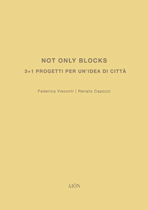
Not only blocks. 3+1 progetti per un’idea di città. A small book, but to some extent a condensation of long studies carried on through research and projects, and which, precisely because of its vast knowledge and mastery of the subject, hides “big” issues between the lines of its simplicity.
It can be read the commitment to knowledge, of the themes and form of the city. It can be found the history, of architecture and of the city, selectively declined in a design key through analogical thinking, moving through the time and space of architecture. It can be seen the method: from analysis, to the project, starting from the so-called “exercise of measure”, namely the collage of exemplary architectures, at the scale of the place to specify the settlement principle, and at the scale of architecture through the choice of works taken as references – as quotations or subjected to variation, coherently operated with respect to the principle underlying the project. It can be recognised a theoretical position, an idea of the city that can be found by looking at the projects together, recognisable despite the diversity of the conditions, times and specific themes of the individual occasions: an idea of an «[…] open city, discontinuous, not homologating and diffusive, polycentric and multipolar […]» (Visconti 2024, p. 32).
The book has an agile structure. Two concise essays, City of Blocks vs City of Places by Visconti and Ideas and Elements for the Open City Construction by Capozzi, specify the posture that supports the arguments and interpretations that follow. Reading them, it becomed clear how the authors’ attention is pointed not so much to architecture per se as, and above all, to the quality of the places they define through their composition and the relationships, of proximity or at a distance, that they establish with each other and with the context. The projects to follow, the real protagonists of the book. A short page written to state what is strictly necessary to highlight the idea of the project anticipates the real “tale” told through the drawings, according to a progression of discourse, from the analytical plan to the synthetic outcome, from the scale of the city to that of the place, up to that of the architecture, which make the forms eloquent with respect to the initial objective.
The illustrated projects – elaborated in the four editions of the Internationale Frühjahrsakademie – are made for the same city, Dortmund, and rethink the shape of some areas with very different morphological and urban conditions: a new university campus in a disused industrial area outside the city walls; a large “zolla” composed of living places and collective places on the suburbs of the city; a project for the central area of the river port; more punctual interventions close to the monumental complexes located along the main axis of the old city.
From the periphery to the consolidated city, in each project it is evident the aspiration for an urban order, to be re-established where it has been lost or to be defined where it is lacking, with the tension towards the search for the definition of the quality of places rather than of individual architectures. Thus the idea of the city that each project represents is never dogmatically applied but is always critically declined according to an idea of space and an appropriate dimension starting from the form of the city and its rules, and then reinterpreting its meaning. This gives shape to open spaces where it requires the introduction of “discontinuity” to define places that act as a counterpoint to a rarefied urban condition but lacking of urban centrality – as in the case of the first three projects – or more bounded, when, on the contrary, the form of the city, dilating without measure, has lost its formal clarity, as in the case of the last one. In this sense, the projects illustrated insist on marginal areas, not necessarily in terms of location but in terms of urban value, with the idea that the city considered as a whole must be built from precise parts, each with its own identity, and endowed with significant places.
Places in which the dialectic between architecture, nature and culture corresponds to a tension to search for a quality that is first and foremost formal, adequate and recognisable, with the aspiration to represent an idea of civitas. It is a position common to those who, like the authors, believe that architecture is “civil art” par excellence. It is a question that requires a commitment to knowledge and a great sense of responsibility because it concerns the world we live in, and therefore concerns our life.
The (unstated) conclusion of the book is actually anticipated, in the writer's opinion, in the opening of the authors' two introductory essays, in the collage of the 3+1 projects on a single plan of the city. A drawn and unwritten conclusion, but eloquent more than words in synthetically representing the general idea about the city that underlies the projects and which the projects support; that settlement hypothesis which, in the recognition of the history of the slow stratifications of the city and its territory, of the monuments and the value of collective places, in the rediscovery of its traces and its founding elements, can be put at the foundation of the urban project as a necessity to determine, according to long and not instantaneous ideal perspectives, the project of its modification.
A way of understanding, in a broader sense, theory and project as complementary issues, the centina and the arc according to the interpretation given by Carlos Martí Arís, which always intertwine in a relationship that is neither consequential nor linear, but of mutual necessity and continuous verification.
The themes in the field and the way of dealing with them, then, are part of a long tradition of urban studies, both Italian and international, but according to methods and tools that, with a posture that belongs to those committed to research, constantly undergo updating – as demonstrated by the urban morphological analyses that precede the projects, enriched by the spatial analysis method introduced and developed more recently by Uwe Schröder (Schröder 2015), thus affirming a continuity between theory, research and design, and between urban design and architecture, which characterises a way of “making school” that the authors, together with a few others, continue to pursue, starting from its heritage, keeping it alive and trying to update it, one step at a time. But how?
Then perhaps it is no coincidence that within a series entitled lezioni e saggi sull’architettura e la città, this book focuses a great attention on projects experimentations and the design of the city, as indispensable moments of research in composition. The collage of projects for Dortmund in fact also says something else, no less important, with respect to the discipline and the problem of urban design: that drawing should be the word of those who deal with form and the only true instrument of control, affirming to some extent that, in a condition in which “the ideologism of rules” – in Gregotti's words (Gregotti 2016) – is prevailing, the architecture of the city and for the city is to be defined with forms.
Claudia Angarano
Author: Federica Visconti, Renato Capozzi
Edited by: Ermelinda Di Chiara
Title: Not only blocks
Subtitle: 3+1 progetti per un’idea di città
Language: Italian and English
Publisher: Aión
Characteristics: 12x17 cm, 128 pages, paperback, color
ISBN: 9791280723314
Year: 2024