Anna Fabris
In the current landscape, dominated by digital platforms and algorithmic visual distribution systems, defined by an intricate and heterogeneous media ecosystem that highlights the growing dominance of digital technology in the acquisition of information, most content is subject to the logic of instant and consumerist use. In this context, the image, understood as the most effective product of immediate consumption, seems to lose a semantic structure in which to recognize a complex system of cultural codes and meanings, limiting itself instead to a mere object of partial understanding.
This process is closely linked to the commodification of ideas, where the sign becomes an autonomous vehicle, detached from its content. However, despite this progressive semantic desertification, the question remains open as to the possibility of regenerating the role of the image as a device that is offered to a subject destined to interpret it, endowed with its own direction and interpretative awareness.
Before turning to the semiological studies conducted in the 1960s across various disciplinary fields, identifying them as the most suitable theoretical terrain for this consideration of the image as a vehicle for messages, it seems necessary to intercept a theoretical reference framework, which certainly has its roots in the methods of structural linguistics that can be traced back to Ferdinand de Saussure, whose focus is on identifying what is essential in the functioning of language. According to this configuration, language is first and foremost form, since it is constituted primarily by totally arbitrary signs. The arbitrariness of the sign allows us to understand why only social reality can create a linguistic system: the community is necessary to establish values, whose only reason for being lies in their use and mutual understanding within a social context.
The semiological studies conducted in the 1960s played an essential leading role in the acquisition of deep-rooted awareness of the nature of images and icons as semantic derivatives:
Significant signs are iconic, that is, they are images. Images are the visual result of the perception of objects that fall under our eyes. The immediate image-form is ingenuous and of simple resemblance: each part of the object finds in the image a copy of itself that is more or less conforming, with more or less vague contours, depending on the attention and sensitivity of the person looking at the object [...]. (Samonà 1970s)
If the ingenuous image is merely an instinctive perception, the icon represents the contraction of an intentional and meaningful image, the apex of a climax of critical understanding that starts from the ingenuous image and is sublimated in the icon.
The transition of the intended image into an icon means that the latter, as a set of signs and codes aimed at a certain number of subjects towards whom understanding is oriented, extends to a wider audience, taking on a universal meaning.
The image, a vehicle for noble or irreverent meanings, has always been subject to the service of meaning, being itself significant in establishing itself as an icon and representing the outcome of a cultural process of semantic attribution:
«We can therefore refer to the ICONIC CODE as the system that matches a system of graphic vehicles with coded perceptual and cultural units [...]» (Eco 1975)
Assuming that images remain the main vehicle of architectural language, a synthesis of a complex system of signs, what are the margins of vulnerability for a cultural device that only takes shape thanks to the value code it meets, which is currently so heterogeneous in a digital dimension of common ownership? Who has the right to give intentions to the images?
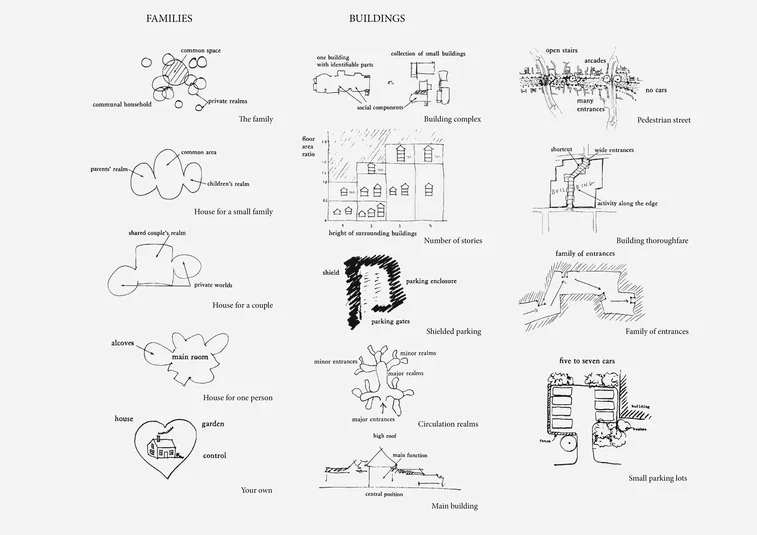
The concept of digital ownership and stakeholder involvement has its semantic roots in the field of participatory design: a virtuous international example is the Oregon Experiment, promoted in the 1970s at the University of Oregon campus by mathematician, architect, and activist Christopher Alexander, who was commissioned to present a participatory design model that would not only be articulated through a master plan, but would also take on a mathematical and grammatical pattern language. The pattern, taken as:
«any type of general planning principle capable, at the same time, of identifying a recurring problem in an environment, establishing the contexts in which it will arise, and offering general guidelines for its solution» (Alexander 1975),
builds a cross-cutting compositional vocabulary shared by administrators, students, and designers, guaranteeing design freedom based on common and circumscribed principles, a sort of “riverbank against chaos” (Alexander 1975).
According to Alexander, the armored system of pre-established models should have guaranteed a system of collective control and defense, as well as a high degree of flexibility. Instead, Giancarlo De Carlo’s prediction from a few decades earlier seemed to come true:
«Collective participation introduces a plurality of objectives and actions whose results are unpredictable». (De Carlo 1972)
The participatory design experiment died out two decades later, due to negligence and general indifference on the part of students, factors that Alexander had not considered as possible causes of self-destruction.
This experiment took on an archetypal role in terms of participatory design, not because of the concrete attempts at implementation, which ultimately failed, but because it brought principles of sharing that became pioneering in the digital field: faced with the general apathy of those who were supposed to be the main authors of the design process, Nicholas Negroponte and the Soft Architecture Machine Group at MIT tried to translate participation into software. Although architecture and computer science were still distant disciplines at the time, a new idea of digital design was born, based on Herbert Simon’s definition:
«a body of notions about the design process that are intellectually demanding, analytical, partially formalizable, partially empirical, and capable of being taught». (Simon 1969)
The attempt at digital transition focused on isolating input and output, thus avoiding the disorganized tangle of the community mindset.
This new methodology owes its development to the years immediately following World War II, when a series of data generated by the war effort made a new paradigm of “systemic thinking” necessary. The idea of operating in terms of networks of interrelated contingencies quickly spread to architecture and was the subject of various texts, design activities, and academic conferences. In its broadest sense, it was a new science linked to the exchange of knowledge through the nodes of a cybernetic system, and its insights could be applied to any discipline and any problem. In the field of architecture, systematizing collaborative design with the support of new computational technologies seemed an infallible solution. (Ratti 2025)
In this case too, the specific experiment proved unsuccessful, because systematizing a multitude of variations and prerequisites in terms of design proved short-sighted compared to the harmonious approach of a single-purpose design imposed from above. Above all, however, the designers themselves showed that they wanted to jealously guard the design decisions that fell within their remit.
How should this new environment be programmed, now that we are so involved with each other; now that we have all become the unwitting workforce for social change? What is this buzzzzzzzz? (McLuhan, Q. Fiore 1967)
While in the architectural landscape, in the face of such experiments, attempts at participatory design have proved unsuccessful, both in concrete terms and in digital terms, in the field of networking there are participatory paradigms that have become predominant in the field of information and software. A virtuous example is the Linux operating system, originally created by a computer science student at the University of Helsinki, Linus Torvalds, who developed it in 1991 and released the code the following year, allowing the system to be modified, developed, and implemented by anyone with access to the network:
«This software was created by an open and widespread group of developers… And it works. Torvalds is convinced that ‘open source is the only way to make software’». (Ratti 2025)
This is a completely new type of design, defined by sociologist and academic Richard Sennett as a “public artifact” (Sennett 2009), in which maintainers, including the creator himself, constantly receive thousands of requests for collaboration and integration of the system, thus benefiting from the widespread intelligence of thousands of users.
But as McLuhan has repeatedly stated, the real anthropological revolution affecting our century is based on connectivity and participation, rather than on the amount of content acquired: for this very reason, form is subordinate to image, or consumerist contraction.
Linux, the product of participatory design, represents the virtuous outcome of two phenomena: open source, a new collective economy that is not monetary but cultural, supported equally by the ideological and democratic contribution of professionals and students, united for the final result; and crowd sourcing, the practice of involving the public in the creation of an open project, contributing free content in the form of ideas, actions, and thoughts.
The intercontinental project that best embodies this phenomenological synthesis is Wikipedia, “the free encyclopedia”, or rather the largest repository of digital information, subject to continuous revisions and modifications by a multitude of authors who act for the sake of a reputation economy, free of charge.
To describe all this, we must necessarily talk about a radical change in the way people interact and socialize, which has affected almost all cultural spheres except architecture. Why can’t open source, a methodology that offers almost unlimited potential in the digital world and has always existed in non-digital form throughout the history of architecture, have the same transformative effect on contemporary design and construction practices? […] The world of architecture revolves around its well-established orbit, seemingly immune to the gravitational pull of online participation. Can architecture really stand aside? (Ratti 2025)
Although the architectural discipline strives strenuously to maintain the impregnability of the design territory, the great digital transformation is gradually tending to engulf the architect’s centralizing attitude and demolish the traditional division between designer and user, democratizing the compositional process and converting it into open source.
In this sense, it is worth mentioning Cameron Sinclair’s digital project, the OAN, Open Architecture Network, an open source platform designed to welcome the design contributions of a community of “socially responsible designers” (2006). Among the various principles underlying the transdisciplinary and cross-cutting platform are not only the sharing of projects, mutual review of solutions, and multidisciplinary exchange with professionals from other sectors, but also a system for protecting intellectual property rights and the direct involvement of end users, who are entitled to influence design decisions.
Carlo Ratti, in an entertaining flight of fancy, uses a culinary metaphor to reinforce his position on participatory digital and compositional design, which, like the art of cooking, should make use of peer review, which should then be incorporated into the changes to the project-recipe between one phase and another, after being shared, eaten, and then modified the next time with the addition of other ingredients (Ratti 2025).
This evolution of the design process, as well as its unfiltered openness to a hybrid community of experts and laymen, will inevitably bring advantages in terms of sustainable economics, based once again on exclusively reputational principles, but at the same time it will undermine the overall sensitivity that allows design to be conceived as a “human activity”.
This lack of a unified conception of architecture and design as the construction of a ‘structure’, an integrated system, an organism in which the components, Vitruvius’ triad of utilitas, firmitas, and venustas, are not only present but necessarily fused, resolved, and dissolved in the resolution of ‘architecture’. (Quaroni 1977)
As early as 1977, in his book Progettare un edificio, Otto lezioni di architettura, Ludovico Quaroni denounced the presence of a deep crisis, a disorientation due mainly to methodological pluralism and the lack of an overall vision, which would gradually lead to a civilization of disharmony.
Inexorably, the hyper-sectoralism and fragmentation already scrutinized and predicted by Quaroni have reached a progressive extreme, including fragmentation and the consequent redistribution of roles through open source systems. While this approach still raises many concerns in terms of design, it seems interesting to transfer the same dynamic to the level of transmissibility and participatory training, using digital archiving platforms and integrated artificial intelligence systems.
The growing dominance of digital technology in the acquisition of architectural information attests to the now undisputed supremacy of social media, web portals, and online platforms over more traditional information vehicles, guaranteeing the image, in its various forms, exclusivity in terms of immediacy.
And it is precisely by questioning the significant role of form and its contemporary derivatives of rapid consumption that we arrive at the archetypal role of the image: whether it is the bearer of a symbolic load, the programmatic manifesto of a current, or a pure commercial product, it does not lose its primacy as a catalyst for thought and a vehicle of meaning in the digital age, where the space-time dimension is nullified by the consumption of fast, fragmented, and approximate content, often administered without adequate awareness.
The issue becomes even more urgent when considering the growing role of artificial intelligence technologies in the processes of image production and interpretation. Generative AI platforms, such as LIA, Midjourney, or DALL·E, do not merely reproduce visual forms, but actively participate in the construction of meaning, proposing images that are already the result of interpretative pre-processing. This raises profound questions: can AI generate icons, images that are not merely similarities but intentional outcomes of a semantic project? And again: who determines the intentionality of the image produced by a machine? The prompt, the dataset, the algorithm, or the interaction between these factors?
But if AI imagines intentional and therefore autonomous images, disconnected from an original model, perhaps, as Jean-Luc Nancy argues, we live in a world of new operational realities: but in their continuous surrender to consumption, when and how are they true?
The image touches on this ambivalence whereby meaning (or truth) is constantly distinguished from the network of meanings, which it nevertheless continues to touch upon: every sentence formed, every gesture made, every intention, every thought brings into play the meaning of the absolute (or truth itself), which nevertheless never ceases to distance itself and withdraw from every meaning. Indeed, every established meaning (for example, this sentence and this entire speech) constitutes in itself a distinctive sign of the threshold, beyond which meaning (truth) is absent. It is not elsewhere, in fact, that meaning is absent, but right here.
This is why art is necessary, and not a diversion. Art highlights the distinctive features of that absence that makes truth absolutely truth. But precisely for this reason, it is disturbing and can be threatening: both because it removes its very being from meaning and definition, and because it can threaten itself and destroy within itself the images that have been deposited in a meaningful code and in a certain beauty. (Nancy 2002)
It is not a question of succumbing to a deterministic view of technology, nor of demonizing its use, but of understanding how the digital image can still be a vehicle of meaning, but only if accompanied by critical awareness. In this sense, text — verbal, critical, contextual — once again becomes fundamental: images need to be interpreted, but also contextualized, anchored to a thought, made part of a network of meanings that transcend them. Only in this way can we move from ingenuous images to intentional images: through a process of conscious semantic attribution that involves both the production and reception of content.
In truth, the challenge of the present lies not in the quantity of images produced, but in the value of their intentionality. In this continuous dynamic of production-transmission and reception, new means of communication have exponentially accelerated processes and reduced the emotional impact of the content offered to the user, largely returning ingenuous images. In this scenario, the attribution of a critical and conscious meaning that each socio-cultural context generates in its own time, using a multifaceted system of content, takes on even greater value: the question then arises as to when future media, supported by the new frontiers of artificial intelligence, will be able to return intentional and non-ingenuous images, providing an interpretative and structured decoding, using the support of multimedia platforms such as LIA. Combining the potential of open source, and therefore participatory design, with the potential of artificial intelligence and databases of material already archived and present on academic training platforms, would allow us to acquire ‘cyber-awareness’, or rather an intentional use of content through a preliminary interaction with AI. A good practice in the use of digital resources could involve formative and preparatory control, through a series of questions posed by artificial intelligence to the user, based on the interest they show in a piece of content on the platform through a given input. In this way, the new form of participation between the user and artificial intelligence, or what could be called a digital ‘intentional’ process, would lead to a conscious consultation of content – already present on the LIA platform, mainly images and drawings – guided by the AI filter. To date, the numerous supports that artificial intelligence already provides, such as requesting an image from channels such as ChatGPT, respond with a variety of content, both specific and reference, but there remains a large gap in terms of protecting the corresponding level of user awareness. At the same time, the intentional image – an image that conveys meaning – remains the last bastion against the dissolution of meaning in the infinite surface of images responding to any and all potential outputs. In the digital age, therefore, it is not a question of opposing the image, but of regaining its power: restoring its depth, direction, and language. Only in this way the image could return to be not just an object to look at, but a subject to understand.
ALEXANDER C. (1975) – The Oregon Experiment, Oxford University Press, Oxford. (It. Trans. Un esperimento di progettazione democratica. L’Università dell’Oregon, Officina, Roma, 1977). ↩¹ ↩²
DE CARLO G. (2013) – L’architettura della partecipazione. Quodlibet, Macerata. ↩
ECO U. (1975) – Trattato di semiotica generale. Bompiani, Milan. ↩
MC LUHAN M., FIORE Q. (2011) – Il medium è il massaggio. Corraini, Mantua. ↩
NANCY J.L. (2002) – Image et violence; L’image – Le distinct; La représentation interdite. Éditions Galilée, Paris, (It. Trans. Tre saggi sull’immagine, Cronopio, Naples, 2002). ↩
QUARONI L. (1977) – Progettare un edificio. Otto lezioni di architettura. Mazzotta, Milan. ↩
RATTI C. (2025) – Architettura Open Source reloaded. Vele 252, Einaudi, Turin. ↩¹ ↩² ↩³ ↩⁴
SAMONÀ G. (s.d.) – Mie riflessioni, manuscript, Archivio Progetti Iuav, Fondo Giuseppe e Alberto Samonà, Samonà 2.fas/102. ↩
SAMONÀ G. (1979-1982) – in Lettere su Palermo di Giuseppe Samonà e Giancarlo De Carlo, per il Piano Programma del Centro Storico.
SENNETT R. (2009) – The craftsman. Penguin, London. (It. trans. L’uomo artigiano, Feltrinelli, Milan, 2008). ↩
SIMON H.A. (1969) – The Sciences of the Artificial. MIT Press, Cambridge (Mass.). (It. Trans. Le scienze dell’artificiale. Il Mulino, Bologna, 1988). ↩
VALVASON A. (2025) – Segni, spazio, figure. Giuseppe Samonà: le icone dello Stretto. PhD Thesis in Architectural Composition, 37th cycle, Iuav University of Venice.
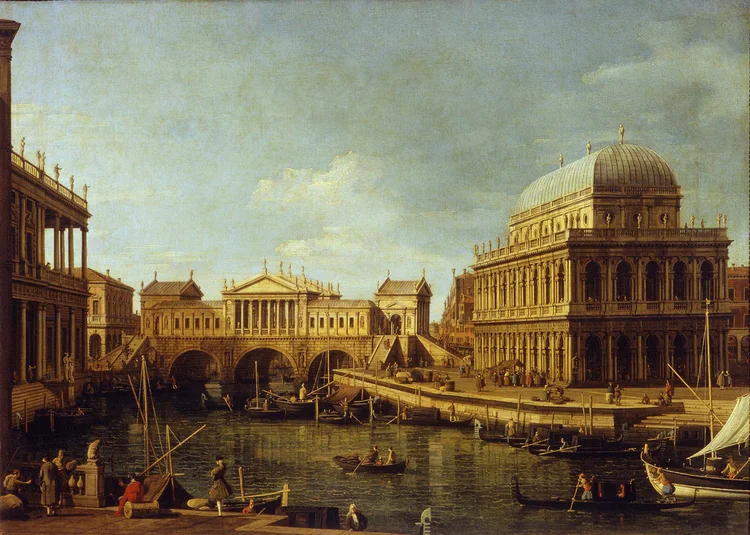
Fig. 1 – Canaletto, Capriccio with Palladian Buildings, after 1744 – before 1758. Oil on canvas (58×82) cm. National Gallery of Parma.
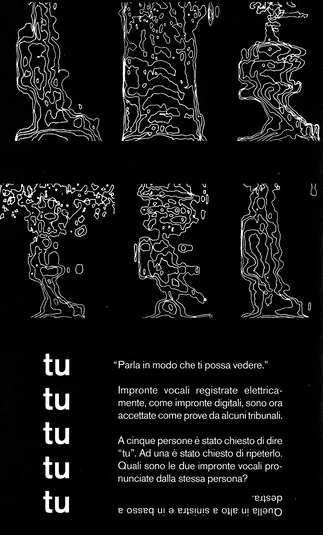
Fig. 2 – “Vocal imprints electrically registered, like digital fingerprints” (McLuhan M., Fiore Q., The Medium is the Massage, 2011, Corraini Edizioni, Mantova). Intended iconographic transposition of an ingenuous action.
Fig. 3 – Collage of diagrams with typological-iconographic matrix drawn from Alexander’s “pattern language”, a compositional approach and typological atlas that dissects the design process into segments.
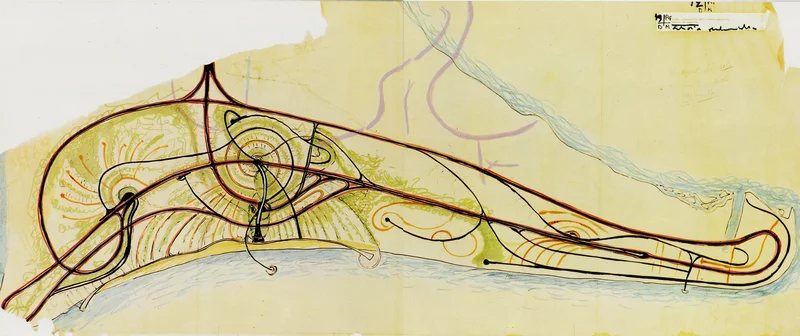
Fig. 4.1 – Marcello D’Olivo, Lignano Pineta, the dolphin, 1953–56 (from D’OLIVO M., Discorso per un’altra architettura, 2: 1948–71, cit.).
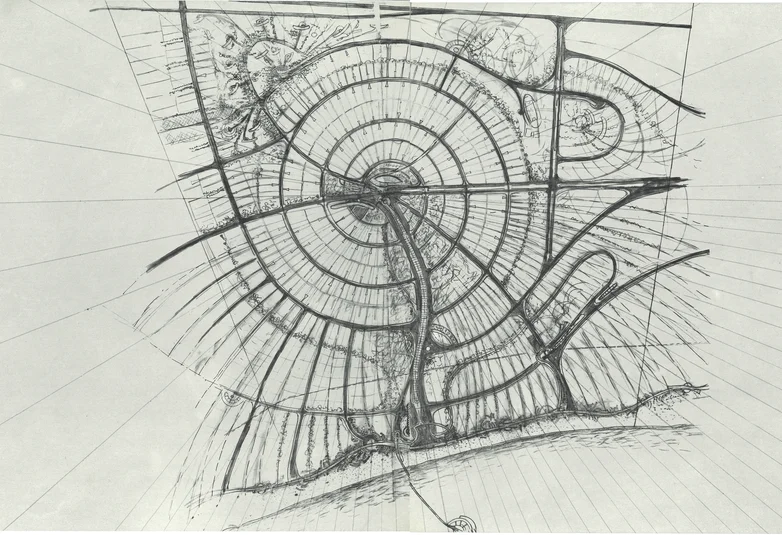
Fig. 4.2 – Marcello D’Olivo, Lignano Pineta, Spiral road layout, 1953–56 (from D’OLIVO M., Discorso per un’altra architettura, 2: 1948–71, cit.).
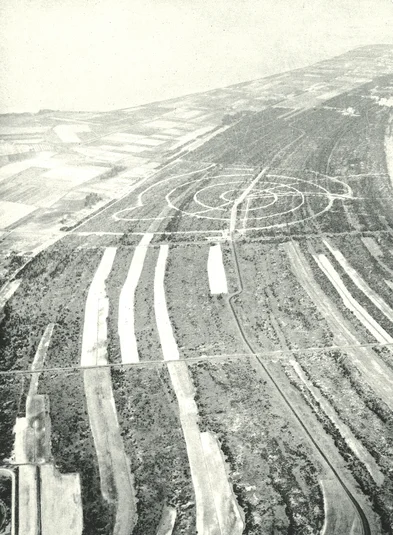
Fig. 4.3 – Marcello D’Olivo, Lignano Pineta, Spiral seen from the air, 1953–56 (from D’OLIVO M., Discorso per un’altra architettura, 2: 1948–71, cit.).