When we read the word "I", without knowing who wrote it, it is perhaps not meaningless, but it is at least estranged from its normal meaning (Husserl 1900).
"Porto's Faculty of Architecture: points toward[1] a Grand Tour", aims to contribute and expand a critical spirit associated with travel and, in particular, with Architectural Travel. The article is based on the conviction that Architecture travel is a specific journey and on the hypothesis that this specificity resides mainly in the predisposition of the traveller to choose and pursue a set of architectural artefacts, natural or artificial, in an in-depth manner. This hypothesis leads us to consider that the visited works or environments embedded in a given cultural heritage should be thematically dense, incorporating an authorial approach with charged design levels. The density of an architectural artefact depends less on its size or programme and more on the quality and diversity of the informed design themes into which it can be broken down or from which it can be developed. The aim is to engage an open sensorial and comprehensive in-situ reading in order to go beyond available digital dissemination or published information and identify the whole, the composition, feel the scale, the proportions, inhabit the space, the context, etc. The possibility of identifying the clues and decoding these themes depends on the traveller's appetite and cultural background, which can be cultivated and enhanced through prior study or education.
In this sense, the possibility of applying the idea of a Grand Tour to the architectural journey concentrated in a single dense architectural work is admitted, and we propose a set of points that could support and justify its selection. Firstly, the complexity of its relationship with the place that receives it – broad context comprehension and insertion. Secondly, the number and variety of design problems faced versus the number and variety of design solutions tried out. Thirdly, the potential for the building to function as a reference within the author's oeuvre and the quantity and variety of architectural references that it calls upon. To this end, the article attempts to demonstrate that the Faculty of Architecture of the University of Porto (PT), by architect Álvaro Siza (1933-…), will be relevant as the seul motif of a Grand Tour.
At the University of Porto, the Faculty of Architecture (FAUP) was established in 1979[2], separating the Architecture course from the disciplines of Painting and Sculpture. The creation of a new Faculty exclusive to architecture brought with it the need to move away from the Fine Arts School, set in downtown Porto, and create its own facilities. As part of the ongoing programme to renovate and expand the University of Porto, the new Faculty would be installed in the Campo Alegre area to the west of the traditional city centre and on the way to the Atlantic Ocean. The university acquired two estates, Quinta do Gólgota and Quinta da Esperança, on the slopes of the Douro River, overlooking the river mouth.
The Faculty of Architecture of the University of Porto, as we know it today, is the result of a design and construction process, which included four moments: (1) "Renovation of the Quinta da Póvoa House", also known as Quinta do Gólgota (1983-1985); (2) Renovation of the former Stables (1984-1986); (3) the Carlos Ramos Pavilion (1985-1986); the new building in the former Quinta da Esperança ([1979] 1985-1997). Although spread in time and with a rich evolutive design process, the ensemble was conceived as a cohesive whole, where the distinctive parts reinforce the whole's textured character and general intent.
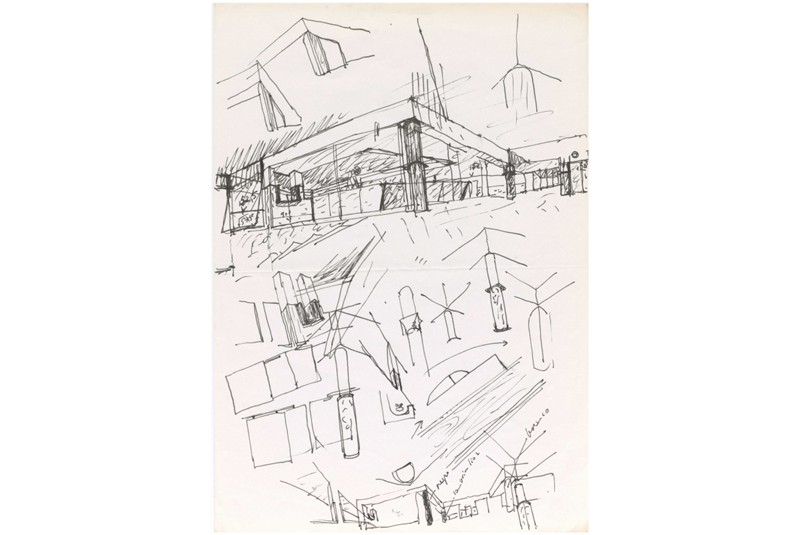
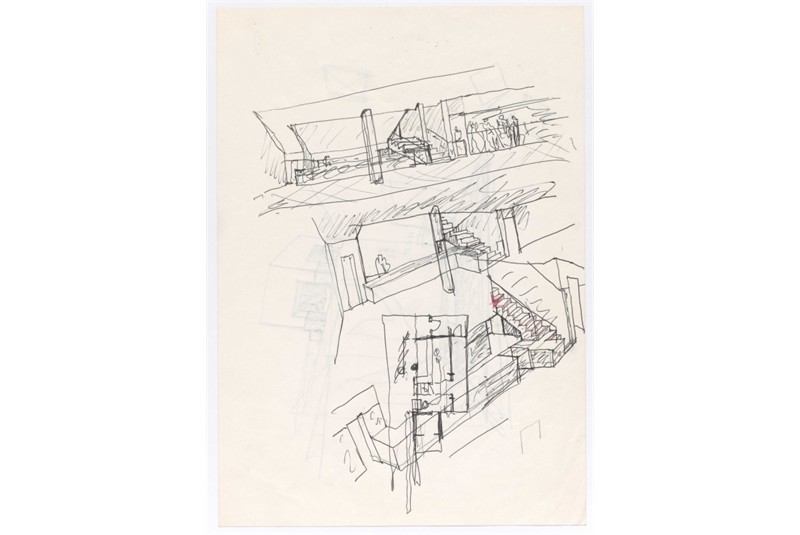
Since FAUP has already been extensively debated by different authors, in this article, only those episodes pertinent to the genesis of a Grand Tour will be argued. To the present study, there are archival materials[3] of different types and nature, such as drawings (sketches, rigorous renderings, models of the different project phases, solutions and variants), written records (descriptive memories, interviews, etc.), but also, and above all, the building itself which is par excellence the main architectural document to be carefully inhabited and analysed.
Longue durée
In FAUP's design, Álvaro Siza invokes the history of urban transformation as an operational design tool. The project is determined by an in-depth understanding of the long-term nature of the city and, specifically, the site of the new ensemble. This acknowledgement will inform Siza's reading on the relation between project and place. The faculty constitutes an example of respect and exaltation of the place's singular architectural elements, but also, and simultaneously, as a case of interpretative and expressive autonomy founded on the recognition of the architecture's principle of unity and continuity over time. Álvaro Siza reduces the condition of the pre-existing place to its essentials and endows it with a new spatiality, undoubtedly urban and human. In other words, Siza rehabilitates, builds new in continuity and builds new within a future intent, reinterpreting place within contemporaneity demands.
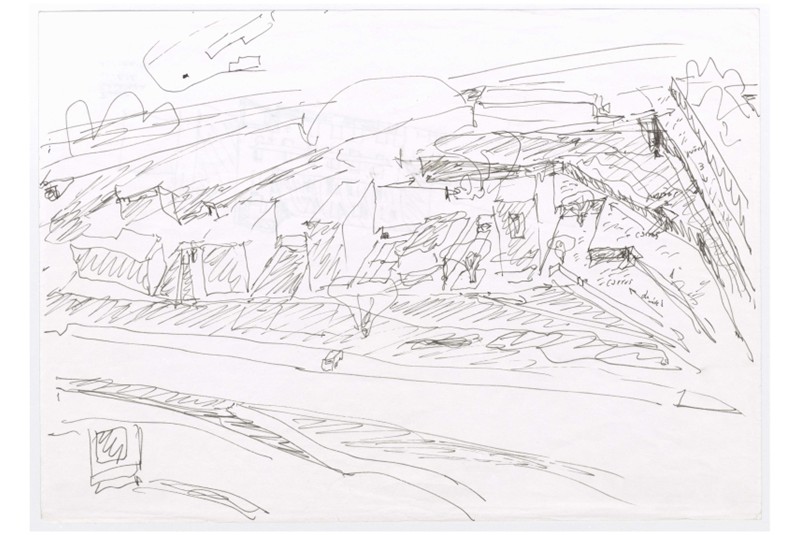
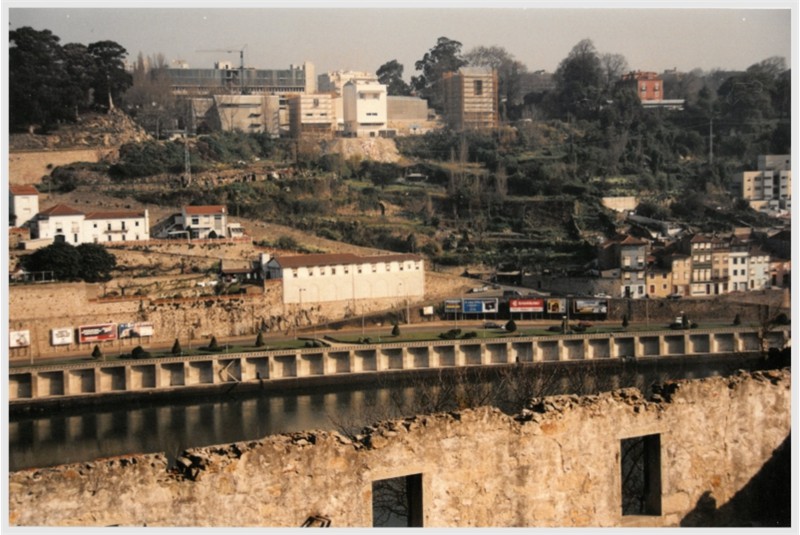
Siza recognises the faculty's site, on the slope of Massarelos overlooking the Douro River and the Arrábida Bridge, as an exceptional location in Porto's landscape due to its character and atmosphere. Contradicting these conditions would go against previous urban options and compromise the coherence of Porto's urban structure. Consequently, the project faces an integration design problem within the landscape/atmosphere in continuity with the river embankment. One of the main conceptual strategies developed to preserve the atmospheric qualities that characterise the place is, on the one hand, the preservation of the buildings, green areas and relevant heritage quality elements and, on the other, the preservation of the place's global image seen from the opposite embankment, which is that of a large luxurious platform garden. FAUP's site is one of the last in the city where the atmosphere, portrayed in 18th-century engravings, persists: an atmosphere of contrasting values, where the hustle and bustle of the river are recorded alongside rough topography, fertile agricultural platforms and well-designed houses amidst luxurious gardens composed of exotic trees and plant species. An atmosphere indexed to when this piece of hillside constituted an alternative to the traditional city, with large and fertile farms. This hillside was chosen as the preferred place to live by the foreign colony related to the Porto wine trade, who found pure air, clean water, mild climate and wide views, alongside a similar social neighbourhood environment, safe for establishing a family.
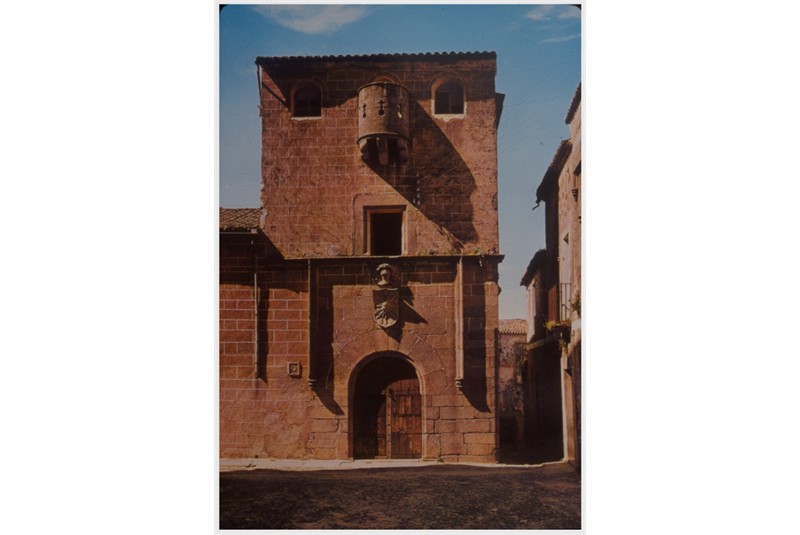
Quinta da Esperança is part of one of these rural properties, whose surface is organised along the slope in platforms exposed to the south towards the river. While the Quinta do Gólgota on an elevated platform, with a two-storey family house, stables, a ludic luxurious garden and remarkable granite elements consisting of tanks and boundary walls, occasionally broken to overlook the river, was probably built by one of those families, combining local construction tradition with English living standards: hygiene, comfort and atmosphere. By the end of the 1970s, Quinta da Esperança is no longer a relevant, productive farm, for supplying Porto. At the same time, Quinta do Gólgota's architectural value remained well-kept and recognised within the city's heritage. Consequently, Siza decides to preserve the Quinta do Gólgota's romantic character and explore a contemporary meaning for the lost terraced garden image of Quinta da Esperança within three clear design options. Firstly, the decision to value existing structures in Quinta do Gólgota by rehabilitating the family house, stables and ludic garden set within the high granite boundary walls and site only one new volume, Carlos Ramos Pavilion, on the opposite side of the garden, concurred with maintaining the scale and proportions between the different elements or features, enhancing the existing atmosphere. Secondly, the option to continue the exceptional tree cover that characterises Quinta do Gólgota and to modulate Quinta da Esperança's surface into platforms, in many cases green, articulated with the preservation of significant century-old trees. Thirdly, the decision to review the layout of the plot's southern boundary running along the slope to the river, by redesigning the panoramic road structure and allowing the integration of embedded granite structures, containment walls, gates and a series of tanks into the ensemble's global layout, grafting the composition into the broader rural context.
A longue durée urban study of the hillside reveals a constant desire for transformation since the end of the 19th century and, particularly, since the intention to build a second bridge over the Douro River – Arrábida Bridge. This decision transforms this territory into a "bridgehead" and, potentially, into Porto's "modern gateway". This problem has been studied for over three decades through five municipal urban plans developed by national and international architects. Almost without exception, these proposals share Siza's understanding and choice to preserve the atmosphere of Quinta do Gólgota and reinterpret Quinta da Esperança's transformation in light of the contemporary circumstances. In this sense, all urban plans are developed between the 1940s and 1970s and aim to consolidate the green landscape of this part of the hillside and introduce a new urban scale design based on collective land policy implementation. The different proposals imagine Quinta do Gólgota and Quinta da Esperança as part of a public green belt, green surface or a mixed urban park, integrating the most significant built and natural heritage, including the topographical locations with the most extraordinary river and ocean views. They are, therefore, intended for the pleasure and general enrichment of the whole city.
Specifically, at the end of the 1940s, Fernando Távora proposed, on a free and continuous green surface, entirely in the public domain, a civic centre with a neighbourhood unit for three thousand inhabitants. Távora studies the best placement strategy for a series of unité d'habitation de grandeur conforme, on pilotis (stilts) and with toits-terrasses (roof-terraces). These housing ensembles are placed according to the cardinal points and perpendicular to the riverbank, offering an image of compact and abstract vertical masses to those crossing the Arrábida Bridge. This silhouette of elegant contemporary towers at the city entrance associated with the new bridge was to be read in counterposition to the city's silhouette of towers consolidated in the 18th century, seen from the downtown Luiz I Bridge viewpoint. Although Fernando Távora's urban plan was quickly abandoned, the idea that a silhouette of towers could characterise this part of Porto's riverbank will persist in time. Fernando Távora repeats the concept in a project for a surrounding area in the middle of the following decade, but again without any built consequences. Finally, Armenio Losa and Cassiano Barbosa return to the concept at the end of the same decade, managing to leave a built trace, facing the mixed urban park proposed by Januário Godinho. The proposal organises a set of 7-storey blocks perpendicular to the river, arranged on a continuous double-height base, giving the landscape a unique character. This plan was carried out by different architects in the following years, and its meaning seems to have been taken up again by Siza in the Quinta da Esperança.
In FAUP's proposal, Siza summons the notion of "tower" as an undoubtedly urban image to characterise a public space that aspires to be urban even though the bridge, the motorway and the heavy traffic compromise common urban activities. The tower, as a narrow, tall façade of a long volume located perpendicular to the river, constitutes a tradition on this stretch of the Douro slope, whose origins date back to the 18th century. Houses like Gólgota are, in reality, built in this way. They correspond to buildings of three, four or five storeys, located at prominent points of the topography, which turn their narrower and higher front towards the Douro, with unique balconies and terraces. When studying FAUP's site conditions from the opposite embankment, Siza certainly notices how these autonomous, abstract volumes, developed in perspective depth, inhabit the topography and calibrate the in-between open and green spaces. On the one hand, this traditional footprint/layout contrasts with the long warehouses built on the lower riverbank as commercial and industrial facilities and, on the other, integrates the overall urban front while giving an updated urban spatiality for which the human scale is the first reference.
Repository of design problems
One may state that FAUP constitutes a repository of design solutions for universal and timeless architectural problems. Despite FAUP's close ties to the city, its project is not simply determined by a specific culture, occasion or particular place. On the contrary, programme and place seem to be pretexts for elaborating a symphony of forms, spaces, and light set within a spatial narrative characterised by its own architectural language. In other words, FAUP reveals a more ambitious objective than the response to a programme, a time or a place, as if Siza entrusted his project with the duty of critically inquiring or formally defining different solutions to a set of problems to which architecture has always had, and will always have to respond. These solutions arise from the response to a practical purpose and quickly become expressive opportunities, also certainly animated by the problem of culture and architectural references indexed to the notion of a faculty of architecture as an experimental place, possible learning tool or a manifest of a way of thinking.
A close observation of FAUP's design process reveals Álvaro Siza seeking multiple solutions to problems that arise in different design phases and on different scales. Of these, the following stand out: the problem relative to the typology of the plan associated with the siting principles, the theme of exceptional spaces and repetitive spaces, the problem of articulating levels, the theme of openings or the question of stereotomy(s). When placed in an initial design phase, the different solutions developed for these problems correspond to the study of different design versions for the same problem. When placed in an advanced phase, Siza disassembles the posed problems through the pursuit of variants within a family of solutions (with more than one variant being built).
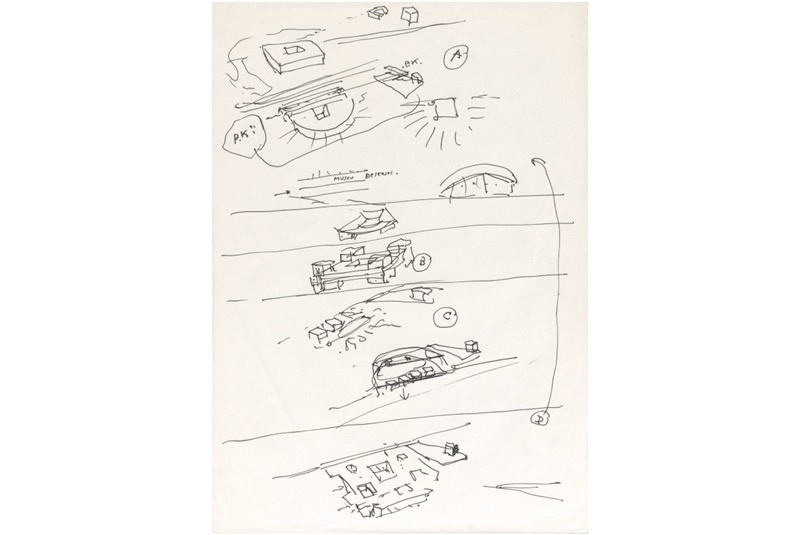
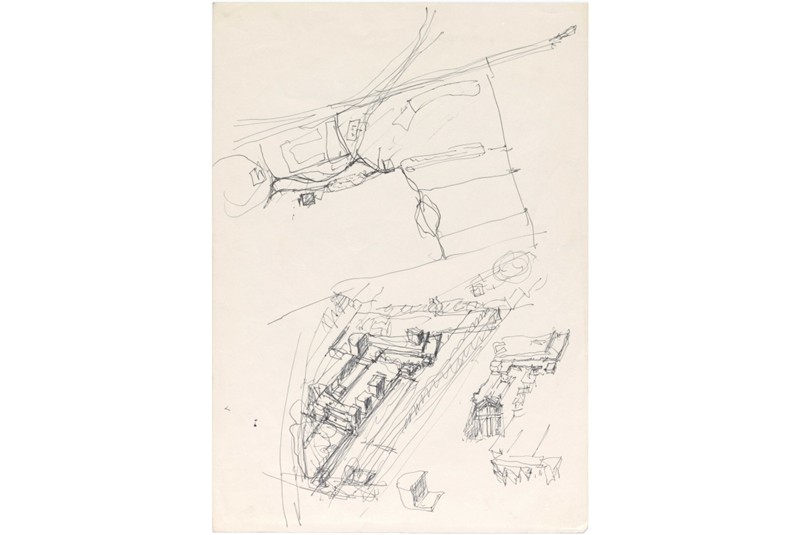
The design process reveals different exploratory hypotheses for FAUP's overall layout in Quinta da Esperança, both in terms of the plan form and volume. The design oscillates between a single volume marking a point, freeing the slope and a group of several volumes spread across the surface, transforming it completely. At Quinta da Esperança, Siza begins by proposing a compact mass of large dimensions in an easily graspable geometric shape perforated by a central void, taking advantage of the topography. In this design option, Siza evokes, in terms of scale, Nicolau Nasoni's Episcopal Palace[4] seen from the Luiz I Bridge and, in terms of type, Louis Kahn's Exeter library. The development of the work leads, over a series of design alternatives, to the transformation of this clear single volume, through its fragmentation, into a compositional chessboard of mass and voids and later into an articulated system of volumes that inhabit the terrain, recognise its limits and profoundly alter them.
Transversal to this exploratory process is the continuous focus on the courtyard or patio as the core compositional space in any of the design variants or options. Within the family of FAUP's versions that focus on volumetric fragmentation, this courtyard varies in shape and size but is invariably characterised, on one of its sides, by Quinta do Gólgota's ensemble. This option calls for a sensitive and sensorial dialogue between the new courtyard and the collection of singular species – cultivated, romantic, luxuriant – in the garden of Quinta do Gólgota, within its high boundary granite walls.
In numerous explorations, Siza organises the successive volumes and qualifies the spaces according to the same compositional principle: just like the architecture of a city, the faculty is composed of exceptional and repetitive volumes/architectures, and neither of them can be annulled without compromising the overall composition. For Siza, the classrooms correspond to the architectures of repetition in the invariant "tower" form, always with the same footprint but with individual configurations and heights complying with the overall urban narrative. He consistently repeats the "tower" as often as the programme requires but does not give up on personalising the interior layouts, exploring interior-exterior dialogues (framing the Douro landscape), and drafting unique and playful elevations.
In turn, each social, administrative and representative programs correspond to exceptional architecture, namely the cafeteria, the main vertical lobby (with secretary, bookshop and administration), the main auditorium, the museum spaces, and the library. Each of these programmes is set within a continuous promenade and associated with a specific and unrepeatable volumetric relationship within the general composition. To determine the shape of each volume, the design process reveals different footprints, configurations, and spatial interactions hinged on a latent geometric order as possible alternatives.
The footprint of all these volumes enhances the courtyard in the centre and reinterprets the significance of the plot's limits. To the south, the successive individual "towers" take the alignment of the existing Gólgota House and open the courtyard to the riverfront, giving an insight into the Arrábida Bridge (in this case, by suppressing a "tower"). To the north, a continuous string of shapes sustains a heterogeneous volumetric flow (inhabited by the exceptional programme), protects the courtyard and buffers the highway traffic density. This volumetrically diverse composition is brought together through a homogeneous material characterisation, dominated by continuous plaster surfaces mediated or tempered by natural stone expressions – marble and granite in different textures and stereotomy(s).
To contrast with this material homogeneity, Siza drafts, in the transition with the highway, a set of volumes in apparent brick masonry indexed to the heating system, topped by a pyramidal chimney.
FAUP's original archival organisation structure complies with the sequential portrayal of these volumetric depictions that can be traced to the project's principles. On another level, documents are organised according to architectural element types, such as stairs, ramps, windows or skylights.
At FAUP, these architectural elements are never devices for simply articulating levels or allowing for natural light, i.e. only complying with the functional or technical requirements or needs. Each staircase, ramp, opening (window, door) or skylight responds to its own design ethos set inside the bigger whole, which is translated into a specific form, spatial sequencing or promenade. This means it is challenging to recognise two identical staircases, ramps or two identical windows because each element is portrayed and characterised through a unique poetic rendering. Consequently, FAUP establishes itself as a repository of architectural elements and artefacts. As an example, in relation to the staircase as a singular architectural element and the various ways it is embodied in the faculty, there are: staircases that reach one or more floors, single or multi-flight stairs with parallel flights or mirrored flights and stairs with opaque or transparent railings, in multiple variants. In terms of poetic meaning, some stairs complement the space, giving it continuity, and others are the main protagonists and dominate the space, as in Michelangelo's Medicea Laurenziana library or other Siza works, like the Serralves situation or Quinta do Portal Winery main staircases. Even in the faculty's repetitive programmes (towers), the stairs may resemble each other in form and dimension, but the fact that they occupy different positions within each volume alters and particularises their reading: sometimes they follow a typical movement, and sometimes they are inverted; sometimes they are enclosed, sometimes they are punctuated by strategic openings; sometimes they end a contained space (corridor), sometimes they top a wide space (atrium), etc.
Continuing to understand that the design of FAUP goes beyond the simple affirmation of a grand gesture, governed by vectors of force and geometric tracing lines[5], Siza also decisively calls upon the study of finishings, skirtings, light devices and furniture pieces to create the atmosphere (interior and exterior) of the faculty. There are countless sketches in which the architect addresses the problem of materials, their transition, and their stereotomies, as well as several details that underline how to place, cut, and align in each situation. To understand the meaning and criteria of the applied materials, we just have to inquire how different the main courtyard would be without the blue granite pavement, without the cladding walkway that folds onto the "towers" base, without the platforms that contain the courtyard in heavy yellow granite with a green covering on the approach to Quinta do Gólgota.
Thus, Álvaro Siza's proposal translates, through a necessary humanist condition, an informed but sensitive and sensorial approach which portrays: the manifesto condition, the ability to transcend place and programme through its interpretation; the latent geometric order as a design tool, regulating the elevations in continuity with openings capturing the exterior landscape into the interior and the condition of going beyond a geometry based design, evoking the sense of genius loci.
Symphony of voices
In regard to architecture education, we will not encounter resistance in stating that FAUP is a dense object, capable of being studied and broken down into various design themes and notions. This reading may be reinforced by FAUP's potential to stand as a paradigmatic example of Siza's body of work, to allow for a better understanding of subsequent designs through open thematic readings and to give voice to a wide range of authors, buildings and places as operative references.
There are many projects in the wake of FAUP in which Siza uses self-quotation as a creative mechanism. The design solutions become basic prototype ideas for developing these projects, establishing themselves as invariants of Siza's design practice and as a memory of his work. Consequently, the faculty's in-depth study allows for a more precise interpretation of a set of Siza's works in Portugal and abroad, which share with FAUP spaces of the same nature, meaning and atmosphere, such as the Galician Centre for Contemporary Art (Santiago de Compostela, 1989-1993) or the Serralves Museum of Contemporary Art (Porto, 1991-1999). Additionally, FAUP is an example of a multi-referential body of work in which Siza places a broad and organised set of anonymous and erudite references in dialogue, many of which have been analysed or are to be studied in-situ.
The tested design solutions allow us to identify echoes of the architect's travels to Spain, Sicily, North Africa or Finland, namely, valorising the essence of form as a strategy for the natural integration of the whole. They also invite us to recognise the premises, conditions and quotes from works by architects like Le Corbusier, Adolf Loos or Alvar Aalto that Siza explored by his endless sketching in A4 black notebooks during his Grand Tours.
All these travel sketches reveal Siza's thought process. They are expression of a whole way of interpreting reality and working on it, be it a depiction of Rome or an unravelling the encounter of a new context or place. In either cases, there is not an intention of turn the visited circumstance into a quick-information reference, based on photogenic imagery or frozen notion or concepts. The places visited frequently appear as a battleground in Siza's sketches, upon which various architectural realities reveal their conflicting constituency. Siza's travel drawings are recordings of an expressive intentional character rather than any kind of precise projection, they consist of fluid magma that has yet to solidify into a final new form. The challenge is that the same will happen when an architect or student visits Porto's Faculty of Architecture.
[1] "Toward" as in direction of something, referenced to Towards an Architecture by Le Corbusier, translated by John Goodman and introduced by Jean-Louis Cohen.
[2] The Faculty of Architecture was created by Decree-Law 498-F/79, of 21 December 1979.
[3] Archive Álvaro Siza: Collection Serralves Foundation – Museum of Contemporary Art, Porto. Donation 2015.
[4] Notion shared namely with Dubois 2023.
[5] Namely, on FAUP's geometric tracing lines, cf. Fonseca 1996.
HUSSERL E. (1900-1901) – Logische Untersuchungen [Logical Investigations]. Niemeyer, Halle. ↩
"Álvaro Siza: 13 Works" (1989) – In: Álvaro Siza 1954-1988. A+U Extra Edition, Tokyo.
CROSET P.A. and ANGELILLO A. (1991) – "Scuole in Portogallo di Alvaro Siza". Casabella, n. 579 (May), pp. 4-11.
DUBOIS M. (2023) – "Siza na Bélgica / Siza in Belgium". In: Siza: 90 anos/years. 100 Folhas, Matosinhos. ↩
FONSECA T. (1996) – A construção do Polo 3 da Universidade do Porto: planos, projetos e edifícios. PhD Thesis (supervisor: Álvaro Siza), Faculdade de Arquitetura, Universidade do Porto. ↩
"Escuela de Arquitectura de Oporto" (1994) – Álvaro Siza 1958-1994. El Croquis, n. 68/69, pp. 136-141.
FRAMPTON K. (1993) – "Sketching: Álvaro Siza's Notes". Lotus, n. 68, pp. 73-87.
FRAMPTON K. (author), FLECK B. and ÁBALOS M.D. (eds.) (1995) – Álvaro Siza, Obras e proxectos. Electa España, Madrid.
LE CORBUSIER (author), COHEN J-L. (intro.) and GOODMAN J. (trans.) (1924, 2007) – Toward an Architecture. Getty Research Institute, Los Angeles. ↩
"Pabellón Carlos Ramos" (1994) – Álvaro Siza 1958-1994. El Croquis, n. 68/69, pp. 156-183.
RAMOS S. (2017) – Campo Alegre Cidade. Da sua longa metamorfose. PhD Thesis. Faculdade de Arquitetura, Universidade do Porto.
SIZA VIEIRA Á. (1988) – "La nuova Facoltà di Architettura di Porto". Casabella, n. 547 (June), pp. 4-15.
SIZA VIEIRA Á. et alii (2003) – Edifício da Faculdade de arquitetura da Universidade do Porto: percursos do projeto / The building of the Faculty of architecture at Oporto University: course of the project. Faup Publicações, Porto.
SIZA VIEIRA Á. (2009) – "Pavilhão Carlos Ramos". In: Á. Siza, 01 textos. Civilização Editora, Porto.
SIZA VIEIRA Á. (2018) – "Pavilhão Carlos Ramos". In: Á. Siza, 02 textos. Parceria A.M. Pereira, Lisbon.
Archive Álvaro Siza, Col. Serralves Foundation – Museum of Contemporary Art, Porto. Donation 2015 (PT-FS-ASV-18; PT-FS-ASV-19). ↩