Alessandra Gabriele
It is 21 October 1961. It is Sunday evening. Dutch television broadcasts a single channel, in black and white. The young broadcaster AVRO (Algemene Vereniging Radio Omroep), the first Dutch public broadcaster, has been in existence for only ten years.
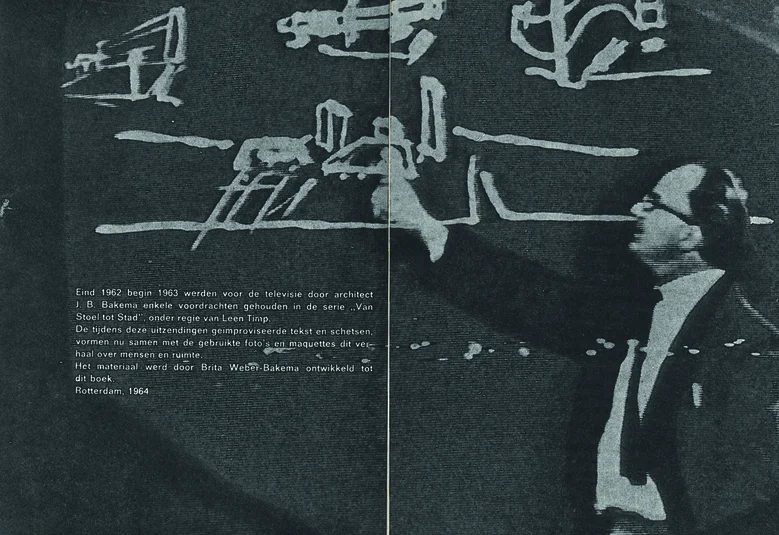
Wearing a jacket and tie, his left hand in his pocket and his right hand holding a piece of chalk, facing the camera with his back to the blackboard, Jaap Bakema enters the homes of all Dutch viewers.
What appears before families is the figure of a teacher rather than that of an architect; yet the Rotterdam-based firm Van den Broek–Bakema is one of the largest architectural practices in Europe, with numerous projects to its name and hundreds of collaborators.
At the opening of the programme, the camera frames a chair and a handwritten chalk inscription, in cursive script: Van Stoel tot Stad (From Chair to City). After a few seconds, the shot cuts to a medium close-up of Bakema, wearing a wry smile, with a series of sketches on the blackboard behind him. In his hand, a piece of chalk with which he continues to fidget:
Ladies and gentlemen, the story of the chair and the city is a difficult one. Difficult because, in fact, I do not intend to speak about chairs or cities, but rather about the space in which both are situated. [...] I want to speak about a love for space: you will surely understand how difficult this subject is, especially on a Sunday evening. Still, I believe it is worth addressing. And I will gladly do so. I have the feeling that we are living in a historical moment in which love for space is lacking.1
These are the introductory words of Jaap Bakema: the programme Van Stoel tot Stad was broadcast in two episodes between 1961 and 1962,2 and was directed by Leen Timp for a liberal, non-leftist channel, AVRO. As Dirk van den Heuvel notes,3 Timp was, at the time, one of the leading Dutch directors and was married to one of the most popular television presenters, Mies Bouwman. Bakema designed a single-family house (which was never built) for the couple and also planned a center for disabled people, which was constructed thanks to a televised fundraising campaign promoted and hosted by Mies Bouwman in 1962.4
These facts attest to Bakema’s position within the postwar Dutch establishment: a membership which, combined with his talent as a skilled communicator, enabled him to utilize various media to disseminate spatial themes, especially to non-specialist audiences. Indeed, Bakema proved capable of employing both specialized journals and general newspapers, television, exhibitions, lectures, workshops, and video recordings to share urban planning and architectural decisions with civil society, all according to a particular democratic vision of society.
As Francis Strauven (1992, p. 48) points out, the work and thought of Jaap Bakema are closely linked to the principles and characteristics of Dutch society: «a society with a strong sense of the common good and a tradition of social cooperation rooted in Calvinist ethics; a country largely reclaimed from the sea and traditionally ruled by a strict geometric order, dictated by the requirements of drainage engineering».
It is precisely in the Netherlands, in the northern Groningen region where he was born and raised, that Bakema finds his theoretical references in his wife’s family: a family of doctors, teachers, and clergy through whom he was introduced to Krishnamurti’s theosophy and the anarchist ideas of Domela Nieuwenhuis (Strauven 1998, p. 215).
Inspired by these currents of thought, Bakema conceived of the world as a space full of energy. From this pantheistic and theosophical view of life and space, the architect emerges as a figure tasked with mediating and facilitating the public’s understanding and use of space within a democratic and just society – an open society.
For Bakema the idea of the open society evolved around the relationship of the individual toward the larger whole, be it the neighbourhood, the city, society itself, or what he called “total space”. Architecture then was to enable the individual to become aware of his or her relationship to this larger whole, while the open society should be so generous and tolerant as to allow for the individual’s self-realization (van den Heuvel 2014).
Therefore, for society to be truly democratic, it is necessary that citizens become more aware both of their own housing needs and of the possibilities offered by construction and building practices. Television, in this case, is a useful tool for Bakema to share architectural issues.
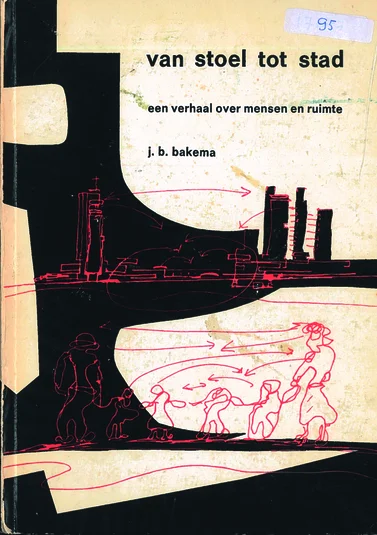
In 1964, the content of the television broadcast was transcribed by Bakema’s daughter, Brita Bakema, into the eponymous book Van Stoel tot Stad (From Chair to City). The subtitle chosen for the publication is emblematic: A Story of People and Space.5


It is of people, of space, of ancestral spatial actions, of construction techniques, and much more that Bakema speaks on television, addressing a general audience with direct language and easily understandable metaphors. And he does so by drawing. During the afternoon, he prepares a sort of conceptual map – an early prototype of what would now be considered such – outlining the evening’s lecture: on the blackboard behind him appears a series of sketches and drawings. A remarkable visual journey that synthesizes his discourse through graphic symbols, especially, as he notes, to prevent a potential hazard: «otherwise they fear I might speak for too long».
The use of a conceptual map – even in its embryonic form – as a quintessential educational tool, designed to facilitate understanding and retention of knowledge, is an expression of Bakema’s maieutic abilities. The architect frequently employs drawings, sketches, and diagrams to communicate a project after it has been realized: the Bakema Archive at the Nieuwe Instituut in Rotterdam contains numerous drawings produced retrospectively, not only for clients but often for ordinary citizens as well. Dirk van den Heuvel refers to these as apocryphal drawings.6
Bakema drew less to design than to explain. Many of his drawings were not personal annotations but attempts to convey a message. They usually appeared in series and, in their explicit and narrative nature – often combining images and text – they recall the language of comics. (Baeten 1995, p. 3)
The practice of drawing as an explanatory and narrative tool is closely linked to Bakema’s teaching activities, which from the 1950s accompanied his professional work with an intensive pedagogical practice. In seminars conducted as a visiting professor at numerous U.S. universities, and later as a professor at the Technische Universiteit Delft from 1963 onward, drawing, diagramming, and projection of images and films were employed as pedagogical instruments to make complex spatial relationships and architectural processes intelligible, rather than to define formal outcomes.
The preferred format for these academic engagements was the workshop or design seminar – one that enabled intense study and exchange in a relatively short period of time. The preferred topic was always a local issue related to the modernization of the city, its public spaces, and infrastructure. For instance, at Washington University, where Bakema was a visiting professor in 1959, the design project involved “The Humane Core: A Civic Center for St. Louis” (van den Heuvel 2022, p. 227).
In this light, Van Stoel tot Stad can be understood as a televisual translation of an already established teaching practice: the blackboard, chalk, and progressive construction of the visual discourse reproduce the seminar setting, extending it to a non-specialist audience.
Bakema’s narration on Dutch television, broadcast on Sunday evenings during prime time, was divided into two parts: the first concerning the history of human transformations of space over the centuries; the second updating these same transformative actions and construction techniques according to a persistence of images informed by Warburgian memory.
The story told by Bakema is «a story that began a long time ago, which we still know today: I recall it to encourage reflection», he says. It is a story that stretches from the chair to the city: from the act of sitting as an ancestral gesture of spatial appropriation to the shaping of natural and urban landscapes. Space and humanity are intimately connected through reciprocal relationships: environmental quality depends on how we inhabit and appropriate space, Bakema affirms.
«We do not build only to shelter ourselves from nature, but also to seek a relationship with it». Digging a circular pit to be used as a seat, planting a tree, constructing a church – these are actions that humans have repeated for millennia, shaping the environment and seeking a connection with it, especially when that environment is the flat Dutch landscape.
The blackboard representations are not only perspective and axonometric drawings – three-dimensional depictions of space easily understood by all – but also two-dimensional abstractions such as plans and schematic sections. Quick yet legible strokes. And then the glance at the camera, maintaining visual contact with the viewer and preventing communication from becoming a challenging monologue.
What may seem self-evident to a specialist audience is not so for a general audience. Bakema understood this, and using simple vocabulary and metaphors, he conveyed these concepts on television. Comparisons with contemporary experience are frequent, making the discourse more relatable: the Gothic system of column–arch–buttress allows for large spans comparable to those of a modern airplane hangar. Similarly, the Greek trilitic system is the same system employed in the construction of our houses: columns and walls carry the weight of beams and floors and transfer it to the ground. Thus, transformative and inhabiting actions in space, along with their associated construction systems, persist through time, albeit naturally updated.
Bakema was well aware of the potential of a powerful, far-reaching medium like television in the early 1960s, and he naturally addressed themes emerging from discussions within Team 10, of which he was a member. On an autumn Sunday evening, Dutch households were thus introduced to issues such as public space, threshold space, and the space between objects, accompanied by a critique of «dehumanizing spaces designed for the anonymous user».
In this context, Bakema’s thought is closely intertwined with that of Aldo van Eyck, co-founder of Team 10, who, drawing on Buber’s philosophy, developed the idea of “space between” and defined the In-between Realm as a place of encounter, of relation, and of mediation between opposites. A space that is neither private nor public, neither inside nor outside, neither closed nor open: a relational condition made concrete through architectural form.
In the third issue of Forum in 1960, the famous issue dedicated to threshold space as the space of the in-between, Bakema defines architecture as «three-dimensional expression of human behavior», emphasizing that «the fact that walls, windows, front gap, door, floor, roofs, stairs are primary means of making living an experience of space has simply become unintelligible» (Bakema 1960, p. 122).
To communicate on television the value of the space between things as a space for human relations, Bakema uses a metaphor, whose graphic representation became emblematic and was later used on the cover of the book containing the programme’s transcription.
Bakema states (1964, pp. 48–50): «buildings could become friends again, as sometimes happens among people through their children or animals. [...] Buildings could, in a sense, reach out to each other again, and the same could happen with the two sides of a street».
Bakema thus produces two drawings on the blackboard and relates them to one another. The first depicts an urban profile in which tall lateral buildings define a central courtyard-like space, protected and human-scaled. To this drawing he associates a second: a group of people, two adults at the sides and four children in the center. Through the energetic and positive push of the central children, the adults re-establish human, relational contact, just as the courtyard space resonates with the taller surrounding buildings.
Public space is not only a transitional or passage space; it is the vital space of communal life. As Bakema affirms «the relationship between individual space and public (total) space must result from a design action that simultaneously considers individuality and collectivity» (Bakema 1964, p. 21).
The image of Bakema at the blackboard, drawing and explaining architectural issues, is that of a teacher rather than a solipsistic architect. It bears little resemblance to the contemporary television appearances of architects such as Le Corbusier and Wright, or later to those of Rem Koolhaas or Jean Nouvel. As Sophie Suma argues in her research: «paradoxically, when architecture is presented on television by architects, it is no longer a popular subject!» (Suma 2021, p. 9).
The image of the architect conveyed by the media is often stereotypical: a man, extremely erudite, a solitary creator whose references are frequently drawn from philosophy, art, and music.
For Bakema, by contrast, the architect’s task is to involve and raise awareness within post-war civil society about the processes of territorial transformation. It is therefore necessary to promote communicative and educational actions devoted to architecture. In contemporary society, he writes, decisions in the architectural field are taken by a small circle of professionals, while the majority of citizens lack specific knowledge in this domain.
What does the average user know about our new buildings and cities, about the greater or lesser comfort that different spatial layouts can offer to the miracle that allows them to exist? It is indeed true that in this case, the concept of space is of fundamental importance. (Bakema 1964, p. 91)
Bakema’s television programme Van Stoel tot Stad was broadcast in only two episodes, making it difficult to argue that it had a significant impact on post-war Dutch civil society. Alongside this initiative, however, Bakema engaged in numerous other forms of public dissemination aimed at facilitating the understanding of spatial notions. In addition to his involvement in editing the Dutch magazine “Forum” between 1959 and 1963, Bakema designed and realized several exhibitions – powerful communicative devices with strong educational value.7
In 1970, the firm van den Broek en Bakema, in collaboration with Carel Weeber, designed the Dutch Pavilion for the Osaka World Expo as a gigantic communicative display. Directors, filmmakers, graphic designers, and artists collaborated on the project, which engaged a broad public – thousands of visitors per day – also with architectural themes.8
Alongside television, magazines, and exhibitions, Bakema also made use of the cinematic medium. As early as the mid-1950s, shortly after movie cameras became commercially available, Bakema owned a Bell & Howell camera that accompanied him on all his travels, with which he produced hours of footage, including recordings of the final CIAM meetings and Team 10 gatherings. These films were later screened during his lectures.
Only at a later stage, in the mid-1960s, did Bakema set up a film laboratory in his studio in order to produce explanatory films of his projects: true documentaries, precursors to contemporary 3D videos, created by moving the camera through physical models and used to explain his designs to citizens and clients.
Television, newspapers, exhibitions, and projections were instruments superbly employed by Bakema who, as a gifted communicator, mediated spatial and architectural knowledge to society at large. Knowledge, he argued, is the only way to care for space. This position appears particularly significant when read in light of the poor quality of many contemporary urban spaces, which makes evident the urgency of widespread educational and communicative action in the field of architecture.
The choice to use television to discuss the city, housing, spatial quality, and citizens’ rights is not merely a communicative gesture, but a form of cultural militancy – a way of bringing architecture out of professional circles and into the civic debate. Bakema was able to place at the center of public discourse issues such as the quality of living spaces and the importance and value of public and relational spaces: themes that in the 1960s risked being overshadowed by the grand narratives of modernist planning, and that today have returned to the core of urgent debates on spatial justice, access to housing, and the right to the city.
It is necessary today, as it was then, to reflect on the sharing of architectural culture, to work on the effectiveness of communication between specialists and users, and on the mediation of content and issues pertaining to the field of architecture.
The care of space can achieve results provided that it is a total care. [...] A care that must also be exercised through economic, political, socio-technical, and cultural disciplines. Culture as a balance between use and care! (Bakema in Gubitosi, Rizzo, 1972 p. 20)
1 The two episodes of the program are preserved in the archives of the Dutch Institute for Sound and Vision (Beeld & Geluid). The first part of the program is freely available at the following YouTube link: youtube.com/watch?v=uPYRgLSYt6E, accessed March 2025. ↩
2 The dates of the program are not unanimous: Bakema reports in the book, based on the program’s transcript, the dates 1962–63, whereas the Dutch Institute for Sound and Vision records the dates as 1961 and 1962. ↩
3 See Dirk van den Heuvel, Arjen Oosterman, Brendan Cormier (eds.), Open: A Bakema Celebration, Die Keure, Brugge 2014. Dirk van den Heuvel, a faculty member at the TU Delft Architecture Department, is the founder and director of the Jaap Bakema Study Centre at the Nieuwe Instituut in Rotterdam. He was co-curator of the Dutch Pavilion at the 2014 Venice Architecture Biennale, dedicated to the Dutch architect. ↩
4 The television program Open het Dorp (Open the Village) raised the necessary funds for the construction of the Het Dorp center for disabled people, designed by the Van den Broek & Bakema office, aimed at accommodating disabled individuals (Dirk van den Heuvel, 2014). ↩
5 Jaap Bakema, Van Stoel tot stat. Een verhaal over menser en ruimte, (translated as From Chair to City. A Story of People and Space), W. De Haan N.V. Zeist, Anversa 1964. ↩
6 Dirk van den Heuvel indeed writes: “Notably too, many of the sketches in the archive are apocryphal, made after the projects were realized in order to explain the basic design concept and how it fit his larger view on the discipline as a whole and architecture’s role in society,” in Dirk van den Heuvel, The elusive bigness of Bakema, in Dirk van den Heuvel (ed.), Bakema and the open society, Archis, Amsterdam 2018, p. 21. ↩
7 The exhibition Building for an Open Society, held in 1962 at the Boymans-van Beuningen Museum in Rotterdam, guided visitors through a sequence composed not only of drawings but also of photographs of the studio’s projects displayed at human height. By contrast, the exhibition Cityplan Eindhoven, held at the Van Abbemuseum in 1969, allowed citizens to move freely within a scale model of the urban intervention proposed by the van den Broek en Bakema office for the city center. The model was built at a 1:20 scale and positioned at eye level, so that the spatial experience would be more realistic and immersive. In an adjacent room, an interactive model enabled visitors to touch, move, and manipulate the buildings, almost as if they were Lego blocks. ↩
8 Jorrit Sipkes, Communication Machine, in D. van den Heuvel (ed.), Bakema and the Open Society, cit., pp. 224–231. ↩
Avermaete T., Patteeuw V., Ronner E., Teerds H. – “The Architect as a Public Intellectual”. OASE, 116, 3-12.
Baeten J.P. (1995) – Een telefooncel op de Lijnbaan: de traditie van een architectenbureau: M. Brinkman, Brinkman en Van der Vlugt, Van den Broek en Bakema. NAi Publishers, Rotterdam.
Bakema J.B. (1948) – “New Architecture and Freedom”. Forum n. 2, 48-50.
Bakema J.B. (1960) – “Architecture is the three-dimensional expression of human behaviour”. Forum n. 3, 122.
Bakema J.B. (1964) – Van Stoel tot stat. Een verhaal over menser en ruimte. W. De Haan N.V. Zeist, Anversa.
Gubitosi C. and Izzo A. (edited by) (1972) – van den Broek/Bakema. Officina Edizioni, Roma.
Ibelings H. (edited by) (2010) – Van den Broek en Bakema 1948-1988. Architectuur en stedenbouw. NAi Uitgevers, Rotterdam.
Risselada M. and van den Heuvel D. (2005) – Team 10 1953-81. In search of a Utopia of the present. NAi Publishers, Rotterdam.
Orandakan – 1970 World Expo Osaka. Den Haag, Staatsuitgeverij 1971.
Suma S. (2021) – Que font les architectes à la télévision? Éditions Deux-cent-cinq, Lione.
Strauven F. (1992) – “Il contributo olandese. Bakema e van Eyck”. Rassegna 52 (Gli ultimi CIAM).
Strauven F. (1998) – Aldo van Eyck. The shape of relativity. Architectura e Natura, Amsterdam.
van den Broek en Bakema (edited by) (1976) – Architektur-Urbanismus = Architecture-urbanism. K. Krämer, Stuttgart.
van den Heuvel D., Oosterman A., Cormier B. (edited by) (2014) – Open: A Bakema Celebration. Die Keure, Brugge.
van den Heuvel D. (edited by) (2018) – Bakema and the open society. Archis, Amsterdam.
van den Heuvel D. (2022) – “The global Workshop”. In Beatriz Colomina (edited by), Radical Pedagogies, The MIT Press, London.
Fig. 1 – Jaap Bakema, Van Stoel tot Stad. Een verhaal over mensen en ruimte (transl. From Chair to City. A Story of People and Space), W. De Haan N.V. Zeist, Antwerp 1964. Cover.
Fig. 2 – Jaap Bakema, Van Stoel tot Stad. Een verhaal over mensen en ruimte (transl. From Chair to City. A Story of People and Space), W. De Haan N.V. Zeist, Antwerp 1964. Opening pages.
Fig. 3 – Jaap Bakema, Van Stoel tot Stad. Een verhaal over mensen en ruimte (transl. From Chair to City. A Story of People and Space), W. De Haan N.V. Zeist, Antwerp 1964. Interior pages: evolution of construction systems drawn by Bakema on the blackboard.
Fig. 4 – Jaap Bakema, Van Stoel tot Stad. Een verhaal over mensen en ruimte (transl. From Chair to City. A Story of People and Space), W. De Haan N.V. Zeist, Antwerp 1964. Interior pages: evolution of construction systems drawn by Bakema on the blackboard.