Alessandro Brunelli
Alessandro Brunelli: In the book Arte contemporanea. Da Cézanne alle ultime tendenze, Renato Barilli cites Marshall McLuhan's theory on the technological medium, linking Gutenberg's printing press and the discovery of electricity to changes in the arts1. Using McLuhan's parallelism (paraphrased by Barilli), one could argue that the technological medium underlying ArchiDiAP is Information Technology. What was the starting point, or the insight that linked the medium of Information Technology with the transmission of design culture?
Orazio Carpenzano: ArchiDiAP is a digital platform created to share and promote architectural culture by fostering cultural cooperation among all members of the university. The portal is an open-source space that offers high-quality content through contributions curated by an editorial team that selects which projects to publish. ArchiDiAP was conceived when, together with Fabio Balducci, we realized that searching for architectural works online was often limited to Wikipedia alone. We therefore felt it was necessary to build a project portal with a historical-critical focus, with the support of the academic community. The idea behind ArchiDiAP is to democratize architectural knowledge by disseminating content capable of nurturing and connecting the academic community with the professional one. The platform was created with the ambition of serving as a theoretical and educational experimental laboratory capable of testing new technological methods of learning and knowledge transmission.
Digital technology allows for a series of implicit references, like Chinese nesting dolls, that facilitate expansion from both a logical and a perceptual perspective. One can start with a map, identify a building, and expand one's knowledge to include archival drawings, photographs, and even the finest details. The learning process can therefore be likened to a chain of associations in which a project is interconnected across multiple levels of depth.
Another fundamental component of ArchiDiAP is undoubtedly its interdisciplinary nature: the platform promotes dialogue with other arts, urban planning, and technology. The portal allows everyone free access to the content, even those who cannot afford to buy books or invest in a trip to explore architecture. The platform's aim is to offer users content capable of stimulating social intelligence: it is a sort of Peripatetic path, like that of the ancient Greeks.
AB: Fabio, you're now in charge of editorial and publishing coordination as well as graphic design, a task that's certainly not insignificant in today's image-driven society. What was your initial contribution to the platform?
Fabio Balducci: While I was doing my architectural apprenticeship, I remember reading a book — by Bruno Zevi, if I'm not mistaken — that dealt with the integration of video as an educational and disseminating tool for architecture2. The book sparked a discussion with Orazio about the dissemination of architecture via the web; specifically, a format not limited exclusively to photography but incorporating simultaneous content. In this regard, we created a think tank for the development of ArchiDiAP, aiming to bridge the gap between scientific and sector-specific architectural communication directed at a limited audience. The aim was to find a middle ground by scientifically disseminating the works through drawings, bibliographies, geolocations, and finally themes. One of the portal's first initiatives was Roma 500 Architetture3, linked to QART: the laboratory for the study of contemporary Rome directed by Piero Ostilio Rossi within the Department. The intention was to enrich the portal starting from a specific location, Rome.
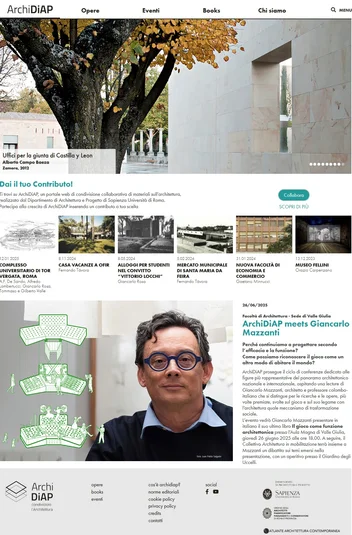
Regarding the role of the portal's visual design, it is important to emphasize that ArchiDiAP is not a site centred on the persuasive power of images, as its intent is to maintain an academic character through its analytical profiles. The current graphic design is the result of a competition we held among all students of Italian architecture schools; the competition was won by Simona Piccato of the Polytechnic University of Turin. The competition prize did not include a cash reward but rather the implementation of the most deserving graphic design. All competition entries were displayed in an exhibition at the Casa dell'Architettura in Rome, the headquarters of the Chamber of architects, which, together with IN/ARCH, contributed to the launch of the platform. The site therefore strives to maintain a simple graphic design, more akin to Wikipedia, seeking to avoid falling into current trends that instead focus on eye-catching and immediate visuals. ArchiDiAP does not prioritize speed, as the platform's time must be that of slow learning tied to the study of the works.
AB: The keyword of the ArchiDiAP portal is "sharing", a term that the Treccani dictionary defines in the context of information technology as referring to the simultaneous access and use of shared resources by different users. In ArchiDiAP, sharing is not merely an IT concept; rather, it intersects with the act of communicating with the community. In an age of constant and immediate persuasion, in which communication has become the antithesis of knowledge (to paraphrase Mario Perniola), must ArchiDiAP become more persuasive in order to survive?
OC: One of the main challenges facing collaborative platforms is ensuring the continuous updating of content and, consequently, the active participation of the community. To maintain consistent engagement, it is certainly necessary to be appealing without diluting the content by showcasing only architectural images. Many portals share only images without addressing the various levels of knowledge and depth of analysis. On ArchiDiAP, all content is equally essential — including floor plans, sections, elevations, text, the relationship between the building and its context, the setting, the architect's personality, and so on. Of course, users can explore the materials at varying levels of depth, but the platform's aim is to ensure a rigorous selection process for everyone through editorial validation of contributions. Finally, there is the matter of how to communicate architecture; ArchiDiAP seeks to address a varied audience (students, professionals, citizens) at different levels, without oversimplifying the content. The issue of communication in architecture is central because communicating means, first and foremost, going beyond the purely technical information of the discipline; for me, this must apply both within and outside the school. I have always sought to highlight the poetic and evocative dimension of architecture, which is the true core of the transmissibility of architectural culture. Passing on the poetic dimension of a project means telling people how a work has been able to move and inspire through its built space. We cannot, therefore, overlook the analysis of the compositional sphere that originates from a distinctive poetic dimension. All of this may seem like a minor aspect, often overshadowed by technology, but this is my vision: the enhancement of architecture's humanistic dimension. This does not mean rejecting technology tout court; on the contrary, I view new technologies with great interest because, when I was young, I had the good fortune to work with motion capture and motion graphics. I have always been fascinated by anything that expands my capabilities. The challenge, therefore, is to exert intellectual control over new technologies so as not to lose any capabilities but, rather, to acquire new ones. Artificial intelligence, for example, must be challenged with the right questions to generate meaningful dialogue. In some cases, this dialogue can become a game — always a conscious one, of course — navigating between irony and harshness, terms I've used as the title of my upcoming book, which emphasizes the humanistic dimension of architecture. In the contemporary context, in fact, our discipline risks being crushed between certain communication slogans such as energy efficiency, sustainability, parametric architecture, and urban regeneration. Slogans cause us to lose sight of the complexity of the architectural work — that is, its poetic, humanistic, and polysemic dimension — whereby things can have meanings other than those conveyed by a single word alone.
AB: Do you think it's necessary to launch a social media campaign to promote ArchiDiAP among younger generations, or do we risk getting caught up in a pointless competition with other architecture portals that are undoubtedly less scholarly? I'm thinking of Divisare, Archiportale, and Archilovers — platforms that share projects without references or bibliographies and function as communication channels of a different nature.
FB: Establishing effective communication through social networks requires diligent and constant work. But ArchiDiAP is essentially based on a working group that changes depending on the academic careers of its individual members. Compared to other portals, ArchiDiAP offers the opportunity to explore works in greater depth through drawings, text, geolocation, site references, and bibliographies from a multimedia and hypertextual perspective. The critical text is essential content for delving into the architectural work, as the writing describes the architect's poetics, the historical period, and may refer to other textual works.
Returning to social media, I believe there are some pages — such as The Beauty of Plan on Instagram — that present floor plans of certain works in an appealing way, but without a scientific basis. ArchiDiAP certainly should not be confused with such content, as it originates within the academic sphere.
AB: In the current educational landscape, characterized by the integration of institutional channels and informal, web-mediated learning methods, a significant question arises: to what extent does academic education continue to be central to the acquisition of design culture? In this context, do digital platforms dedicated to architecture (such as ArchiDiAP) represent a genuine opportunity for the dissemination and sharing of knowledge, or do they risk, due to their visual immediacy, weakening the critical dimension of traditional classroom instruction?
OC: The challenge of making the discipline accessible is of the utmost importance, and as the dean of an architecture school, I strive to give my all to this task. ArchiDiAP is by no means intended to be an alternative to traditional university lectures; rather, it is a tool, a resource that seeks to address the challenges of contemporary architectural communication in terms of accessibility and depth of content. As I have already stated, the challenge is to communicate architecture not merely as a collection of data and images but as a poetic and cognitive experience capable of engaging people emotionally and intellectually, with the aim of sparking in users a desire for deeper understanding. What does it mean to communicate architecture today? It means striking a balance between technique and its evocative power, its poetic complexity. Only in these terms can architecture once again become indispensable in contemporary society.
The transmission of poetic quality certainly cannot occur through the independent study of a student using a platform on their own. Complexity is learned within universities, which are the places of questions, research, study, and experimentation.
AB: Returning to the question posed to Orazio Carpenzano regarding the learning of the discipline, it is possible to say that ArchiDiAP belongs to the realm of self-directed learning outside of school. In this regard, have you had the opportunity to test the platform's effectiveness in student training?
FB: I have only been able to partially verify the effectiveness of ArchiDiAP, specifically when students were involved as authors in drafting some of the analytical profiles. We have certainly received positive feedback from doctoral students and researchers who use the platform as a research tool to explore modern and contemporary architecture in Rome. In this regard, we consistently receive a great deal of appreciation from various institutions, including those abroad, that use the portal as a research resource. Speaking of research, it is important to mention the relationship between ArchiDiAP and certain seminars at the doctoral school, whose insights have been incorporated into the portal. A prime example is the study on Recinti (Leoni, Spirito 2021) published by Quodlibet. Finally, the recent celebration of the portal's tenth anniversary was further proof of the fruitful relationship between the platform and the community of doctoral students, who have become the authors of the architectural profiles for Rome's University City. Thanks to university funding for the "third mission", the buildings on the Sapienza campus have been equipped with QR code plaques that link to the portal's profiles4 and allow for in-depth exploration of the constructed works.
AB: ArchiDiAP functions as a dual educational tool: on the one hand, it is a cultural repository from which students draw knowledge; on the other, it is a participatory editorial workshop that sustains itself through the academic community, which identifies and reworks the materials to be published. When the building profiles are curated by students, the editorial board (composed of researchers, faculty members, and doctoral students) validates the content. Is it possible to extend this participatory workshop to other universities, or must the editorial content originate exclusively from the Department of Architecture Theory and Design?
OC: The idea of expanding the workshop to other universities could be feasible, but it should certainly be limited to the production of the fact sheets, since the editorial team must necessarily remain a single entity to ensure the quality of the content. Opening up to other universities would be very interesting; in general, I believe that engaging in dialogue with other institutions is always productive.
AB: The ArchiDiAP platform is therefore an editorial workshop but also an educational tool capable of extending beyond the web through the creation of events and books. The ArchiDiAP meets events are a valuable opportunity to bring academia closer to the world of critics and professional firms of national and international renown, such as Juan Navarro Baldeweg, Giancarlo Mazzanti, Jean-Luis Cohen, and Vincenzo Latina. Do you think these events bridging the gap between the school and the outside world can be implemented? Why not introduce study trips where students visit design studios or architecture exhibitions, practising what Samonà called "spiritual gymnastics of the imagination" (Samonà 1945, 9)?
FB: On the topic of travel, it's worth mentioning the app we're developing with Open City Roma; the idea is to create an app for self-guided scientific itineraries within the city. As for study trips, I believe the first in the series could be the current Venice Biennale, considering that ArchiDiAP is included in the cultural program of the Italian Pavilion curated by Guendalina Salimei.
AB: What future do you foresee for the platform? Could artificial intelligence help the portal grow, or does ArchiDiAP run the risk of being swallowed up by new tools like ChatGPT? I'm thinking of future freshmen — digital natives — who will seek answers to design problems directly, without going through a process of data analysis (data increasingly sourced from the web and certainly less from journals and books). Isn't there a risk that students will start directly with generative AI rather than with the accumulated body of design knowledge preserved and scientifically catalogued by ArchiDiAP?
OC: I don't believe the platform should compete with the web's artificial intelligence; rather, I believe it should identify key objectives for strengthening its role in relation to the academic community and external stakeholders. We are currently working on ArchiDiAP Plus, an application that integrates with our database for architectural recognition. In the future, I believe ArchiDiAP will continue to develop in line with emerging trends in the cultural heritage and digital architecture sectors, such as those pioneered, for example, by Arthemisia. To enhance content engagement, ArchiDiAP could evolve toward more interactive and personalized systems capable of fully leveraging AI technologies and implementing the interface on mobile devices. In conclusion, on the one hand there is a need for dialogue with new technologies, and on the other, an urgent need to collaborate with research organizations, universities, cultural institutions, and international partners. Undoubtedly, the internationalization of the platform could strengthen ArchiDiAP's role as a meeting point between research, education, culture, and society.
AB: In a recent study conducted as part of a doctoral program at the University of Architecture in Parma, focusing on the phenomena, tools, and prospects of extra-academic knowledge transfer, Riccardo Rapparini reports on a survey administered to architecture students, which reveals that 71% of respondents use websites and online platforms as a source for acquiring information related to architectural design culture5. In light of new IT tools, such as ChatGPT, is it possible to forge an alliance with artificial intelligence for the development of the platform?
FB: The web is a far more pervasive and fascinating universe than the printed pages of a book or magazine. The key is to learn how to navigate this vast sea, that is to develop a critical eye capable of selecting the content to be incorporated when drafting an architectural project. The development of critical judgment is the responsibility of teachers, who must teach students how to see architecture. Regarding artificial intelligence, I believe it is essential to find ways to forge an alliance with this new tool or rather, with this alien form of intellect. I'm not sure if ArchiDiAP, in its current form, can already be integrated with AI; that is strictly a matter of computer science. Artificial intelligence can certainly be used as a disciplinary learning tool, that is as a selective filter based on comparative mechanisms grounded in analogy or imitation, according to a definition by Mario Carpo. In this sense, an extensive archive on very specific themes, such as the one ArchiDiAP can offer, is undoubtedly fundamental for identifying recurring characteristics in certain architectural works. ArchiDiAP will certainly evolve in the future, but without losing its intermediate nature between mass dissemination and scientific communication — the starting essence of its being.
When users type the name of a building or an architect into any search engine, they often end up on the ArchiDiAP website, where they frequently find exactly what they were looking for: a floor plan, a detail, a photo, or the history of an architectural structure. But who is the web user who lands on ArchiDiAP? It is a multifaceted individual who can be identified as a scholar (of any level), a graduate student, a researcher, a professor, or simply a curious, non-expert enthusiast of the discipline. Founded in 2012 within the academic community, ArchiDiAP is an architecture platform born from the collaborative sharing of architectural knowledge (similar to Wikipedia), with the goal of reaching beyond academia to engage the broader online community. As stated on the site:
ArchiDiAP combines the advantages of a huge user base which simultaneously becomes a co-author of the content […], with the quality control […] guaranteed by the Editorial Board […], in order to offer a product […] useful […] for teaching and research […], as well as an effective means of dissemination to a non-specialized public6.
Free from any market logic, the platform is a tool for disseminating architectural culture but at the same time serves as an effective dual-purpose educational resource: on the one hand, the portal functions as a cultural repository from which students draw knowledge, while on the other, it serves as a participatory research laboratory for the Department of Architecture and Design (Sapienza University of Rome). The platform is self-sustaining, in fact, through the academic community (including doctoral students), which compiles the project profiles while earning academic credits toward their degrees and scientific qualifications7.
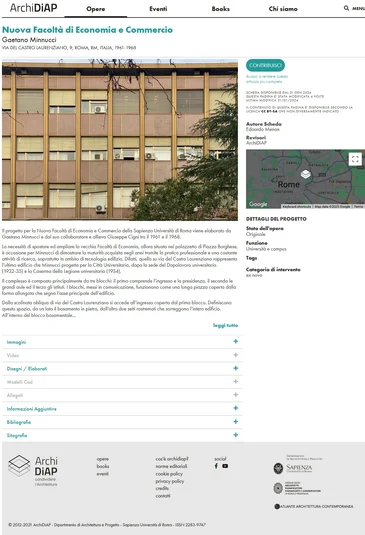
Unlike other Italian platforms such as Divisare, Archiportale, and Archilovers, ArchiDiAP offers a scholarly perspective on architectural works, which are catalogued in profiles and organized by images, text, credits, CAD models, web references, and bibliography. These categories allow users to explore the portal at multiple levels of depth, and visitors to the website can choose to view only the images, simply read the project's chronology, or consult the bibliography to expand their research into other contexts. It is precisely the bibliographic references, the cataloguing method, and, finally, the review of the entries by an editorial team of experts (doctoral candidates, PhDs, researchers, and professors) that make the portal a scientific tool for the dissemination of the discipline. But ArchiDiAP does not belong solely to the online world; ArchiDiAP is an educational platform that extends its virtual dimension into the physical environment by organizing conferences and publishing books.
Thirteen years after the portal's creation and in the midst of a new IT revolution, the interview with Orazio Carpenzano and Fabio Balducci (the founders) reflects on the virtual transmissibility of the discipline of architecture. The concluding remarks on the future of ArchiDiAP bring the fundamental aspect of its nature back to the center of the discussion: being a communication tool for the school beyond the school. According to this premise, artificial intelligence is therefore not a threat but a resource for the portal, whose intellectual domain belongs exclusively to the scientific community.
The sharing and free access to knowledge are therefore the defining characteristics of the platform, which has no intention of succumbing to the persuasive trends of contemporary web design. ArchiDiAP's ultimate goal is to promote and defend the poetic dimension of architecture by communicating its profound essence through thoughtful content that goes beyond the slogans and images of today's media culture. ArchiDiAP's democratic effort to disseminate design culture is a laconic way of communicating knowledge that, as Gramsci states regarding the intellectual's commitment to the formation of society, does not focus on "original discoveries, […] –but insists– critically […] –on– truths already discovered –in order– to socialize them […] and make them the basis of vital actions" (Gramsci 1977, Quad. 11, 1377–1378). In the society of spectacle and distraction, ArchiDiAP stands out as a reliable reference point for design culture, a web channel dedicated to disseminating high-quality works and themes through minimalist, timeless graphics, yet one that invites us to reflect on the form-content relationship in the discipline's current communication.
1 Cfr. L'arte contemporanea: da Cézanne alle ultime tendenze, pp. 16-20. ↩
2 The book cited is Editoriali di Architettura. ↩
3 The Roma 500 Architetture initiative, open to all students of the Faculty of Architecture at Sapienza University of Rome, awarded 1 CFU in exchange for the submission of a descriptive profile of a work selected from the list published on the ArchiDiAP website. ↩
4 See the "Chi Siamo" section on the ArchiDiAP portal website: https://archidiap.com/benvenuto-in-archidiap/ ↩
5 Cfr. "Parte 3 Come agisce l'Esterno oggi. Una indagine sui processi di apprendimento esterni alla scuola". In: Riccardo Rapparini, Per una Scuola fuori dalla scuola. Fenomeni, strumenti e prospettive della trasmissibilità extra-accademica, Doctoral research in "Civil Engineering and Architecture", cycle XXXVI, University of Parma, tutor: Enrico Prandi. ↩
6 See the "Chi Siamo" section on the ArchiDiAP portal website: https://archidiap.com/benvenuto-in-archidiap/ ↩
7 The portal is classified with ISSN 2283-9747. ↩
8 For further information on ArchiDiAP's communication, see also Comunicare l'architettura nel web 2.0, undergraduate thesis by Verdiana Ciampricotti, Faculty of Political Science, Sociology, Communication – Degree programme in Communication Science and Technology, Sapienza University of Rome, supervisor: Giovanni Ciofalo, academic year 2016/2017. ↩
BARILLI R. (1984) – L'arte contemporanea: da Cézanne alle ultime tendenze. Feltrinelli, Milano 2011.
CARPO M. (2018) – "On Cats, Dunces, and the Uncannily Human Talents of Generative AI". A+U, 654 (March 2025): 56-59.
CANELLA G. (1999) – "Intervento". In: E. Bordogna (ed.), Composizione progettazione costruzione. Roma-Bari, Laterza.
CARPENZANO O. (2013) – Idea immagine architettura. Tecniche di invenzione architettonica e composizione, Gangemi, Roma.
CARPENZANO O. (2018) – Qualcosa sull'architettura: figure e pensieri nella composizione. Quodlibet, Macerata.
DEBORD G. (1967) – La società dello spettacolo. Roma, Stampa alternativa.
DE FUSCO R. (1967) – Architettura come mass medium. Note per una semiologia architettonica. Bari, Dedalo.
ECO U. (1974) – Il costume di casa: evidenze e misteri dell'ideologia italiana negli anni sessanta. Bompiani, Milano 2011. ↩
ECO U. (2022) – L'era della comunicazione. Milano, La nave di Teseo.
GRAMSCI A. (1975) – Quaderni dal carcere, ed. V. Gerratana. Torino, Einaudi 1977. ↩
LEONI S., SPIRITO G. (eds.) (2021) – Recinti. Quodlibet, Macerata.
PERNIOLA M. (2004) – Contro la comunicazione. Einaudi, Torino. ↩
RECALCATI M. (2014) – L'ora di lezione. Per un'erotica dell'insegnamento. Torino, Einaudi.
SAMONÀ G. (1947) – "Lo studio dell'architettura". Metron, 15 (March): 7-15.
TAFURI M. (1968) – Teoria e storia dell'architettura. Bari-Roma, Laterza.
ZEVI B. (1983) – Saper vedere l'architettura. Einaudi, Torino.
ZEVI B. (1979) – Editoriali di Architettura. Einaudi, Torino.
Fig. 1 – ArchiDiAP homepage.
Fig. 2 – Record of a work catalogued in ArchiDiAP.