Luigiemanuele Amabile, Marianna Ascolese, Alberto Calderoni
In web design, deep scrolling is an approach where new content is dynamically added to the bottom of the page as the user scrolls down. It is a method of creating social media content that guides the viewer towards virtually infinite new visual materials. The upward thumb movement leads the viewer towards vast expanses of heterogeneous content that is increasingly aligned with the user’s emotional state as they use the platform. The result of algorithms based on increasingly precise data collections, it generates a flood of images that is hard to avoid and that, indeed, architects are increasingly trying to absorb and manage to their own advantage. 1080x1350px is the new shared standard within which the intentions and expressions of architectural design are framed. Web pages proliferate, offering anthologies of Instagram profiles dedicated to architecture students. Here, one can immerse themselves in what appear to be contemporary trends1 alongside guides to self-promotion strategies2, visual identity curatorship and professional networking. In this sense, Instagram is not only configured as a platform to gain visibility and conduct business, but also as an authentic laboratory where a learning process based on imitation and the reiteration of content through communication is experimented with. Over time, this feedback system – more likes and confirmation of the success of the communicative act – determines style orientations and behavioural trends within an extensive disciplinary community. «The interactions of users with architects’ images on Instagram suggests that the architect’s greater preoccupation is with the production and cultivation of audiences, not images» (Denny, 2018).
Instagram is one of the most widely used social networks, and in fact the most prominent one in Europe today. Launched in 2010, it quickly gained popularity, reaching 1 million registered users within two months, 10 million within a year, and 1 billion by June 2018. On average, people aged 18 to 24 (a group that includes many undergraduates and some postgraduates) in the United States spend 533 minutes per day on Instagram. In Italy, the average adult spends about 30 minutes on this platform per day4, but this figure is steadily growing. Instagram’s pervasiveness across a wide range of contexts puts its detractors – those who downplay its impact and effectiveness, confining it to a mere distraction from authentic experience – in an anachronistic position. In a context where the goal seems to be the establishment of figures in the cultural and professional market through the acquisition – or acclaim – of legions of “authentic” followers, does it make sense to oppose this transformation? A priori rejection of this dimension could appear dangerously outdated, especially in an era where online visibility is a prerequisite for authorial recognition, which is becoming increasingly elusive due to the progressive fragmentation of the architect’s role into specialisms, or conversely, due to the hyperproduction and omnipresence of multi-trait figures (Canty, May, Koreitem, 2023): architect, professor, curator, artist, publisher, etc. «Social media platforms like Instagram reconfigure the terms of circulating information. These acts of sharing promote knowledge at the same time that they produce selves vis-à-vis authorship. For the architect, the Instagrammatic production of the author is in fact first a function of producing an audience (and reciprocally, the audience is produced as an effect of sharing information)» (Denny 2018).
At the same time, anxiety about new things can turn an innocent hobby into doomscrolling, a kind of digital hypochondria. «Media hypochondriacs are obsessed with the depressing novelties they constantly uncover, especially through the internet and digital mass media»5. It is hard not to notice how this trend also has consequences in architecture. In this context, information overload and FOMO6 (fear of missing out) lead to the exclusion of those who cannot keep up with the constant flow of online content, creating a divide between those who actively participate in the noisy chatter that fuels the up-to-date architectural world, and those who remain on its margins (Puente, 2024). Those who don’t keep up are left out.
According to Paolo Landi, the issue is that social media platforms such as Instagram, Facebook and Twitter have not brought any significant change to our lives. However, they subliminally manipulate our anthropology and culture, pushing us, for better or worse, to simplify them (Landi 2019). Landi believes that the deeper problem lies in the cultural and anthropological impact of social media as a whole. Instagram does not generate anything truly new. Rather, it amplifies and exploits pre-existing human tendencies and behaviours, often negative, such as social competition, the pursuit of approval and ostentation. The context of architectural education is not immune to these tendencies. These negative attitudes are not only made more visible, but also more accepted and encouraged. In this way, the platform ends up normalising and legitimising dynamics that, in an alternative context, would be considered superficial or morally questionable.
Architecture firms use posts, stories and reels to publicise and disseminate their work, promoting and documenting not only traditional project content, but also the activities, references and narratives evoked by these images. The same applies to design studios and academic workshops, for which Instagram has become one of the primary means of sharing academic activities, such as conferences, lectures and student outputs, both to reach the widest possible audience (including students) and to establish a distinctive visual identity.
Instagram fosters an imitative process that defines modes of information transfer and shapes educational dynamics. Accounts with the most followers set the standard, dictating a prêt-à-porter visual culture that emerges and fades within the span of an academic semester. In practical terms, this leads observers to mimic certain posting styles, such as black-background photos or cropped edge-to-edge images. Overlaid text or neatly framed captions? «Instagramming architecture is not the same as photographing it, carrying not only its own aesthetic and globally conformed standpoints, but an urgency and need for the image to work beyond art object and within an economy of likes, self-promotion, and social currency» (Jennings, 2019).
Over time, this activity has given rise to immaterial archives – yet these are undeniably concrete in the form of digital representations of posters, models, drawings, travel notes and short texts – for the use and, above all, consumption of architecture students worldwide. These archives have effectively become stylistic references, influencing methods of representation and self-promotion both inside and outside academia. While this approach risks oversimplifying key moments of the design process, such as gathering references and representation, by reducing them to a sequence of eye-catching, easily digestible images constrained by the dimensions of a smartphone screen, it also demands critical reflection on the ability to synthesise visual material. Some architects and educators have started to treat Instagram as a form of pedagogical curatorship, carefully selecting images to transform the platform into a tool for disciplined visual discourse.
It is no coincidence that among the most appreciated profiles are those of Swiss architects and educators, or those working in Swiss architecture schools, which have been at the top of international rankings for decades. The cases of Valerio Olgiati (Olgiati_and_ideas, 40,000 followers) and Jonathan Sergison (Studio Sergison, another lecturer at the Accademia di Architettura di Mendrisio, 46,000 followers) stand out as examples of architects who have transformed Instagram scrolling into a veritable manifesto. Two examples that explicitly demonstrate different ways of transmitting design and teaching architecture, clearly outlining educational tendencies found in numerous design ateliers.
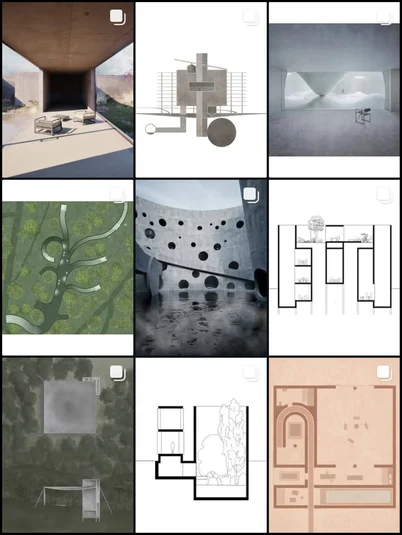
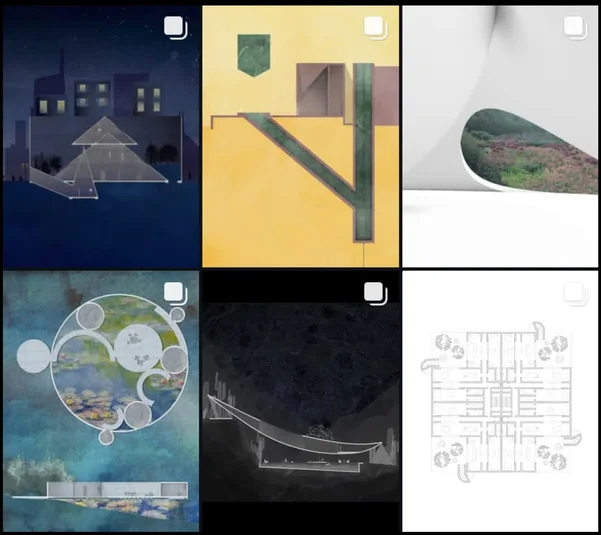
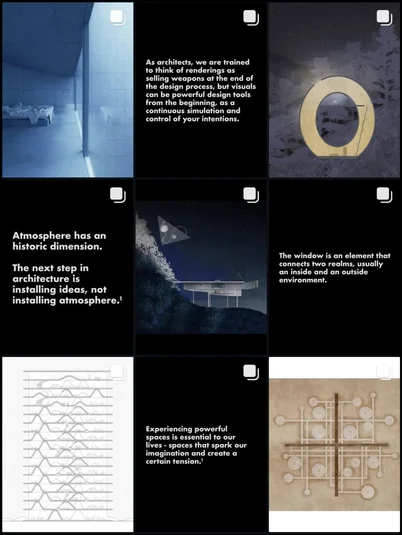
Large, colorful drawings characterized by material textures and tonal nuances alternate with blank white or black pages. On these, a single drawing or a few phrases – almost like dogmas – form the grid of one of the most well-known profiles among architectural design educators. “Olgiati_and_ideas” uses images in an almost archetypal form, evoking a primitive thought process that traces possible interpretations in myths and rituals. The architectural language takes root in a precise way of being in the world, finding its justification in verticality, horizontality, centrality, individuality, and collectivity. Each condition is expressed through a gesture where «architectural forms are a language confined to the union of a few ideograms with an immense branching» (Stokes 2014, p. 75).
These kinds of images seem to leave an indelible mark on the observer and the student, shaping their experience without any conscious reflection (Pallasmaa 2014, p. 163). An easily replicated image often misinterprets – in many cases – the simplicity of the gesture as a compositional oversimplification, highlighting the inability to grasp a deeper, more rooted lesson that can hardly be conveyed through the condensed format of an Instagram grid. This process diminishes that «tendency of images to evoke certain emotions, reactions, and associations» (Pallasmaa 2014, p. 163).
Valerio Olgiati has always placed great importance on image-making as a tool for triggering a different way of thinking about, and practising, architecture. This has clear repercussions for teaching, too. His sequences offer an alternative method of conveying architectural concepts through abstract, metaphysical forms, shifting the focus away from discussions about the form of the various buildings that populate the extensive “Olgiati_and_ideas” portfolio. These dreamlike drawings evoke sensations, atmospheres and perceptions of earth, space, depth and abyss rather than describing materials and structures. Alongside these textured, pastel-like drawings are models – strictly white and photographed against a black background – or drawings with black backgrounds and white lines that heighten the abstraction and evocative power of the depicted spaces. The result is a vast table of ideas comprising sequences of drawn spaces: a visual universe in which architecture appears to transcend reality and serves as a radical meditation on the very notion of imagining space.
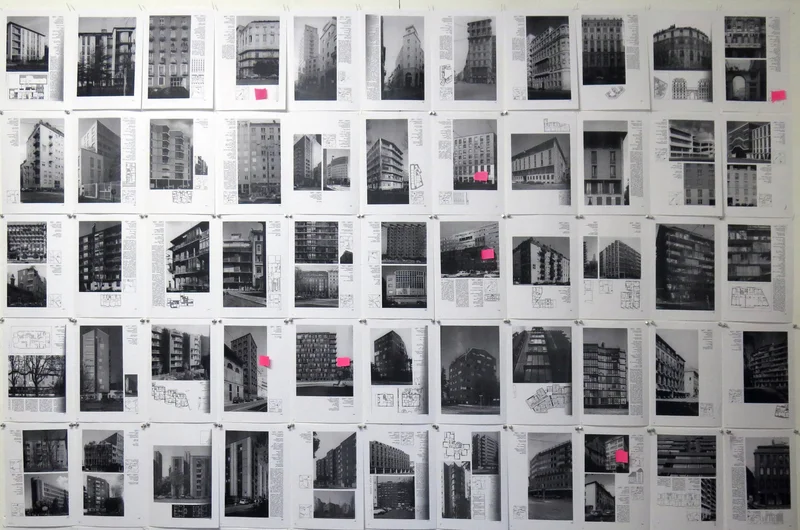
The sequence of architectural drawings and models serves as a narrative device for describing a specific teaching approach – and, before that, a way of observing the world. “Studio Sergison” reveals an almost obsessive desire to interpret architecture, identifying references in the work of the second half of the twentieth-century masters to study, interpret and translate into new forms.
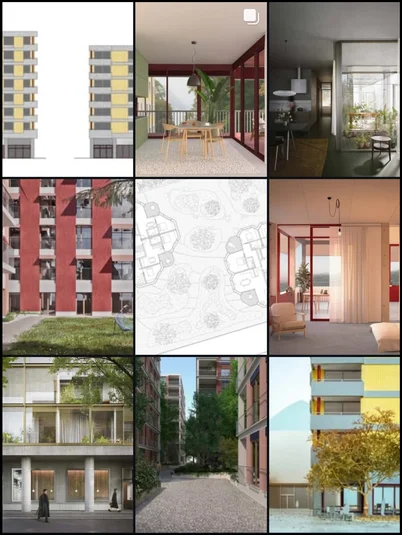
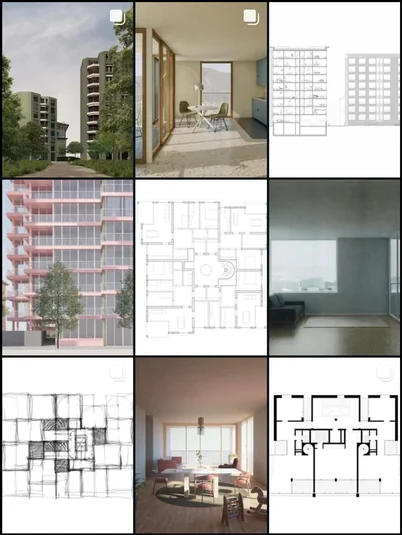
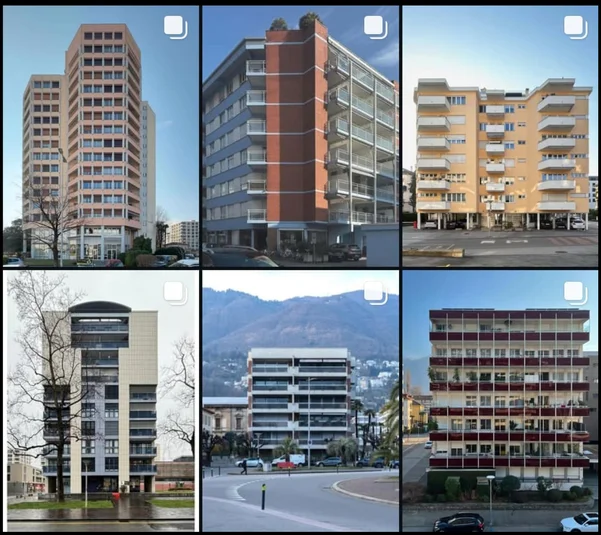
While Valerio Olgiati’s images evoke abstraction, “Studio Sergison” is firmly rooted in reality – an immersive exploration of the urban fabric, carefully tracing the conditions that define true urban architecture. The images alternate between photographs of studied works, models, and drawings, all of which evoke the dense materiality of objects that were first observed and then designed. They strive for the «vividness» of the material world, which can only be grasped by «imitating its persistence» and, crucially, the quality of «being given» (Scarry, 2001, p. 30). This is an architecture of surfaces, layers, materials and textures, tracing detail and particularity to define urban rooms from the inside out (and vice versa), where a profound connection to context is always evident.
This approach to design serves as a valuable reference for educators, particularly those who develop a teaching programme grounded in historical knowledge and the capacity to continually reinterpret it, adding another layer to the city. The residential buildings analysed on various study trips form a shared didactic guide for all students, proposing new interests and inspirations.
The meticulous attention to detail evident in the hatched lines and textures of drawings depicting domestic spaces is also apparent in the models. Some of these models illustrate urban integration, while others are used to create hyperrealistic images of these spaces. The drawings and models of student projects are populated with cardboard, colours, textures and objects, suggesting potential inhabitants who are ready to bring those spaces to life. This Anglo-Saxon tradition focuses equally on researching cities – Basel, Berlin, London, Naples and Zurich, to name a few – and the inherent elements of architecture, such as façades, rooms and thresholds.
The exercises presented on the “Studio Sergison” page outline a teaching methodology for design studios, manifested in programmes and outputs based on observation, translation and interpretation.
When viewing these Instagram pages, a clear tension emerges between the “curatorial” intention and the platform hosting them. Evocative images and post sequences confront the app’s algorithmic feed, which transforms radical content into material for scrolling. As Nicola Zamperini (2018) states, these platforms are «digital meta-nations without physical territory, with citizens, rules, territories, banners, national interests and, consequently, commercial interests as well». On pages dedicated to educational content, these platforms become visual microcosms with their own rules, attracting users who observe and then meticulously reproduce.
In contrast to the verdor terrible (Labatut, 2021) – the cognitive dullness produced by passive social media use, as described by Benjamin Labatut – many students exhibit a paradoxical hyper-selective attention to these profiles. This attitude is rooted in a logic that can be traced back to a form of disciplinary power (Foucault, 1975/2014) that operates within individuals themselves and from which it is becoming increasingly difficult to withdraw. This dynamic is based on the idea that the process of acceleration – of materials, times and spaces – that defines our current situation is linked to a kind of alienation of thought (Rosa, 2021). This translates into a weakening of the process of recognition, which is continuously stimulated by impressions that persist over time, as well as by a flux of shifting images that accumulate and demand attention (Simmel, 1903).
«Usually, the image is conceived in purely visual and stable terms, but the characteristic quality of the senses is their tendency to mix and integrate. A visual image is always accompanied by repercussions marked by experiences in other sensory modalities. Images also exist in the realms of all the senses. The visual image itself is a constructed fusion of fragmented and discontinuous percepts» (Pallasmaa, 2014, p. 63).
The carefully crafted images and meticulous consistency of the photographic sequence create an automatic authority for these visuals. Students obsessively view them until they have studied, replicated and internalised them. Students look, save and repeat these images in order to develop their own approach to design representation. Instagram profiles become the realm of the «proper image», standardising and homogenising approaches to practising and teaching architectural design through the aesthetics of reproduction. This mimetic process, which pushes towards visual reproducibility, endangers the experimental nature of architectural creation and education. Tools intended to support design risk becoming mere «posts», reducing critical space and design exploration. Ultimately, Instagram is not just a repository of images, but an active agent in redefining design education and learning, namely how references are defined and used to stimulate imagination. These digital archives, far from the naive curiosity that characterised social media’s early days, have become as politically oriented and influential as traditional media. They are shaped by likes, shares and comments – only what survives endless scrolling exists and gains value.
Historically, architectural design teaching conducted by architect-professors, particularly those engaged in professional practice, has produced results that transcend academic boundaries and become living matter for the discipline and its theoretical reflection. The materials generated in design studios often formed the basis for publications, exhibitions and writings. The dissemination of these outcomes through books, journals, catalogues and conferences was never secondary, but rather an integral part of establishing a disciplinary position. Architect-professors did not merely “display” results; through filters of selection, narrative and critical reflection, they defined a design vision and cultural stance.
However, the advent of social networks has profoundly altered this scenario, introducing noticeable friction between past and contemporary modes of producing and consuming architectural imagery. The crux of the matter lies, quite evidently, in time. This was once expansive and multi-layered: a time for idea maturation, critical editing, editorial curation and careful reading. Today, the temporality of communication, especially that arising from teaching activities, is compressed, fragmented and accelerated.
In the digital ecosystem of social networks, images have acquired an unprecedented level of importance. In order to be effective, images must be immediate, concise and emotionally impactful. The communicative power of the image is no longer enhanced or enriched by discursive apparatus; rather, it tends to replace it. Textual narration and theoretical depth are being replaced by the logic of visual instantaneity: the quality – or at least the recognisability – of a project is increasingly measured by its ability to become a memorable “emblem” within a few seconds of scrolling. Consequently, what was once the product of collective and patient elaboration has become an object of rapid and ephemeral consumption, often lacking context.
This transformation concerns not only communication formats, but also affects the very nature of architectural theory and its teaching more profoundly. If theory – particularly that implicit in teaching practices – constitutes progressive construction, critical articulation and conceptual experimentation, then iconic immediacy risks rendering it meaningless, reducing it to mere style or a recognisable sign. The image, rather than being a vector of thought, often becomes an end in itself.
We must question the extent to which theoretical reflection is still possible in design pedagogy today. How can we reconcile the potential of digital communication with the need for critical depth to be renewed? How can we re-establish a relationship of resonance between pedagogical practices and the processes of externalisation that characterise everyday experience? Rather than demonising fast images, we must reformulate the conditions under which they might once again articulate an intellectual position rather than merely functioning as communication strategies.
1 See, for example, the webpage https://thearchitectsdiary.com/7-tips-for-architects-to-promote-their-work-on-instagram/ which compiles seven tips for architects to promote their work on Instagram, including «create a business profile» or «use visual content to your advantage». ↩
2 The page https://www.archdaily.com/900778/50-instagram-feeds-for-architecture-students-and-everybody-else contains, for instance, feeds to follow for architecture students. ↩
3 See the web page https://www.emarketer.com/chart/263759/average-time-spent-per-day-by-us-adult-users-on-select-social-media-platforms-2023-minutes. ↩
4 See the web page https://wearesocial.com/it/blog/2025/02/digital-2025-i-dati-italiani/. ↩
5 See the web page https://www.treccani.it/magazine/atlante/societa/Doomscrolling.html. ↩
6 See the web page https://www.treccani.it/vocabolario/fomo_(Neologismi)/. ↩
Canty S., May J., Koreitem Z. (eds.) (2023) – Harvard Design Magazine. Multihyphenate, 51 (F/W).
Denny P. (2018) – “Instagram Ergo Sum”. PLAT, 9 (sharing), 221-224.
Foucault M. [1975] (2014) – in Foucault M., Discipline and Punish, Einaudi, Torino.
Jennings W. (2019) – “Anti-Instagram architecture”. Dezeen, [online] Available at: https://www.dezeen.com/2019/09/05/anti-instagram-architecture-will-jennings/ [Last accessed: 10 June 2025].
Labatut B. (2021) – When We Cease to Understand the World. Adelphi, Milano.
Landi P. (2019) – Instagram al tramonto. La nave di Teseo, Milano.
Pallasmaa J. (2014) – The Embodied Image. Safarà, Pordenone.
Puente M. (2024) – Chachara e altre storie d’architettura. Thymos Books, Napoli.
Rosa H. (2021) – in Rosa H., Alienation and Acceleration: Towards a Critical Theory of Late-Modern Temporality, Einaudi, Torino.
Scarry E. (2001) – “On Solidity”. In: Id., Dreaming by the Book. Princeton University Press, Princeton (New Jersey).
Simmel G. [1903] (1995) – in Simmel G., La metropoli e la vita dello spirito, ed. Jedlowski P., Armando Editore, Roma.
Stokes A. (2014) – In: Pallasmaa J., The Embodied Image. Safarà, Pordenone.
Zamperini N. (2018) – Manuale di disobbedienza digitale. Castelvecchi, Roma.
Fig. 1 – Olgiati_and_ideas. Screenshot of the Instagram page content, June 2025. © Atelier first year Olgiati, Academy of Architecture of Mendrisio, Università della Svizzera italiana.
Fig. 2 – Olgiati_and_ideas. Screenshot of the Instagram page content, June 2025. © Atelier first year Olgiati, Academy of Architecture of Mendrisio, Università della Svizzera italiana.
Fig. 3 – Olgiati_and_ideas. Screenshot of the Instagram page content, June 2025. © Atelier first year Olgiati, Academy of Architecture of Mendrisio, Università della Svizzera italiana.
Fig. 4 – Studio Sergison. Screenshot of the Instagram page content, June 2025. © Atelier Sergison, Academy of Architecture of Mendrisio, Università della Svizzera italiana.
Fig. 5 – Studio Sergison. Screenshot of the Instagram page content, June 2025. © Atelier Sergison, Academy of Architecture of Mendrisio, Università della Svizzera italiana.
Fig. 6 – Studio Sergison. Screenshot of the Instagram page content, June 2025. © Atelier Sergison, Academy of Architecture of Mendrisio, Università della Svizzera italiana.
Fig. 7 – Studio Sergison, Academy of Architecture of Mendrisio, Università della Svizzera italiana, Spring Semester 2015 Milan Facades, pp. 4-5. © Atelier Sergison, Academy of Architecture of Mendrisio, Università della Svizzera italiana.