Carlo Quintelli
With the aim of investigating the training opportunities for architects outside the university today, the editor of this issue of FAM thought it useful to re-propose this introductory essay of mine to the catalogue of the first Festival of Architecture, an international event held in Italy from 2004 to 2012, in Parma a few years ago home to a new Faculty of Architecture and later in a polycentric key also in Reggio and Modena. The editorial choice is justified because even that festival, over twenty years ago in the first Italian season of cultural festivals, set itself the goal of promoting in-formative dissemination, but I would say first of all the perceptibility of a phenomenon, the architectural and urban one, which in Italy, despite everything, remained either within an academic debate or in the contingency of the news, both of a worldly nature with the mythologization of the architect artist and linked to catastrophic and in particular seismic events. A text that, reread today, already seems to me to be quite aware of the syndromes of an architecture marked by the break with the recent Italian tradition, the one that, if we understand it from the mid-twentieth century, has actually operated a continuous reinvention of tradition, in a climate where the laboratory of ideas was very differentiated but united by a common sense of critical role and intellectual honesty with respect to decisive issues for the city, from that of the home to that of public space in the reciprocity of the relationship between architecture and the city. The operation of the Festival, however, was not to detach itself from the university to look outside it for an alternative environment, rather it was an attempt to bring out of the university the contents of scientific research to put them in reaction with an architectural and urban phenomenology that we liked to grasp in its heterodoxy together with complementary arts and knowledge. But above all, the reflections of the time sought to establish possible alternatives to the emerging drifts of an architecture conditioned by the needs of communication aimed at commercial and consumerist success from which a narcissistic model of architect derived. At the same time, the weakness of the cultural line of the public structures responsible for authentic promotion was noted, first of all on the critical level of architectural culture, the Biennale and Triennale above all, and therefore there was a need to create alternative spaces and tools supported from the bottom up of contexts, Italian and European but not only, fed by many scientific resources from time to time stimulated to make the festival its own stage of visibility and testing. Today the inflation of the many small festivals, to be clear those promoted by the MiC since 2019, seems to be following different paths, prevailing slogans, lines of consensus and distribution of resources with who knows what legacy. Many tools of architectural and urban composition, those that are nourished through research, have largely returned to the university. This does not mean that, we hope one day, such research may find new means to escape again thus providing, extra moenia, increasingly diversified and authentic training opportunities.
I had to hide my perplexity in front of Roberto Gabetti who, answering a question about how architecture was perceived today by public opinion, claimed to be positively surprised by how much people talked about it, and how architecture was much more present than it used to be in newspapers and the media in general. Considering the disenchantment of which Gabetti was capable in judging the things of architecture, and I believe in general of the world, I could not help but doubt at that point my excessive ideological zeal, to the point of prejudice, towards how the contemporary media mistreated the complexity and values of architecture. After a short time, after about seven years, I must also admit that that ideological prejudice (I prudently still prefer to consider it this way) is progressively reconstituting itself because in this very short period of time the intertwining between architecture and communication has been further accentuated, for how communication tools speak of architecture but also for how architecture takes on a prevalent communicative character. It seems appropriate to reconsider Gabetti's optimism with respect to a specific historical phase and to a perception perhaps still linked to the conditions of debate and dissemination of architecture prior to the eighties. Not that of dedicated magazines, of course, but that of the generalist media which, since the post-war period, have only rarely dealt with architecture, unlike what magazines, newspapers and televisions do today, even indirectly, with the naturalness through which issues of customs and society such as fashion, rather than mass phenomena, have always been addressed. Because a sensibility that grew up between the seventies and eighties, like that of my generation, cannot escape a now significant rate of falsification which, so to speak, pollutes the media diffusion of architecture without which, on the other hand, any effective dissemination of the same is useless. But if we agree with Mario Perniola that communication is the opposite of knowledge since its efficiency is proportional to the simplification of the ideas it must transmit, the question of a virtuous relationship remains open where communication remains an instrumental means of widespread and not only elitist knowledge. The problem of how much is talked about compared to how it is talked about, and of the balance that should be sought to guarantee cognitive as well as informative purposes, cannot therefore fail to involve the issues of architecture as well. On the other hand, the two aspects are closely linked with respect to the effectiveness of the action because to make beautiful architecture, as Aymonino would say, it is necessary, but not sufficient, a good criticism (ours is extraordinary, from Zevi to Tafuri to De Fusco to Ciucci to Dal Co to Olmo to many other younger historians who deal with contemporary art, not to mention the critical substitution provided by many Italian designers (from Pagano to Rogers to Gregotti just to mention the Casabella supply chain). It is also necessary to know how to tell it, to make it understood and assimilated, to make it an indispensable companion of the design operation, of its interpretative and expressive tools, as well as of the intention (and action) of the client, the one who is in any case father or mother, however you want it, of any architectural construction. On the other hand, it is evident that the peculiarity of the Italian case remains that of an elitist educational action, linked to circles and rituals substantially separated from the main social phenomena that at most are received on the level of an inescapable complexity, and also, from some points of view, voyeuristically enhanced. Compared, for example, to what was the case in the Anglo-Saxon context, where the popularizing action of extraordinary historians such as Summerson and Pevser (as Michela Rosso reminds us well in The Useful Story) arrived in every home, through the BBC airwaves, as early as the thirties. A delay, the Italian one, that we find all the more so today given that mass journalism, bypassing (it seems obvious to me) the most qualified critical baggage, manages to grasp wide swathes of interest, demonstrating that it is still creating a new market of architecture but above all new strategies of consensus. From the vast and multifaceted media world that belongs to us, an extraordinary variety of architectural themes emerges, declined not only on design and furniture, which have always been the most communicated, but also, if not above all, on the city, its buildings, and the search for a fashionable identity that follows. If even the non-city (Tokyo) of Sofia Coppola's Lost in translation manages to be the real protagonist of the reverse shot of the identity bewilderment of a humanity that returns to cling to feelings, if the weekly inserts of the newspapers tell the condition of a Dutch neighborhood, of the last museum in London or Switzerland, as well as of course the house of the writer or scientist positioned on the waterfront or obtained in the redeveloped favela, one cannot fail to draw an interesting consideration from it. Evidently, in this approach, everything tends to mix, and communication demands more and more icons, articulated concepts, material whose visibility/variety/intelligibility ensures the effectiveness of reception. This is how an uncontrolled flow is created within which feng shui, green building, the eco-monster, the Prada store also fall seamlessly and where the famous architect has no choice but to recite watchwords, for example mystifying praise of lightness or architecture without right angles. Apparently much ado about nothing, but which in reality produces the result of the sole recognition of a sign, an icon, and even more of a brand (instrumentally shared between architect and client), and therefore of the products connected to it. Architecture enters the grinder of mass communication, becoming an object of consensus and the consequent production of value.
How can we introduce into this condition components capable of filtering, ordering, distinguishing the architectural heterogeneous and at the same time making effective the potential of cognitive and informative communication? Certainly trying to get out of the conformism of aesthetic-simulacral techniques, of an architectural symbolism all aimed at the self-referentiality of one's own consumption, but perhaps it is not enough. In spite of ourselves, the comparison must still be supported with that mass taste which, as Guido Canella often observes, is increasingly conformed to television models, to their stereotyping, and we should add, to the consequent a-historical and de-contextualized dimension of the perception of the city's becoming. The obvious resistance to this condition is the intellectually elitist one, on the other hand increasingly irrelevant on the level of the becoming of phenomena. And that of even the best architecture magazines today appears as such. For over twenty years, and certainly since the Casabella of the Seventies, the in-formative action of magazines, with reference to specialized ones, has been declining. The architect referent, unable to assume a real cultural and professional leadership in the processes of transformation of the city, often finding himself in unrelevant decision-making positions, deprived of role and skills, no longer recognizes in these tools a formative contribution but also a support with respect to his cultural and professional legitimacy. The critical and non-fiction publishing landscape has also diminished its degree of influence. On the one hand for the bulimia that also distinguishes the architecture publishing sector, on the other for its bending to promotional strategies which, although understandable in terms of survival, in fact diminish its authority. Where then, moreover, it is now taken for granted how necessary but not enough a good book is to make a successful architect.
Between the tendential crisis of traditional public tools through which the comparison and affirmation of the values of architecture was once determined and the potential of generalist media, capable of determining the trends of mass taste, another component appears on the field of communication competition. That of events, certainly not new for architecture that we could consider in fact an event in itself, but today more than ever capable of entering into a logic instrumental to promotional strategies. The historical phenomenon of the universal exhibition, not surprisingly successfully resurrected today as in the striking case of Barcelona now reduced to an expo-city, makes use first of all of the representative architectural identity of the individual participating entity, at the beginning a nation even before being a state but now also a company, lobby and more, where the instrument of the pavilion, autonomous architecture, objectified, therefore capable of strong representative emanation and iconic symbolism, remains in fact the typology of reference for a city created through event-architecture. Even if the architecture-event of the pavilion, used on a pretext in building cities, is often reduced to a media and functional flop, from semantic scrapping in record time, as in the case of the Millennium Dome.
The idea of an event is further articulated: the great competition, capable of highlighting the potential of a theme even before the solutions we will adopt to address it; the opening of a school, as a moment of subjects and expressions capable of evoking, even before producing, the need for a direction, a cultural challenge; or even the great exhibition, from the deep historical to the contemporary, in which it will be possible to highlight the project of a reading, of a vision of things, and therefore of the future of the same. But, more and more often, the types of events listed here, for times and methods obviously different corresponding to their nature, denounce the fatigue of obvious proposals and also of contents that no longer correspond to the expectations of the event itself. Even the occasion of the great exhibition demonstrates the emptiness of this tool at a time when the meaning of the choices is not clear, the interpretation of a project that often no longer causes discussion because it does not pose any thesis to be discussed. The school, in other ways, can be perceived in the key of the event if its identity comes out of it and above all with respect to what, in a given relational context, it will be able to propose in terms of design culture, tools for change, involvement. Certainly not from the tourist-educational perspective of the study stay, of the façade excellence where prestigious signatures now conditioned by the banality of the repertoire of which they themselves are victims can pass. Even the competitions seem to veer more and more towards the level of the clash between big names, complete with a background of intrigue and the game of alliances, between personalities mainly capable of throwing on the plate of the proposal more the prestige of media fame than that of the substance of a detailed design interpretation, beyond a refined representative spectacularization, iconically seductive with respect to the eye of juries whose circuit correspondence with the designers themselves we detect, between relationships and symbolic areas of a sort of architectural serial. The rate of virtuality grows in terms inversely proportional to that of the concreteness of the problems from which the need to hold an event starts and in general the objective is grasped exclusively on the level of notoriety, of what is worth only as a recognizable icon.
But perhaps the most relevant phenomenon of a distorting instrumentality of the concept of event probably lies in the semantic synthesis between architectural work, author and context. This aspect is certainly inherent in the very idea of architecture as an event, if not even as an advent and perhaps an apparition, as Franco Purini told us in a now distant seminar in Parma (La Città del Teatro, 1987), but which today takes on the instrumental radicality, technically evolved as well as rationally piloted, of a marketing strategy whose target is certainly not made up of those who live and appropriate that architecture in that particular context, but rather of that abstract and generalized human referent, easily adopted in the era of globalization, which through that constructive, expressive, functional event should derive a generic and strong identifying denotation of modernity, rebirth, progress, etc., etc. The constitutive processuality of the architectural hyper-event, of which, in the post-ideological modernity of architecture, the contemporary archetype is realized with the Guggenheim in Bilbao, defines an obligatory cause-effect sequence that sees in the internationally renowned author the first communicative value, in architecture, obviously sensational in its spectacularity, the second value that becomes an immediate icon, in and of itself, and above all in a reproduced key, finally, at the third stage comes the context which, reverberated by author and authorial icon, identifies itself as a container of the event itself, transitively assuming the datum of visibility, attraction, consensus. Unlike archetypes from this point of view prehistoric such as the Beaubourg, the Bilbao variant is therefore innovative in that the sensational work, as much as it is extraneous to the story of the context, is associated with the author's signature factor and the identity factor of the context. The media energy of the Beaubourg was reduced to the fact of technological aestheticization, the seventies inertia of the nineteenth-century myth of the machine, beyond the rather unknown authors and the city, Paris, absolutely capable, due to the characteristics of its formation as a capital city, of making use of epiphenomena of architecture-spectacle. In Bilbao, on the other hand, the authoritative, as well as semantically solitary, action of the architectural work is recognizable as an iconic-authorial emblem, a fetish image of the designer's notoriety on which the character of the city is flattened, to the point that Bilbao itself is today, in widespread perception, the city of Gehry's Guggenheim. Returning to the effects of what we call an architectural hyper-event, the result is a capacity for transmission open to the general sensibility, not only of architects but also of users, towards any stardom, as well as in cinema or music of course, but also in figurative art, literature and now in architecture. Public and private clients, both of the large company that influences the destiny of entire parts of the city and of course of the city itself and of the territories, understood as configured administrative subjects, are subject to a strong role conditioning by this state of affairs, now increasingly involved in relaunching the degree of exceptionality and therefore of media renown of an architecture that alone seems capable of restoring identity, it doesn't matter if virtual, in any case identity, to be used, exchanged, in essence to be sold on the market of recognizability. This trend concerns large but now also medium-small cities which, faced with the crisis of a transformation incapable of grasping the links of continuity within which to graft a peculiar innovation, limit themselves, simplistically, to the search for the event that returns an image that is presumptively modern as well as provincial until the caricatured outcome.
In the changed international context of the production of events that have architecture as a protagonist, the role of those public cultural institutions that are responsible for a careful knowledge of the becoming of architectural phenomena, of their being part of the more general processes of anthropic transformation, of the influence that they determine from the point of view of aesthetic as well as behavioral, social and collective culture, is extremely important. The Italian case is particularly privileged, from this point of view, as it makes use of an institution with a great cultural tradition, the Biennale, which since 1975 has been able to express its own autonomous section dedicated to architecture, whose scope, from a critical point of view, cultural orientations and visibility, is able to produce an extraordinary popular value. On the other hand, it is evident that we have to note how this tool of great potential, on the cognitive as well as demonstrative level, fails to correspond to an alternative of attention and critical work capable of escaping from that promotional manifold of architecture in which we are immersed. In particular, the last three editions of the Biennale seem to radicalize this trend. Starting from the edition edited by Massimiliano Fuksas where, to the semantic misunderstanding of the moralistic approach already present in the title, Less Aesthetics, More Ethics, in which components are contrasted that in reality the history of architecture shows us in innate reciprocity, is added the contradiction of the contents never as in that edition subject to an aestheticization of the virtual representation of architecture, to its self-referential abstraction up to the ontological paradox of the dematerialization of architecture through the proliferation of digital-video-illusions of a virtual bewilderment. Certainly closer to the concreteness of the project, Deyan Sudjic's edition, however, fell back on the formula of the updated catalog (Next) of an exhibition-fair, within which the representatives of those who work in the field of major interventions were able to come to the attention of a qualified public. The pragmatic reaction to the baroque ambitions of the previous edition has therefore ended up sterilizing any contribution of architecture that was not in the sphere of technologically striking construction and efficient production from which only the need for a high rate of professionalism of the project seems to emerge. To confirm the trend briefly outlined here, the very title of this latest edition, edited by Kurt Forster, Methamorph (why not metamorphosis, perhaps more stimulating in literature, also for the rest of the world?) and the related results, make us think of a precise desire not to choose, not to thematize, to leave everything in the mystique of the flow of change, not to pose interpretative keys and knowledge of the concrete problems that architecture faces, hidden by the glittering clamor of an international representation that, without a given theme to interpret, is reduced to representing yet another Tower of Babel.
In this amusing panorama, as seductive as it is now often useless and redundant, certainly not entirely random with respect to precise strategies of dissimulation and distraction from the most central questions to which architecture would be called, the very relationship between arts and architecture becomes matter for a shift in interpretative planes, for a mixture where the relationship comes to operate through epidermal trespasses, gratuitous analogisms, role-playing games in which the parts exchange without adapting the tools and the meaning of their use. Is this not perhaps the moment in which the relationship between art and architecture, understood in particular the plastic, figurative and image ones, unlike the heroic phases of modernity, is no longer built on a reciprocity based on differences in role, techniques, interpretative and expressive statutes where the architect returns matter to the artist and this in turn provides further material to the architect? We are witnessing the absolute involvement, in reality not combinatorial, without any elective affinity, between arts and architecture which, it must be agreed with Gregotti, does not mutually benefit because it is not assumed in a process of confrontation but in the ambition of the substitution, exchange-like game, and therefore of weakening of the respective roles. Not only in the theoretical-demonstrative cuisine of schools, exhibitions, debate, but also in that of the assignments to which correspond precise thematic expectations (whether for the square, for the park or for the subway station assumed as a work of art to which the predestined artist awaits, we could say, from the canvas to the city). In the same way, the fashion architect will pursue the identity of artistic denotation to which consensus is sensitive, and the market of commissions, giving proof of visionary to the point of the puerile dimension of an architecture understood as a shapeless cloud, perhaps precisely where there is a city of marble, of geometric foundation, of volumetric plastic concreteness. Starting from here, perhaps, we can also imagine the inevitable decline of a Biennale at this point justified in cutting the corporate branch of architecture to bring it back to the core business of art of which the potential audience is certainly larger (in terms of audience and visitors).
Also with respect to its belonging to the Milanese context, the Triennale itself, emblematic of the institutional role played by a foundation in which public and private components are intertwined, of industrial culture in the first place, also finds evident difficulties in proposing events capable of operating a strategy of critical in-depth analysis, precisely starting from the settlement and production culture of such an important context. This is a critical-propositional vocation that, without evoking the seasons of Persico or Bottoni in the post-war period, up to the poetic tendencies of Rossi and the search for identifying structures of Canella, between architecture and the city, in the seventies, today we can no longer find in any other form in the intermittent vastness of events, reviews and counter-events, a real great emporium of opportunities, although qualified, whose direction is evidently increasingly identifying itself in the Triennale marketing logo that opens the informative news-letter sent to all of us.
From this extraordinary organizational effervescence, of continuous production (and reproduction) of events, but above all of the great development of communication strategies, promotion, induction of the taste and values of architecture and the identity of architects, in the context of an international limelight of increasingly high sensitivity and low cognition, arises the need for a place where we can reflect and restart the reasoning on the role and meaning of architecture, through those who design, build and enjoy it. Thus was born the first Italian Architecture Festival. Which will try to move, as indicated by the metaphorical sailing ship that accompanies the logo of the initiative, towards archipelagos and unexplored depths, touching secondary ports and embarking crews of different origins, looking for the route between new geographies. It is therefore not a question of a revival aimed at competing, in order to overcome it, the great clamor of contemporary architecture, through forms of neo-neo-neo-avant-garde, an attempt that is impossible without the exclusive weapons of the invincible army of communication. On the contrary, it is a matter of dealing with otherness that perhaps has little to do with mediatized architecture but has a lot of meaning and will still mean for the city and the architecture we live in, which we can discover as an integral part of our culture and identity, of which we build peculiarities of values and desiring visions. A hetero-architecture, hence the title of this first edition, which certainly does not want to contribute to the confusion of identities, to the exchange of roles, to the involuntary hybridization of interpretative and operational statutes, but certainly wants to bring true material back to the scrutiny of the critical, cognitive, expressive process that architecture, the best architecture, must demand also with respect to the responsibilities it assumes. A multiplicity of factors and protagonists that shuns simplification, schematisms, aesthetic ideologies prêt-à-porter and where the geographical and cultural places of architecture are at the center of attention as they are inextricably connected to it. The heteroarchitecture of the Festival is the field of problems and characters that come into contact with the knowledge of architecture, influence its statutory evolution and in turn change with respect to the answers that architecture can give. Powerful, decisive answers that affect the sphere of spaces, uses, behaviors, symbols. Architecture understood in the broad sense of the phenomena that determine the shape of places, cities, the environment, and man-made space in general. Through a new way of addressing, discussing and above all making people think of architecture as something that involves us in every moment of our existence and through issues close to us. Gardella said: one is born and dies in architecture.
The Festival immediately posed the fundamental question of how architecture cannot but be hetero-architecture, that is to say a system open to interpretation and exchange with the world because it must build the world's house, the place, the city. And it begins to do so, in this first edition, starting from the relationship with the other arts, the other expressions, including music (contemporary music – Martino Traversa also through Bendini's painting), sculpture (Arnaldo Pomodoro), photography (Paolo Rosselli, Paola De Pietri), fashion (through the experimental experience of Nanni Strada), cinema (review on Kubrick and Bertolucci), literature (where Lucarelli, Barbolini, Biondillo, Varesi discuss the role of the city in the contemporary novel).
To support this broad involvement, the Festival also wants to encourage the continuous collaboration of publishing that talks about art, architecture, cities and their history. There can be no laboratory of knowledge and of the reproduction and dissemination of the same without the support of a publishing capable of doing so. On this role and on the planning of publishing houses, the series of meetings planned should help to outline new scenarios and trends capable of renewing their role.
The Festival is first and foremost exploration. But, certainly, exploratory action needs a direction, orientation tools. In the variety of heteroarchitecture, visual or instrumental navigation is adopted, depending on the case, aware, however, that the orthodoxy of heterodoxy can only be sustained within a complexity of knowledge where that of architecture, of architectural composition in particular, takes charge of the synthesis that will make the choices on the ways and characteristics of the transformation carried out through architecture itself. That compositional direction that, metaphorically, alluding to the cinematographic one, Aldo Rossi reminded us to be the first essence of the role of the architect. But which is then essentially interpretative direction, the ability to deploy the logical-poetic range through the open direction of knowledge, intuition, identity in the making rather than modeling conventions, which can only be easily consumed. This intent immediately translates into a procedural logic where, first of all, the principle of exclusion and zeroing of cultural memory is banished, strategically used to create the artificiality of value around a few selected fetish events-architectures-architects. On the contrary, the aim is to develop an action of revival of what has remained outside the media-promotional circus, and which has nevertheless contributed to the advancement of architecture in the recent past. Hence the retrospective attention of the Festival, abandoning the ambitions of the futuristic as well as the consolatory certainties of the remote past, is first of all aimed at the recent past, already in itself disadvantaged by not yet being under the scrutiny of historical criticism and at the same time sufficiently as apparently extraneous to the present to no longer have a grip on the work of contemporary journalism and the general attention that follows. From the recent tradition, starting with the Italian and European one, there is also a tendency to recover themes, personalities, phenomena incapable of emerging in the speculative context of events, sometimes forgotten or, very often, compared to the younger generations, never known. Having as a reference the background of the generation of masters directly involved in the search for an Italian peculiarity in comparison with the Modern Movement, from Rogers to Samonà, from Quaroni to Muratori, from Gardella to Ridolfi and others, we wanted to propose some significant traits of architects born at the turn of the thirties, of which we continue to recognize the merit of a consistent theoretical contribution to interpretation and systematization of tools of analysis and proposition, from which an original and multifaceted poetic expression will also arise. We refer to Carlo Aymonino, Guido Canella, Aimaro Isola, Roberto Gabetti, Aldo Rossi, Luciano Semerani, Giorgio Grassi, and others including Costantino Dardi as well as, albeit through different research coordinates, Alessandro Anselmi. This is a restitutive action that will continue in the next editions of the Festival, with different roles and stories, in terms of personalities, contexts and generations. Obviously, it is not a question of inventing a trendy signboard, much less a generational one, but rather of underlining the importance of recent architectural research that starts from the shape and characteristics of the Italian and European city, from the relationship with a historical narrative of urban and territorial development where innovation is always dialectically intertwined with the consolidated denotative of tradition, thus becoming itself a new tradition. In this intent, the construction of identities, multifaceted, for different interpretative and expressive paths as on the other hand requires a scientific approach that is not modeling, but still manages to keep the parts together. Architectural action, even in its autonomy and full responsibility, is aware that it always affects the part of a whole, called, depending on the case, city, territory, landscape, society.
The involvement in the Festival of an architect like Gottfried Böhm, interpreter of a continuity of modernity combined with the Gothic-expressionist tradition of construction of the northern European city, one of the most deserved Pritzker Prizes, serves on the other hand to demonstrate how this can be a path of research that can be reflected in Europe as well as in Italy. The Festival will once again invest in this direction, for conditions of settlement history and cultural complementarity, where, also through the cognitive, expressive and constructive action of architecture, the contexts of the individual countries have an effective possibility of relationship and enrichment that can only arise in the maintenance and increase of those diversities that, as in the right vision of the geopolitical archipelago of Cacciari, seem to be the only ones capable of keeping alive an idea of Europe as an aggregate economic-political-cultural and settlement system only because it is physiologically open and composite. This is to try to look for alternatives, with reference to Severino's concerns about a phenomenology of contemporary architecture as a symptom of a more general aesthetic and therefore socio-cultural degradation, with respect to the limit of an anti-humanistic, self-referential, decontextualized technicality that increasingly homogenizes, eliminating the heritage of its characters, the territories of architecture. The Festival carries out this action of recovery of cultural traditions to be summarized for the attention of the contemporary debate also through reference to the specificity of the modern Italian movement. Starting with Terragni, whose promotional means of the celebratory events underway in Como, as well as Libera and Moretti, of which two recent exhibitions are re-proposed. In addition, an attempt is made to identify, through an unprecedented action, eccentric personalities with respect to historical-critical attention but no less interesting from the point of view of an original and very current research, especially from an expressive point of view, such as that of Marcello D'Olivo dedicated to his projects for Baghdad, where the possible relationship between monumental poetics and the absence of rhetoric is demonstrated even if the work is commissioned by Saddam Hussein. In another direction, we look at the most recent generations who are still strongly engaged in the profession, teaching and research. As an anticipation of this area, within which future initiatives of knowledge and comparison are envisaged, the figure of Franco Purini has been taken as symptomatic of problems and lines of research that nevertheless pose the datum of a continuity, albeit between the crisis and recomposition of the disciplinary statutes of composition, of an architecture that is never extraneous to the contradictory with the city. In the same way, an attempt was made to solicit, through the evidentiary incident of the analogous city, a vision of synthesis of a transmissible architectural thought as it is perceived by thirty professors of architectural and urban composition of the Italian faculties of architecture, from which to draw a first geography of sensitivity and theoretical-interpretative tools of those involved in the responsibility of the architect's training.
But the role of the Festival is also to act as an area of active participation, we could say in the unity of space and time, where the confrontation takes place on the process of the project even before its outcome, and takes place in a living, direct form, while it is being carried out. Hence the need to organize a European workshop between schools of architecture, focused on the design solution of an area of the historical fabric of Parma, where every day the participants animate a scene, obviously open to the public, of the evolution of design forms and logics. And at the same time, we wanted to involve the world of university research, in this case doctorates and higher education through the POSTDOT/Compositions conference, which, in the intentions, should be able to open some windows on the future of research, on the problems of thematic orientation, on the relationships between different disciplinary strands and above all on the possibility of comparing the relative methodological approaches.
The need to increase the participatory aspect as much as possible and at the same time to start an action of exploration and knowledge starting from the Italian and European context, moves further forms of initiative such as that of competitions of which the exhibitions, meetings and evaluations in which the public is involved are the fruitive outcome. In this first edition, Italian municipalities were invited to nominate those architectural achievements considered significant for the identity of the contexts to which they belong (Forum of Cities), those of Emilia Romagna in a special session (Architecture-Quality Award of the Region E.R.) in support of what the Region is trying to operate through various legislative and programming initiatives, and finally the young designers (Under 33) called to measure themselves on the theme of places of the night, and the playful, recreational but also behavioral dimension of youth phenomena. In other words, there is an attempt to rediscover an Italy of architecture (between schools, designers, public and private clients, administrations, construction and production companies) scarcely told through the media, much less the specialized ones, which evidently presents structural problems, conflicts and contradictions often capable of deeply undermining its intentions, but nevertheless responsible for the change that surrounds us extensively in the city and in the territory and which will produce the landscape in the near future.
If it is true that the identity of a festival is linked to the theme and the way in which it is addressed, equally decisive is the identity contamination that occurs between the place (in the case of the city of Parma) and the festival itself.
Parma is a city-festival par excellence, not only for the precedents of the University Theatre Festival and the International Festival of Teatro Due more recently, or for the one dedicated to Verdi or to contemporary music of Traiettorie, but also for its position, size, articulation and denotation of the places and spaces it possesses. At the center of the Po Valley context and with easy access also from the Tyrrhenian side, Parma has the typical dimension of the city of art in the Italian province that allows it to adequately host even complex events but at the same time be completely involved, in its historic center, by the atmosphere of the Festival. In addition, Parma, the capital city of the Farnese and Bourbon families from 1525 to the Unification of Italy, is rich in architecturally significant places, monuments that become ideal locations for a significant and non-casual relationship with the contents of the Festival's events. The scene of the city is in itself congenial to an audience that crosses it and discovers it through participation in meetings, conferences, exhibitions, happenings. The Teatro Farnese stages four great Italian architects (Rossi, Canella, Aymonino, Isola) significantly displacing them in the different places of its structure interpreted as a great urban metaphor, the Gothic church of San Francesco opens the construction site for the exhibitions dedicated to Purini and the photographer De Pietri, the complex typological machine of Teatro Due, created inside a structure for the after-work club of the thirties, reveals itself through the exhibitions dedicated to architects of that period such as Moretti and Vaccaro, while Giorgio Grassi exhibits his drawings of the reconstruction of the Roman theater of Brescia inside the Archaeological Museum, among the marble finds of the theater of Parma and, again in Pilotta, Luciano Semerani will order writings and design sketches in the courtly gallery of the ancient Palatine Library, among the shelves designed by Petitot. The Festival Village itself, a place for meeting, information and accreditation as well as an exhibition, has been placed in an underpass of the Via Emilia, in the heart of the urban center, where the structure of a Roman bridge that from an archaeological point of view is second, in Emilia Romagna, only to that of Tiberius in Rimini, can be discovered and, hopefully, redeemed from degradation. Another example is that of the Ducal Park, carefully restored in its eighteenth-nineteenth-century features, where between the botanical greenhouses and the sixteenth-century Palazzetto Eucherio S. Vitale, a small, ephemeral (it lasts the week of the Festival) as well as intense architecture academy will live. Representatives of Italian and European schools participate, led by the French Fabre, the Belgian Terlinden, the Portuguese Barata, the German Schilling, between applied workshops, exhibitions, conferences, to recreate an enlightenment climate in which the park relives its historical dimension as a place of knowledge and art as well as a delight. From this point of view, it is necessary to adopt a directing action, dramaturgically as well as content-wise, capable of giving meaning to the occurrence of the events considered as a system of significant elements, in their contemporaneity in parallel as well as in the sequence measured within the day and the week. This is also part of what the Festival must design for an experience of its contents capable of stimulating critical and cognitive attention as well as emotional participation on the part of those who use and participate in it.
Another component that takes on an unconventional character is that of the public, which is not the public at the moment when we understand the enjoyment of the Festival as a moment of participation, certainly depending on the roles. The potential is that of sixty thousand researchers, teachers and students of architecture (Italian but also European already from this first edition) to which are added students from other faculties and schools (from those of artistic training to humanities faculties with a professional focus on cultural heritage, the arts but also the environment, etc.), of the more than one hundred and eleven thousand architects, of as many technicians, administrators, operators in the sector, stimulated to go beyond their own routine scope, of the many lovers of art in general (of which architecture is perhaps the one in the most rediscovered phase), of all those who have never been able to find the keys to appreciate a perspective or enjoy a space but who nevertheless live daily in architecture and who perhaps through just one of the scheduled events will be able to begin to look at (and judge) the forms of the city and one's own domestic environment in a different way. With respect to this action of approaching an audience, as things stand, still very far from architecture, the Festival promotes communication channels that also make use of playful instrumentality. For example, given the Parma context, with what can concern the world of cuisine, the form and structure of food (Compositional alchemies – cuisine and architecture with chef Michele Bottura of the Francescana di Modena and the critic Andrea Grignaffini, in collaboration with the ALMA International School of Cuisine and the Academia Barilla) or sport when, as in the case of orienteering, the urban orienteering race complete with its own Federation, a race is planned with the monuments of the city of Parma as the main points of reference.
The rich and articulated offer of the Festival encourages the public to make choices, to build their own itinerary, to associate some things with others, to intervene directly in the opportunities for meeting instead of expressing themselves in the evaluation of projects submitted to the judgment of visitors. Furthermore, with respect to a critical action increasingly denied by those communicative spheres whose prevailing attitude is to promote or remain silent, the Festival makes use of the formula of the Disputatio, in which two holders of opposing opinions on a specific theme and at the center of the debate challenge each other in arguing the reasons for their position, submitting themselves to the final judgment of the public (which is not necessarily legitimate but which nevertheless exists). The action of the Festival, predisposed to the involvement of the other, does not take on an exclusively contemporary character, but once again, extensively, places on the level of attention (and the critical elaboration that derives from it) phenomena, actors, knowledge, problems of a historical temporality assumed in its entirety from a contemporary perspective (the only possible one). Thus, to exemplify, the readings of passages by Alberti resonate in certain spaces of the city, while Fiore, Frommel and Calzona discuss modernity in public, and at the same time the theme of symbolic representation and its non-univocal meanings are investigated, according to a reading that is difficult to conclude, by Arturo Carlo Quintavalle in the case of the Baptistery of Parma, or finally precious treatises on architecture from the Palatine Library and drawings from the Academy of Parma, of which an important future exhibition is presented, become opportunities for reflection on the transmissibility of architecture and the educational role of schools. Many other contents of the Festival are demonstrative of this spatio-temporal extensiveness of exploration and research. Last but not least, the extraordinarily incisive one suggested by Salvatore Settis in his latest book The Future of the 'Classic' which even from the architect's point of view, well beyond the Portuguese misunderstanding, would become what it has been on other occasions, the stimulus to a close comparison not only between the Ancients and the Moderns, but also between "our" and "other" cultures.
Many other things could be said about the project and the developments of the Festival, but the curator of this catalogue, preventing me from doing so at this time for reasons of space (12/9/04 at 9 am), gives back to the reader, I hope also a participant in the Festival, the task of imagining and why not also giving a proactive contribution in this sense.
The Festival will therefore not chase Zaha Hadid instead of Rem Koohlaas or the more local Piano and Fuksas. The concrete, problematic and never predictable territory of architecture is where the Festival will instead trace its path. When Renato Nicolini asked me what we expected from his participation, I replied with a title: what does the polis do for architecture? And from there, through editorial revisions of a program with more than a hundred events, the order of factors came out printed, reversed: what does architecture do for the polis? Well, in this perhaps casual and therefore even more symbolic exchange of actions and roles, in this absolutely necessary reciprocity, between polis and architecture, I believe that we can derive, if necessary, the deepest meaning of a Festival destined to seek architecture in the polis as much as the polis in architecture.
* Introductory essay to the catalogue of the Festival dell'Architettura 1 – 2004 entitled Eteroarchitettura, edited by Enrico Prandi, MUP, Parma 2004.
Publications edited by Carlo Quintelli
The City of Theatre. Design Seminar – Parma 1987. CLUP, Milan 1989.
The City of Theatre. For a school of architecture. Design Seminar – Parma 1990 and 1994. Abitare Segesta, Milan 1995.
Criticism and design: seven questions about architecture (with L. Monica). CittàStudi, Milan 1994.
Voices of architecture – Aymonino, Canella, Gabetti and Isola, Gardella. Videodocumentary published by Abitare Segesta, Milan 1997.
CITTAEMILIA. Architectural experiments for an idea of the city. Design internship – Parma 1998. Abitare Segesta, Milan 2000.
Theatre-pavilion. A brief account of an architectural composition. Abitare Segesta, Milan 2000.
S.S.9 via Emilia. Architectural projects and new places along the Via Emilia between cities. Architectural and Urban Design Workshop – Parma 2000. Abitare Segesta, Milan 2000.
Portraits. Eight masters of Italian architecture. CELID, Turin 2003.
Fig. 1 – Logo of the Festival dell’Architettura di Parma, n. 1, 2004.
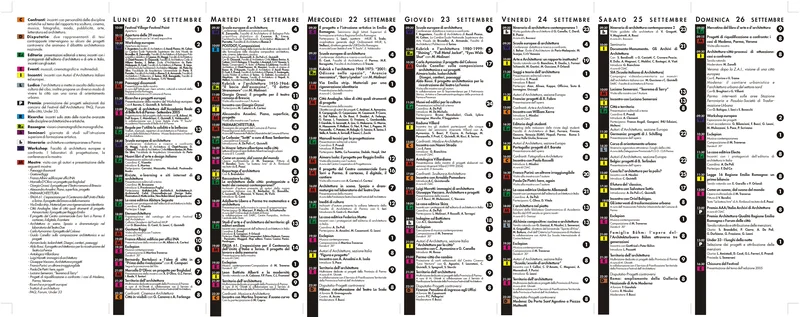
Fig. 2 – Brochure of the Festival dell’Architettura di Parma, n. 1, 2004.
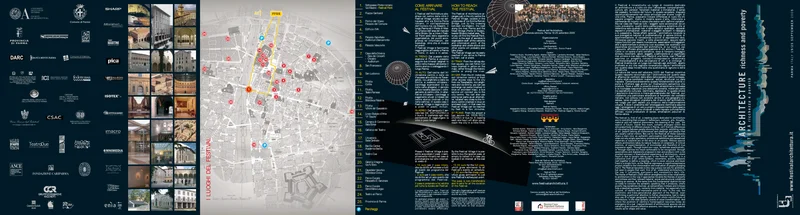
Fig. 3 – Brochure of the Festival dell’Architettura di Parma, n. 2, 2005.
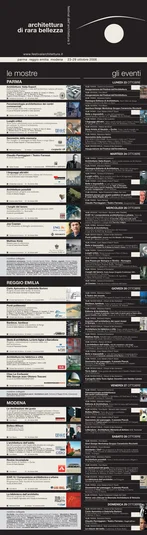
Fig. 4 – Brochure of the Festival dell’Architettura di Parma, n. 3, 2006.
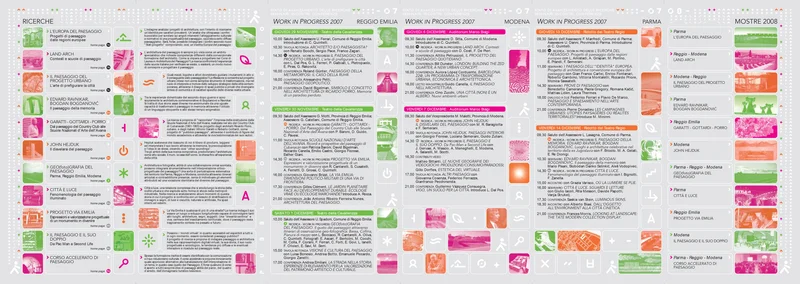
Fig. 5 – Brochure of the Festival dell’Architettura di Parma, n. 4, 2007-08.
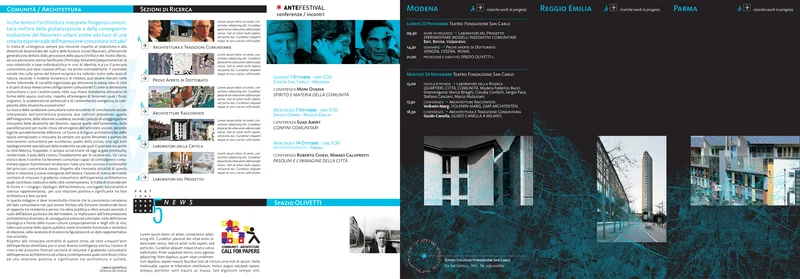
Fig. 6 – Brochure of the Festival dell’Architettura di Parma, n. 5, 2009-10.
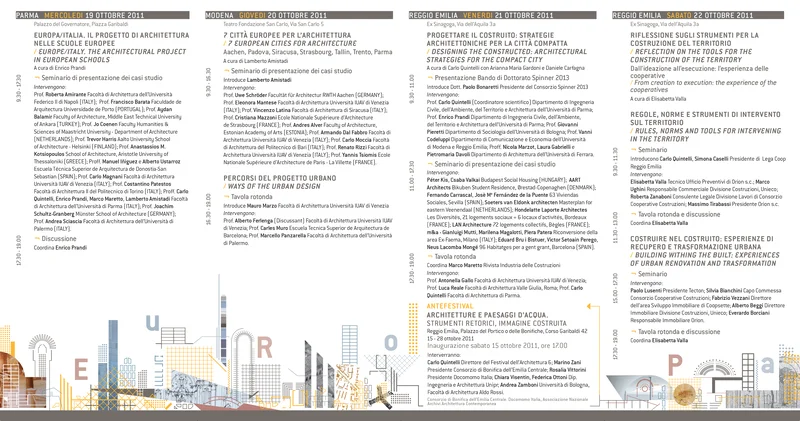
Fig. 7 – Brochure of the Festival dell’Architettura di Parma, n. 6, 2011.
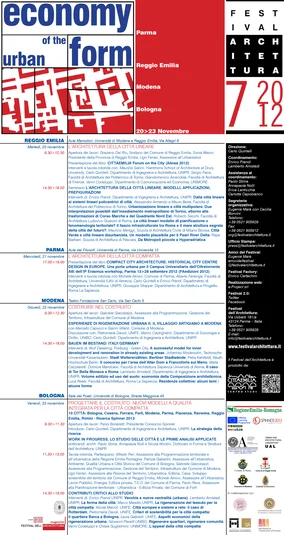
Fig. 8 – Brochure of the Festival dell’Architettura di Parma, n. 7, 2012.
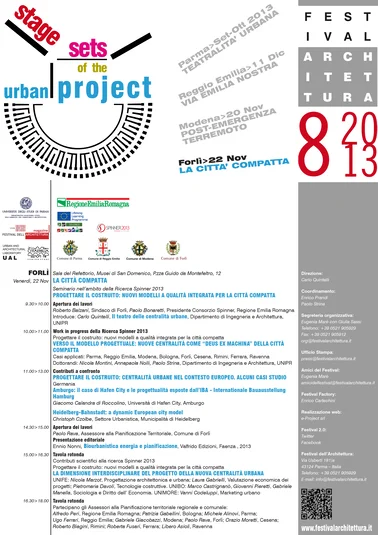
Fig. 9 – Brochure of the Festival dell’Architettura di Parma, n. 8, 2013.
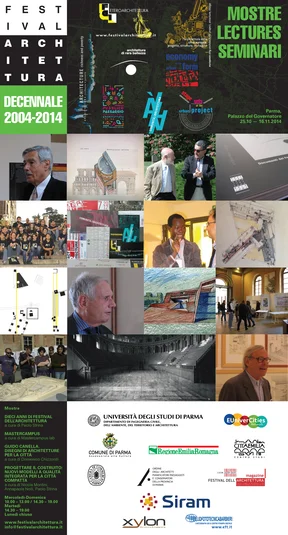
Fig. 10 – Brochure of the Festival dell’Architettura di Parma, organised on the occasion of the tenth anniversary of FA1, 2014.
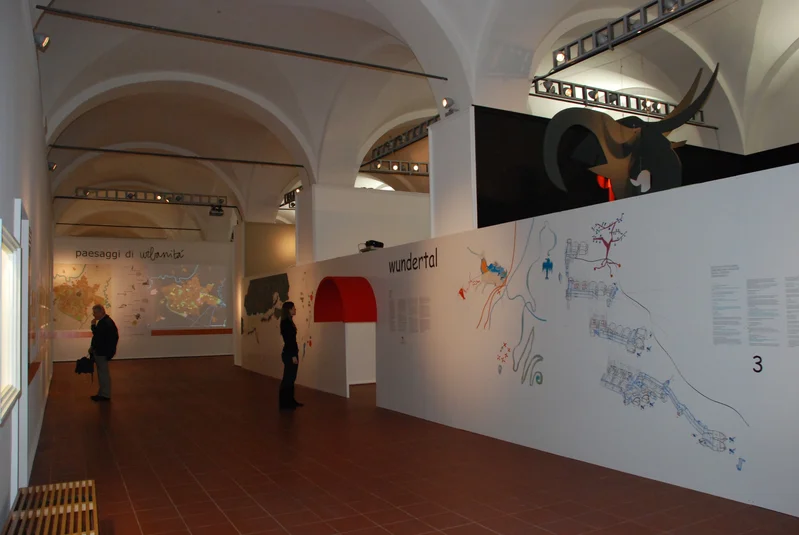
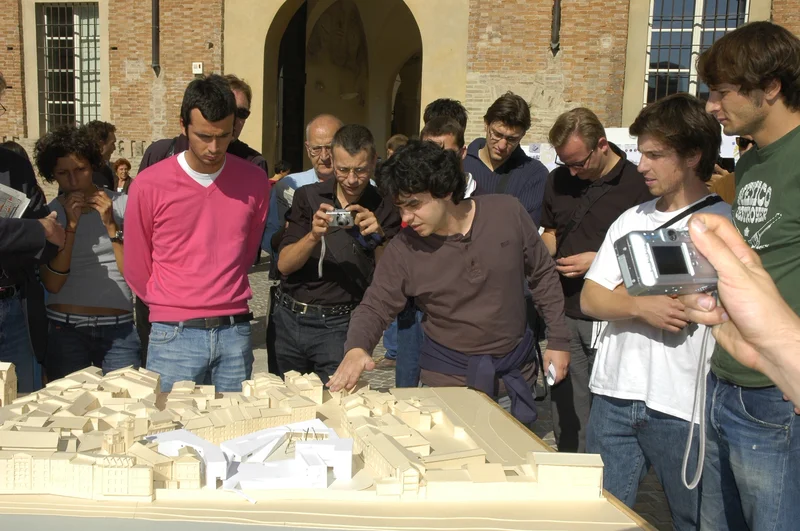
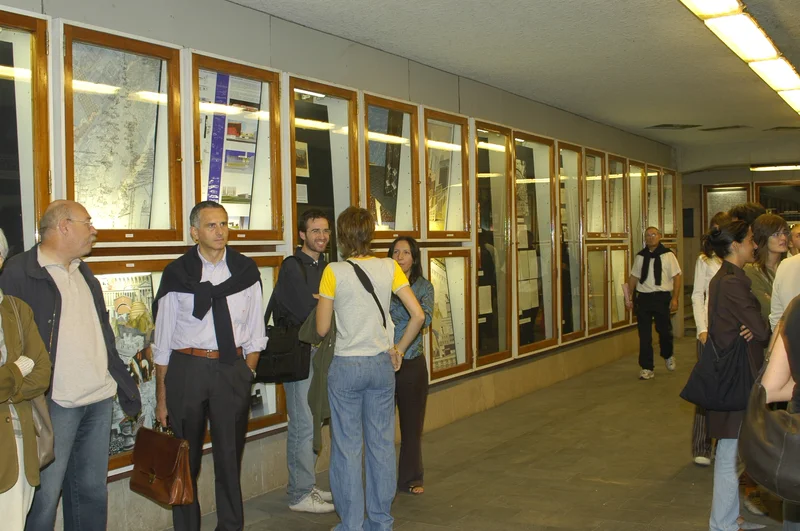
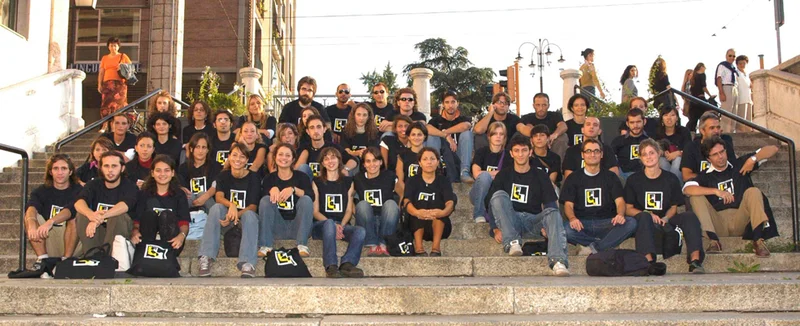
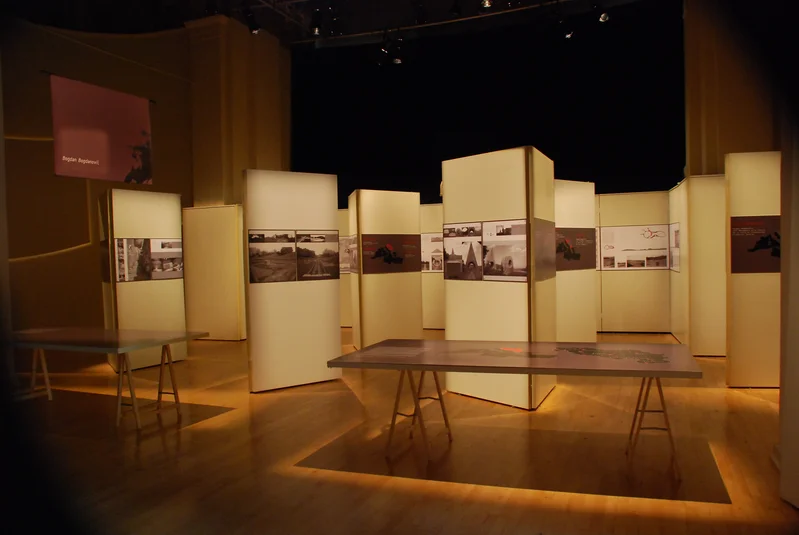
Fig. 11 – Images taken on the occasion of the Festival dell’Architettura di Parma, 2004-2014.
Fig. 12 – Images taken on the occasion of the Festival dell’Architettura di Parma, 2004-2014.
Fig. 13 – Images taken on the occasion of the Festival dell’Architettura di Parma, 2004-2014.
Fig. 14 – Images taken on the occasion of the Festival dell’Architettura di Parma, 2004-2014.
Fig. 15 – Images taken on the occasion of the Festival dell’Architettura di Parma, 2004-2014.