Reviews
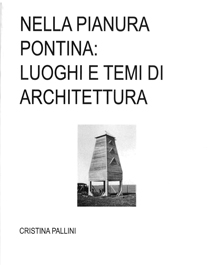
Palimpsest, types, figures
Author: Cristina Pallini
Title: Nella Pianura Pontina: luoghi e temi di architettura
Language: Italian
Publisher: Casa dell'Architettura Edizioni
Format: 16.5 × 24 cm, 191 pages, paperback, black and white
ISBN: 9788889002148
Year: 2024
Nella Pianura Pontina: luoghi e temi di architettura is, above all, a tribute to design as a process of knowledge. In this specific case, it concerns an understanding of a territory that has long been the subject of a long tradition of critical studies which, over time, have offered complex and multifaceted analyses and judgments. It is therefore not an easy task to navigate the plethora of documents and viewpoints. The catalyst for the original research undertaken by Cristina Pallini – whether through documents or directly on site –, was the European research project Modscapes (Modernist Reinvention of the Rural Landscape), which was subsequently continued with the direct involvement of students and graduates from the design studios taught by the author at the Politecnico di Milano. The opening essay provides a concise account of this research, while the larger part of the book focuses on the design experiments developed with students across various "sites" in the Pontine Marshes.
The Modscapes research project aimed to unravel the oxymoron "modern rural" by comparing rural landscapes created in the 20th century, highlighting their distinctive role in recent European history. The eleven case studies begin with the first Jewish settlements established in Ottoman Palestine from 1878 onward, before moving on to the 1920s with the Greek Orthodox refugees from Asia Minor "transplanted" into the rural areas of Northern Greece. In the 1930s, the project focused on the completion of the drainage of the Pontine Marshes and on the developments in the Tavoliere delle Puglie and in Libya, considered the "Fourth Shore" of Fascist Italy. In the same decade, Salazar's Portugal and Franco's Spain also began the colonisation of their inland regions to compensate for the crisis of their respective colonial empires; while in the 1950s, in French Morocco, rural centres in the Gharb Valley were modernised to counter the exodus to the major cities. At the same time, in the post-war period, agricultural collectivisation and mechanisation were exported from the Soviet Union to Eastern Bloc countries such as Ukraine, Estonia, and the German Democratic Republic.
"Comparison" has been the key word in investigating this shared, often underestimated, heritage. The comparison between such diverse historical and geographical contexts reveals affinities, disparities, and significant dichotomies. The criteria adopted in organising the case studies include, in addition to the different political systems, the timing of project implementation, the strategic role of rural modernisation in the various contexts, as well as the national, international or colonial management of territorial transformation processes. Crucial to understanding the relationship between these key settlement experiments and the architectural design is also the layout of the villages – whether compact or scattered – in relation to the presence or absence of pre-existing settlements, as well as the distinction between places of production and representative spaces marked by institutional buildings. A substantial difference, in fact, lies between communities conceived on the basis of a principle of secularism and those united by religious belonging and oriented towards new values.
A pressing question concerns the extent to which the models of social organisation that inspired these settlements found fully realised architectural expression. In this sense, the relationship between the standardisation of rural housing – necessary to ensure minimum hygiene standards and contain construction costs – and the siting of public buildings, as well as their formal and figurative character, is particularly significant.
What made these settlements not "traditional" but "innovative" was their orderly arrangement within an isotropic grid, a concentric layout, or a design that conformed to topographical features. An order expressed both in the hierarchy of streets according to their cross-section and in the arrangement of buildings in relation to open spaces.
Within this complex framework, Italy in the 1930s represents a case in point. The reclamation of the marshes south of Rome, long celebrated by artists and travellers on the Grand Tour, quickly gained international recognition. The significance of the Pontine Marshes project is further highlighted by the specific role played by architectural design.
In the reclamation project, a precise settlement strategy was in fact being tested, in which new towns formed the nuclei of a broader infrastructural system extending across the territory through villages and farms, closely linked to the traces of previous reclamation attempts and to the works carried out by the Civil Engineering Corps between the 1910s and 1920s. Within this territorial framework, which in a decade would give rise to an entire province, the hierarchy between village and town is made evident by the presence of a system of squares with a theatrical vocation – true scenographies in which architects reinvented established types such as the church and town hall whilst experimenting with new themes promoted by the regime (Casa del Fascio, headquarters of the Opera Nazionale Dopolavoro, Casa del Balilla).
Starting from these interventions, Cristina Pallini, through and in collaboration with the architectural project, persistently investigates the distinctive features of the Pontine Marshes in accordance with Braudel's principle of the longue durée, recognising beneath the transformations produced by successive reclamation efforts a latent order with extraordinary characteristics, without being misled by the visible yet superficial upheavals caused by human activity. Alongside the principle of the longue durée, a fundamental concept has been that of the "palimpsest," borrowed from André Corboz, which is useful for interpreting the relationships that, from time to time, transformation projects have established with the resources available in the territory.
This "palimpsest" forms the backdrop for the design interventions carried out between 2018 and 2024 in the academic context, organised into a series of case studies encompassing sites with diverse characteristics, capable of defining a broad spatio-temporal section. The thesis projects are divided into three groups: the first gathers five projects for five notable locations in the Pontine area; the second includes two projects for Pontinia, and the third comprises five projects for the centre of Latina. In the contemporary landscape, alongside the foundation towns, historical places with distinctive qualities thus re-emerge: the Acropolis of Cori, Ninfa along the consular road, Mesa along the Decennovio of the Via Appia, the village of Fogliano, and the abandoned quarry of Montecchio. A considered choice that rescues them from neglect and restores them to a renewed collective use and value.
Starting from a careful reflection on the relationship between architecture and urban design, in Pontinia the projects reinterpret the "hidden geometry" underlying the parts of the city, for example through spatial sequences grafted onto the "theatrical backdrops" of the square; in Latina, instead, they operate through "contrapuntal" insertions and by completing the existing fabric.
In other contexts, rather than the intervention area itself, the focus has been on potential points of reference and integration, identified through a careful survey of the environmental resources with which to establish relationships. Orography, hydrography, road networks, built heritage, and open spaces, together with the identification of planimetric focal points to which the orientation of the new layout could refer, have made it possible to identify visual axes and "focal points" where the new and the existing come together into a single scene. These aspects then converge in the typological definition and figurative characterisation of the projects. In such diverse contexts, perceptual and proportional aspects have been fundamental in developing, on a case-by-case basis, promenades architecturales, new "offshoots" and the re-proportioning of existing spaces.
A valuable and exceptionally rich body of iconographic material, comprising archival documents, field surveys and meticulous reconstructions, helps to strengthen the relationship between theory and practice, between existing elements and new additions, and between intrinsic values and figurative intuitions: a patient and ingenious endeavour, not so common today, which itself becomes part of the creative process.
For their part, the projects testify to a typological and figurative research highly sensitive to place, yet never subordinate or inclined to mimicry, but rather oriented towards experimentation capable of prefiguring possible futures, expressions of an architecture that is authentically contemporary in the fullest and most positive sense of the term.
Francesca Bonfante