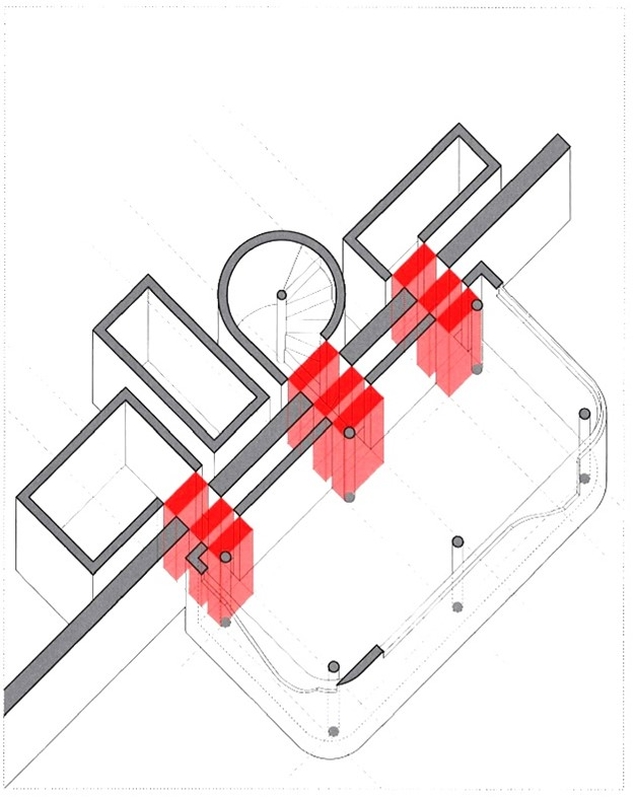
The Auckland Drawing School.
On the margins of architectural representation
Marco Moro
Fig.
2 - Exhibition The Auckland School, Centenary of the University of
Auckland School of Architecture and Planning, Gus Fisher Gallery, 8
September – 4 November 2017. Photo by Samuel Hartnett
(Courtesy of the University of Auckland School of Architecture)..
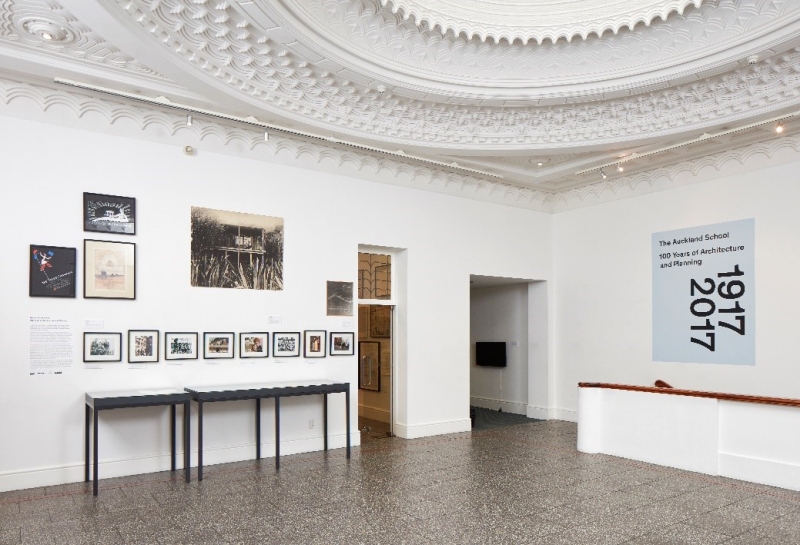
Fig.
3 - Mapping of the 43 architecture schools competing for the Venice
Prize at the Fifth Architecture Biennale (from «Lotus
International» 73, 1992).
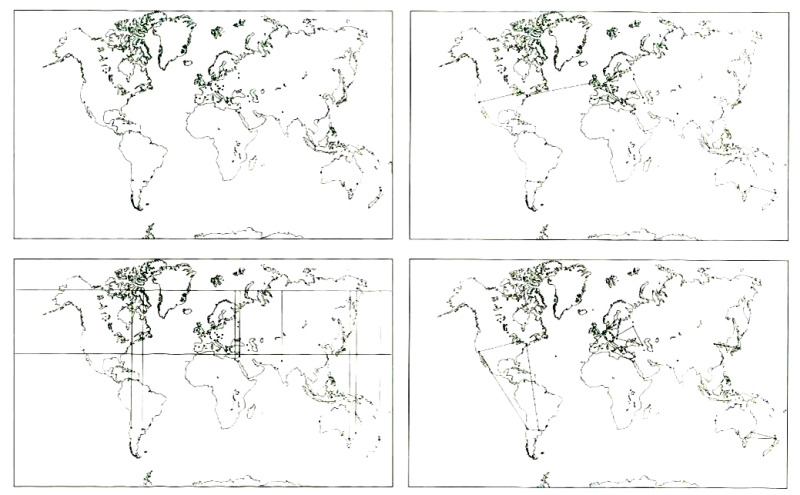
Fig.
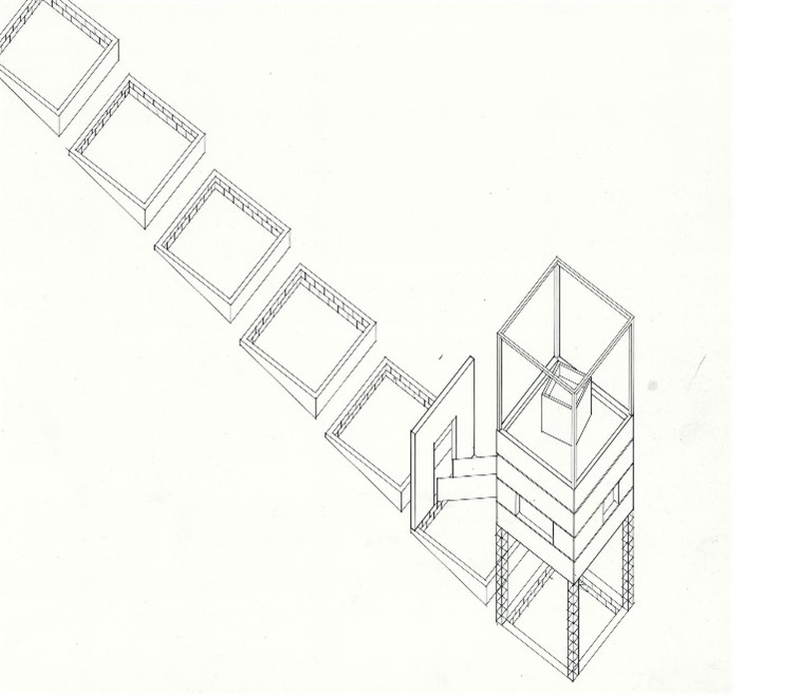
4 - Axonometric drawing made by New Zealand architect Craig Moller, as
a student of the design studio directed by Mark Wigley in 1985 in
Auckland, New Zealand. (Courtesy of Craig Moller). (Courtesy of Craig
Moller).
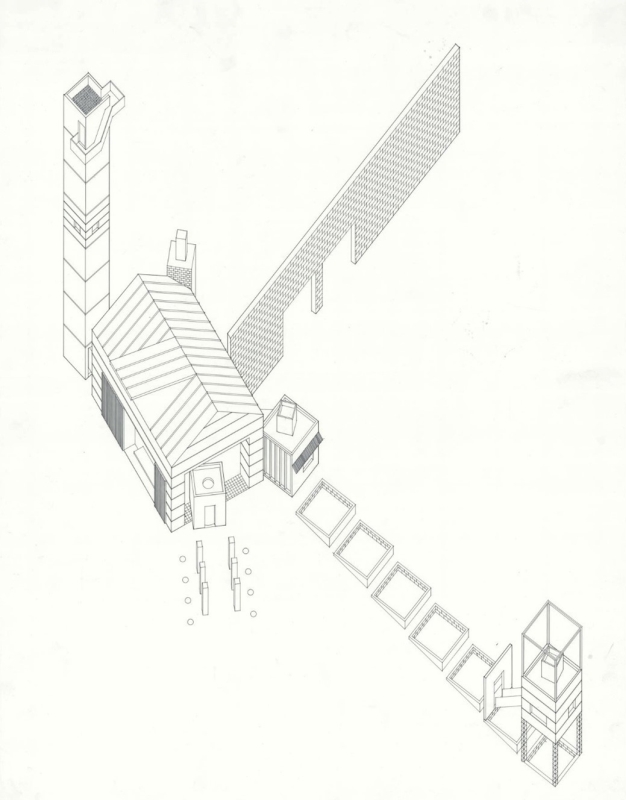
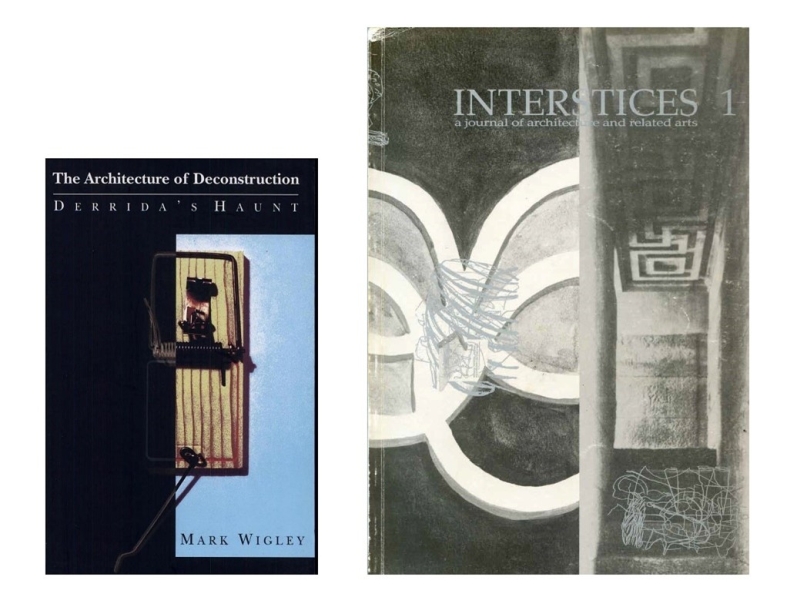
Fig.
5a-b - The Architecture of Deconstruction (1993) and cover of the first
issue of the New Zealand journal «Interstice»
(1990).
Fig.
6 - Stanley Tigerman, axonometric drawings for the Formica company,
1986.
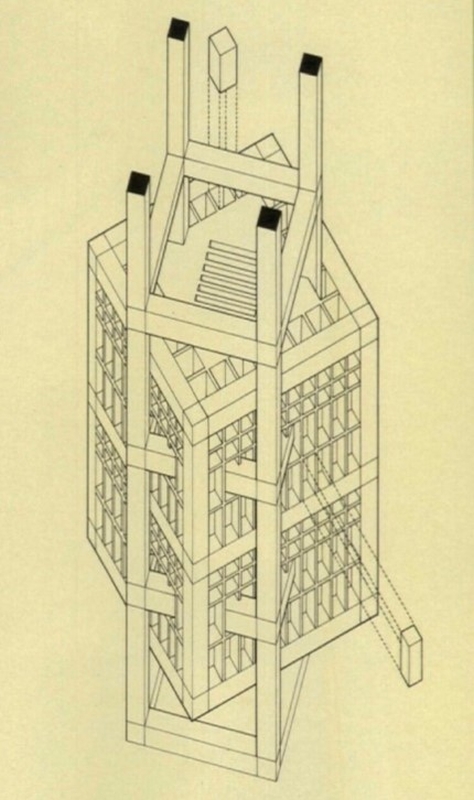
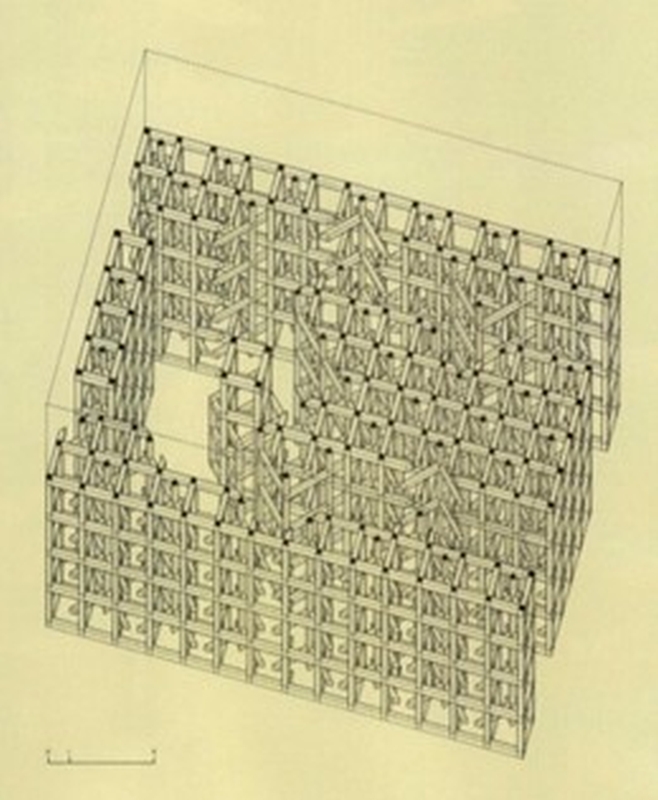
Fig.
7 - Enlargement of Craig Moller's drawing which highlights the material
qualities and the domestic character of the fragments represented.
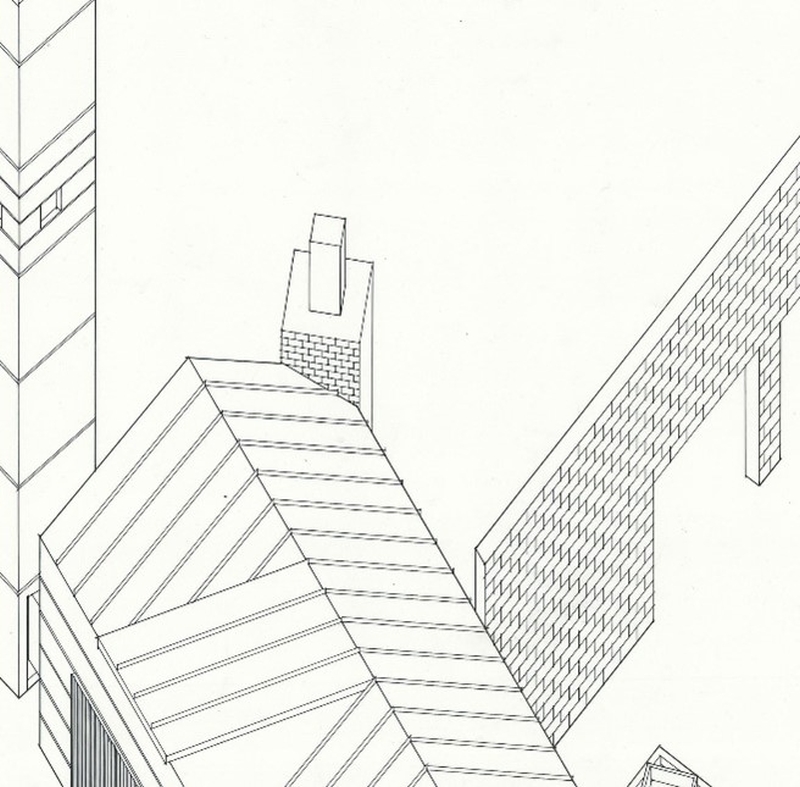
Fig.
8 - Manifesto of the Group Architects, “On the necessity for
architecture”, 1949 (Courtesy of Special Collections,
Libraries
and Learning Services, University of Auckland).
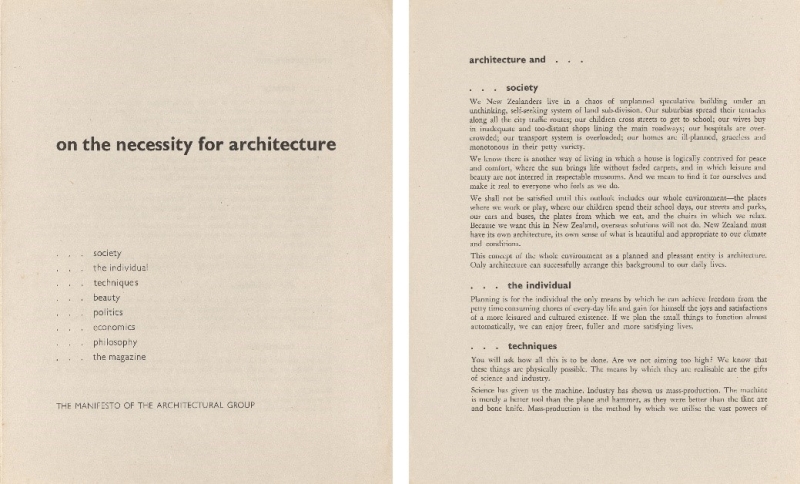
Fig.
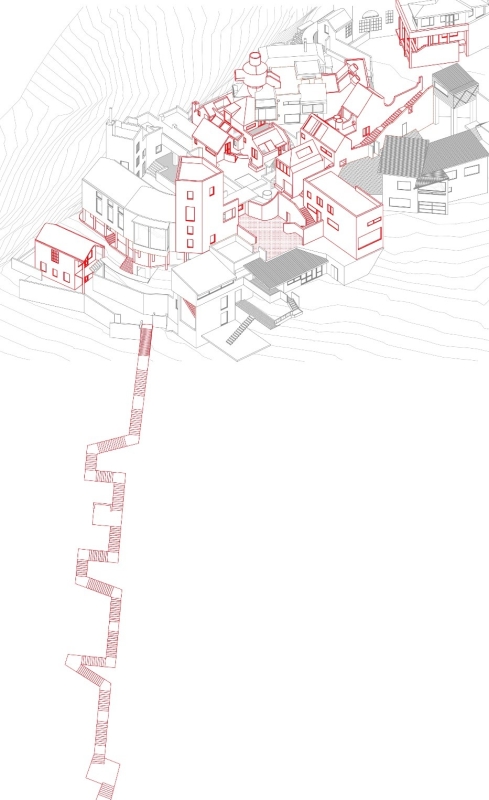
9-10 - Athfield House-and-Office (redesign by the author).
Enlargement of Craig Moller's drawing showing the natural slope of the
ground.
One of the most recent written works by Peter Eisenman,
undisputed
champion of analytical drawings as applied to architecture and its
theoretical contents, is edited with Elisa Iturbe under the title of Lateness
(2020). This is a concept that, as the authors argue, goes
far beyond the attempts of chronological framing of styles or of the late
individual production of artists. On the contrary, this concept appears
as a unique condition ambiguously suspended in time: «a late
work
can break historical narratives and cause time to become
discontinuous» (2020, p. 19). In the perfect tradition of
Eisenman’s investigations, the concept of lateness
is
explored through the medium of axonometric drawings able to further
magnify the «analytic frame devoid of function, technology,
or
social purpose» (2020, p. 4)[1]. The proposed axonometric
analyses, in this case applied to the work of three authors united by
an alleged subconscious lateness
– Loos, Rossi and Hejduk – aim to reveal the formal
structure behind the theory of fragmentation, with its well-known and
canonized version pervading the late-1980s architectural discourse
under the impetus of deconstruction. (Fig. 1) A
decidedly less
known aspect concerns the circulation of this theory between the two
hemispheres, with Eisenman himself personally involved as external
examiner of the doctoral project developed by a young Mark Wigley at
the School of Architecture of Auckland, New Zealand: The
Deconstructive Possibilities of Architectural Discourse
(1986), conceived in a remote periphery of cultural interests, would be
travelling from one hemisphere to the other very soon becoming one of
the most influential architectural theories of contemporary times.
Starting from this episode, this paper intends to investigate the
agency of architectural representation within a peculiar context, the theoretical
turn at the School of Architecture of Auckland, already
known as “Drawing School” in the South Pacific area.
The Drawing School. Opportunities and limits
Celebrated in 2017, the School’s centenary was an
opportunity
to evoke its epithet earned over time. A warmly received exhibition and
related publication (Gatley and Treep 2017) put on stage the
extraordinary production of drawings held in the archives and premiered
as the School’s distinctive trait progressively refined over
the
hundred years of teachings in Auckland[2].
(Fig. 2) The Venice Prize at Quinta Biennale di Architettura (1991)
stands out among the first international recognitions in this
trajectory, awarded to a group of students that unexpectedly excelled
with their work on the 43 schools of architecture in competition
(Purini 1992). (Fig. 3) At the same time, a certain amount of
self-criticism arises from the accounts of Auckland’s former
students confessing their immoderate fascination with the effects of
representation, that is, complex geometric compositions with delicate
shadings, transparencies, and hatches, so meticulously executed that
the conceptual-argumentative fundamentals of their projects were
obscured[3].
Among the various astonishing examples that confirm this
tradition,
a bare and discreet axonometric drawing finds a small space. This was
produced as a result of a design studio taught by Mark Wigley in 1985,
that is, during the final stages of his doctoral studies. The author of
the drawing is Craig Moller – currently director of Moller
Architects that designed Auckland’s iconic Sky Tower in the
early
1990s – at the time involved in the School’s
complex
transition from the obsessive production of «Caran
d’Ache
pastel drawings to hard-line analytical drawings»[4].
(Fig. 4) Indeed, this bare and discreet axonometric was part of a
larger movement since a School’s internal current began
working
to affirm the relevance of theoretical thought underlying architectural
projects, supported but not dominated by those forms of representation
that made a thought conveyable. It is important to note that Mark
Wigley belonged to the first generation of students from the School
moved by such an ambition, handed down to them by a small group of
young teachers. His thesis supervisor Mike Austin was in the group
along with other well-recognized figures – such as Ross
Jenner
and David Mitchell – though they weren’t alone[5].
(Fig. 5) Sarah Treadwell, the first woman to be permanently integrated
into the school staff, offered a crucial contribution towards a
full-fledged theoretical turn. With her
essay-manifesto Architecture Drawing: A statement of Position
(1986), Treadwell claimed the potential of drawing in informing the
most critical, speculative and argumentative dimension of architectural
thought[6].
However, it is through
a close analysis of Moller’s axonometric –
apparently
marginal if compared with the restless period – that one can
interrogate the complicit relationship between the solid affirmation of
a theoretical thought and drawing as a penetrating tool to convey that
same thought. This bare and discreet axonometric, hence, is not simply
reconsidered to document the complicity playing in favour of deconstruction
as one of the most influential theories of contemporary architectural
discourse. In fact, scrutinized in its materiality, the drawing reveals
unexpected possibilities of insinuating a counter-argument within the
same theoretical apparatus from which it seems to derive.
The brief. On the pedagogy of analytical drawing
Moller’s drawing is the result of a short-term
design studio,
at the second professional year in Auckland. It lasted about three
weeks, at the end of which there was a dedicated time for the
preparation of the drawings to be submitted for the final crits. The
studio brief did not seem to be particularly
informed by theoretical issues on deconstruction
that Mark Wigley was deeply investigating. As Moller himself recalls,
«there were no seminars on Derrida’s philosophical
thought
to inspire our design proposals»[7].
It does confirm the main argument behind Wigley’s work, that
is
to problematize the relationship between architecture, representation,
and deconstruction by resisting the superficial appropriation of
concepts from other disciplines (bad borrowings)
and the simplified translations from theory to practice (bad
translations).
In an attempt to reverse this relationship by stimulating the
contribution of architecture to the powerful deconstructionist
theoretical framework, students were required to put into action a
collision between two architectures arbitrarily chosen by each of them,
that is to say, by resorting to one’s own reference field
inherent with the discipline as derived from one’s own
innermost
memories. The explication of the collision process in the final
composition was entrusted to a specific representation technique:
«each drawing had to be axonometric […] We
weren’t
allowed to draw in plan, or in section, let alone the perspectival
sketches which were fairly dominant in the school at the
time».
The final draft was thus converted into a proper analytical device
which aimed not simply at overcoming the experiential and perceptive
approach rooted in the school. But it did so by purging the studio
brief of all the information that would assimilate this experiment to a
situated object in terms of construction, function,
and place.
In the context of lateness. Reference field
between Rossi, Judd and Gehry
Apparently, Moller’s axonometric composition obeys
all the
studio brief instructions. It should also be considered that the
previously described analytical approach acquires a specific and deeper
meaning in the context of New Zealand’s marginalization. The
construction of a disciplinary field of references suffered the vast
distance from the official distribution centers of architecture debate
and the consequent impossibility of finding updated information[8]. However,
it is precisely this delay in the flow of information – a
suspension in time or lateness
– that the most original recombinations can benefit from,
such as
the one represented in the axonometric drawing in question. In concrete
terms, the potential of analytical approaches seem the more appropriate
in order to evade the passage of time in a context of isolation such as
that of New Zealand, rather than making choices based on the
updatedness of a given architectural language. (Fig. 6) It should be
emphasized that, by admission of its own author, the compositional
process elaborated by Moller was to some extent influenced by Aldo
Rossi’s thoughts: «I was certainly aware that the
hay barn
at the center of the composition was the archetype
of New
Zealand […] and besides Rossi’s typological
intuitions I
was incredibly fascinated by those late concepts exposed in his Scientific
Autobiography»[9].
Indeed, analysing the content of the axonometric composition we can
easily recognize the typical hay barn surrounded by other fragments:
some of them are memories recovered by the author – the
imposing
block wall – while others derive from his disciplinary field
of
reference. For instance, the ordered sequence of cubic elements was
inspired by Donald Judd’s sculptures which started to
circulate
in the early-1980s art magazines, while the watchtower-like structure
that creeps into the lower corner of the composition is extrapolated
from the Norton House in Venice, California (1983-84) designed by Frank
Gehry.
The sphere of influence of the whole composition appears so
complete, as for Wigley’s intent of «exporting the
qualities of architecture» (2002, p. 92) using drawing as a
textual and argumentative practice in the field of deconstruction. In
addition to this, the Rossi-inspired paratactic configuration of
‘pieces’ and ‘parts’
– in the terms
expressed by Ezio Bonfanti (1970) – might suggests the
repositioning of this drawing scattered across the extreme periphery of
architectural debate as an excellent example of the time. What goes
unnoticed, however, is the tense relationship between drawing as a
mental space for formulating architectural thoughts and its material
consistency resulting from the method of representation which has been
adopted as an agent to impact the design process itself. In other
words, this tension makes the agency of drawing explicitly operational
by insinuating a counter-argument into the initial brief
and calling into question all those aspects that were intentionally
left out.
Between lines. Construction, function, and place
While the rapidographer’s geometric and sharp trait
enhances
the required analytical approach, the varied treatment scrupulously
applied to the drawing’s textures betrays the
author’s
intention to convey a piece of information on the constructive aspects
of the architectural fragments that participate in the axonometric
composition. The size of the blocks is easily measured in the slanting
wall and in the cubic elements inspired by Judd’s sculptures,
as
well as for the cross-hatching as applied to the cladding: «I
was
obviously aware of how to describe the New Zealand hay barn, and how to
put all the constituents of its materiality on paper: light timber
frame, metal cladding, wide openings and sliding doors often mounted on
the outside […] I’m pretty sure that all this
knowledge
about construction wasn’t part of the studio. But it was
definitely part of the two architectures I chose
for the
drawing, and of all the other fragments that compose it».
This
revelation sounds quite interesting when compared with a certain
obsession with those constructive aspects typical of Kiwi architectural
culture, which for Wigley had represented the greatest obstacle to the
development of radical architectural thinking in the country (Wigley
1986; Barrie 2013). In this sense, function was
also seen as
a limiting attribute to the point of being neglected in the studio
brief. The detail of the brick chimney scratching a corner of the hay
barn, however, insinuates a sense of domesticity in the use of the
space with the archetype of the barn suggesting alternative ways of
living (Fig.7). Moller recalls that, although no function was initially
established, «the final result is an inhabited space made up
of
three autonomous elements that define three different
areas/functions»[10].
It
must be said that, however generic, the act of declaring a residential
function offered a contingent response to the New Zealand context, in
the constant search for alternatives to the settlement model of
detached-houses. This lively and rich debate dates back to the Group
Architects’ manifesto (1949)[11],
(Fig.8) later reinterpreted and radically applied by New Zealand
architect Ian Athfield on the Wellington hills. Although it was not
explicitly included in the reference field of Moller’s
axonometric composition, the Athfield House-and-Office (1965)
stimulated collective forms of living and working in a built complex
made of pieces and parts as
a result of an
incremental process – still in progress – which
explored
the housing topic on a large-scale in a completely unprecedented way[12]. (Fig.
9) The large-scale is that of the landscape,
the third element inextricably connected with New Zealand architectural
culture and subtly insinuated into Moller’s axonometric
composition through a nearly imperceptible detail. The analytical
approach enhanced by a rigorous line drawing did not prevent the author
from signalling the inclination of the lines that define the orderly
disposed sequence of cubic elements. This simple gesture provide us
with more information on the slope of the ground above which the
composition is arranged, and its specific location (Fig. 10):
«I
well remember that those kind of architectural investigations
weren’t site-specific. However, when I
did my final
submission that included this drawing, I did select a site».
The
composition suddenly becomes a situated object in the Chatham Islands,
that is the easternmost point of New Zealand. Apart from the mostly
uncontaminated hilly landscape that inspired the author’s
choice,
the geographical position is that of a place suspended in space, but
especially in time, since a gap of 45 minutes on Aukland makes the
Chatham Islands the first inhabited land to inaugurate a new day every
day: «The Islands are, if you like, between New Zealand and
the
rest of the world. That was also the same principle according to which
I positioned my proposal for Mark’s studio, namely between
the
New Zealand hay barn and the Judd’s sculptures, or the other
fragments from my memory. I believe the same was true for the
architectural theory discourse that informed this drawing, I mean, not
necessarily a theory of New Zealand architecture, but a theory about
architecture which embraced New Zealand for the first time».
In conclusion, leaving in the background the long conflict
between
adherence and resistance towards different representation techniques,
this apparently peripheral episode brings to the center the crucial
role of drawing in the formulation of architectural thought. Not only
as an instrument to legitimize a theory as such, but as a privileged
territory of contestation as happened in the case of one of the most
influential theories that have travelled between the two hemispheres.
Notes
[1]
Eisenman is certainly not
the only exponent in the use of axonometric drawing, but he is
certainly among those who have enhanced its analytical function in
complicity with theoretical thought. This analytical approach, Eisenman
recalls, dates back to the time of his doctoral research The
Formal Basis of Modern Architecture (1963), deeply
conditioned by Colin Rowe’s teachings in representing what is
missing in architecture rather than what is
already clearly visible.
[2]
The publication edited by Julia Gatley and Lucy Treep (2017) contains a
dedicated section entitled 100 Years of Drawings.
[3]
Andrew Barrie, currently
professor at the School of Architecture and Planning of Auckland,
reports in detail on the students’ approach at the time:
«They would hunch obsessively over a few sheets of mylar or
expansive watercolour for weeks, clutch pencils and fanatically 6H
leads in hand. This could go to extremes […] students would
skip
straight from conceptual thinking to presentation drawings to allow
more time to draw» (Barrie 2017, p. 108).
[4]
Craig Moller, interviewed
by the author on 13/11/2020. In general, this contribution is
structured on the basis of the author’s on-site studies, that
is,
visits, archival research, and conversations with the protagonists of
the local debate.
[5]
Ross Jenner obtained his
PhD on Italian Modernism at the University of Pennsylvania under the
supervision of Joseph Rykwert, then he founded the New Zealand magazine
«Interstice» to promote the theoretical discourse
on
architecture. In the same years, David Mitchell was co-author of The
Elegant Shed: New Zealand Architecture since 1945 (and of
the homonymous television series).
[6]
Sarah Treadwell, who
currently continues to work as a New Zealand-based artist, obtained her
first teaching appointment in the field of drawing and representation
in 1981, as a result of the heated protest of the activist group Woman
in Architecture formed in 1979.
[7]
This is also confirmed by
Wigley himself: «In my own teachings, I have never asked
students
to read a single text by Derrida, despite having devoted a decade of my
life thinking about his work» (2002, p. 93).
[8]
In a recent conversation with Julia Gatley (Fast Forward
lecture series
- Spring 2021), Wigley traces his first intuitions on deconstruction in
the architectural field to the brief encounter with Stanley Tigerman
who occasionally visited New Zealand at the invitation of the Formica
company (1984). In fact, his visit was highly anticipated since
Tigerman was among those who were literally manipulating the late
modernist architectural discourse (the Titanic
collage
depicting the sinking of Mies’ iconic architectures was
already
famous), but the inability of the school to hold the guest for a
reasonable period of time sparked a student revolt against the
limitations of isolation. That same year, isolation was mitigated
through the foundation of SAHANZ (Society of Architectural Historians,
Australia and New Zealand).
[9]
Moller deepened these studies in his two years of Masters at Yale,
where the English translation of Rossi’s Scientific
Autobiography published by «Oppositions»
was circulating since 1981.
[10]
Reference is made to the
barn as a living area, the raised structure of the watchtower as a
studio space and the bathroom located on the ground floor of the back
tower.
[11]
From the Group
Architects’ manifesto, the first expression of New Zealand
modernism, we can read: «New Zealand must have its own
architecture, its own sense of what is beautiful and appropriate to our
climate and conditions […] We New Zealanders live in a chaos
of
unplanned speculative building under an unthinking, self-seeking system
of land sub-division». On this subject see Gatley (2010).
[12]
The Athfield House-and-Office came to house 40 residents and 25 workers.
References
BARRIE A. (2013) – “Architecture to a
Fault?
Deconstructivist Architecture in New Zealand”. In: A. Brown e
A.
Leach (edited by), 30th Annual Conference of the Society of
Architectural Historians, Australia and New Zealand, 29-40.
Queensland, Australia, 2-5 July 2013.
BARRIE A. (2017) –
“‘Architecture to a
Fault’. The Postmodern Years”. In: J. Gatley e L.
Treep
(2017), The Auckland school : 100 years of architecture and planning.
Auckland, New Zealand, 103-127.
BETH G. e SALLY F. (2020) – “Trajectories
of Axonometry
through Distances and Disciplines”. In: V. Jackson Wyatt, A.
Leach and L. Stickells (edited by), Distance Looks Back. Sydney:
SAHANZ, 2020, 172-83.
BONFANTI E. (1970) – “Elementi e
costruzione. Note
sull’architettura di Aldo Rossi”. Controspazio, 10,
19-28.
EISENMAN P. e ITURBE E. (2020) – Lateness.
Princeton University Press, Princeton.
GATLEY J. (2010) – Group Architects:
Towards a New Zealand Architecture. Auckland University
Press, Auckland.
GATLEY J. e TREEP L. (2017) – The
Auckland School: 100 Years of Architecture and Planning. The
University of Auckland, Auckland.
HARTOONIAN G. e WIGLEY M. (2002) – “An
Interview With
Mark Wigley”. Architectural Theory Review, Vol. 7:1, 89-102.
LINZEY M. (1992) – “Architecture to a
Fault”.
Interstices, 2, 190-194. Translated in Italian as
“L’architettura
dell’incertezza”. In: Quinta Mostra
Internazionale di Architettura. Electa, Milan, 1991.
MITCHELL D. e CHAPLIN G. (1984) – The
Elegant Shed: New Zealand Architecture since 1945. Oxford
University Press, Auckland.
PURINI F. (1992) – “Le prime
quarantatré storie.
Le scuole di Architettura alla Biennale di Venezia”. Lotus
International, 73, 6-24.
TREADWELL S. (1986) – “Architecture
Drawing: A statement of Position”. New Zealand Architect, 1,
33-35.
WIGLEY M. (1986) – Jacques Derrida and
Architecture: The Deconstructive Possibilities of Architectural
Discourse. Phd dissertation, University of Auckland.
WIGLEY M. (1986) – “Paradise Lost and
Found: The
Insinuation of Architecture in New Zealand”. New Zealand
Architect, 5, 44-45.
WIGLEY M. (1993) – The Architecture of
Deconstruction: Derrida’s Haunt. MIT Press,
Cambridge MA.