The Rural Social Condenser The collective farm of Nākotne as
an asset and a challenge
Yuliia Batkova, Laine Nameda Lazda
Fig.
1 - Arturs Čikste (left), Henrikas Šilgalis (right) and the
model of the theatre of the culture house for 800 people. 1970s.
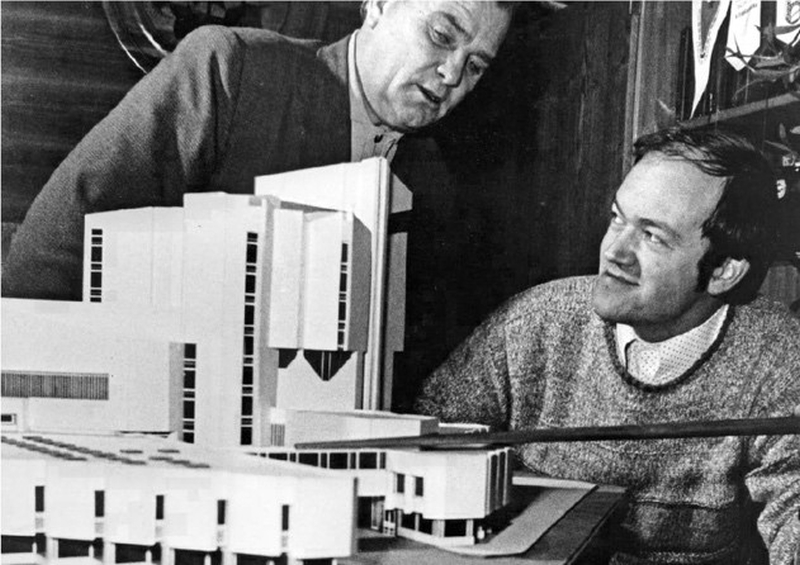
Fig.
2a - Henrikas Kestutis Šilgalis, Model of the proposal for
cultural center, early 1980s.
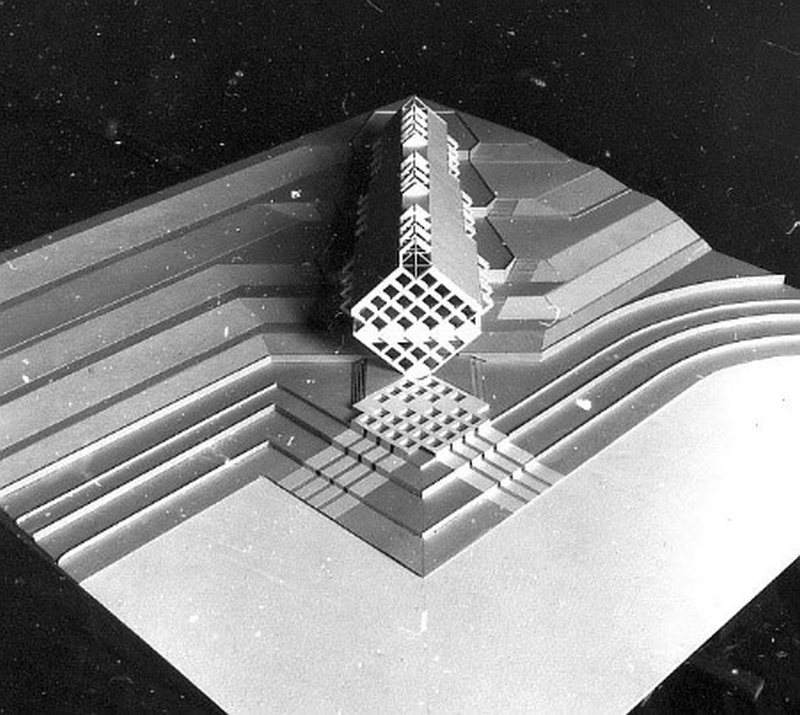
Fig.
2b - Henrikas Kestutis Šilgalis, Model of a private house in
Caucasus, 1980 (right).
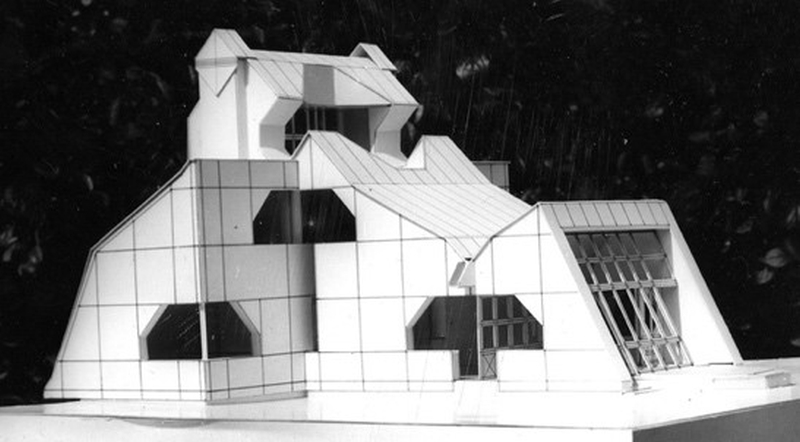
Fig.
3 - Urban structure of the collective farm Nakotne. Early 1950 (left);
urban structure of the collective farm after 1966 (right)
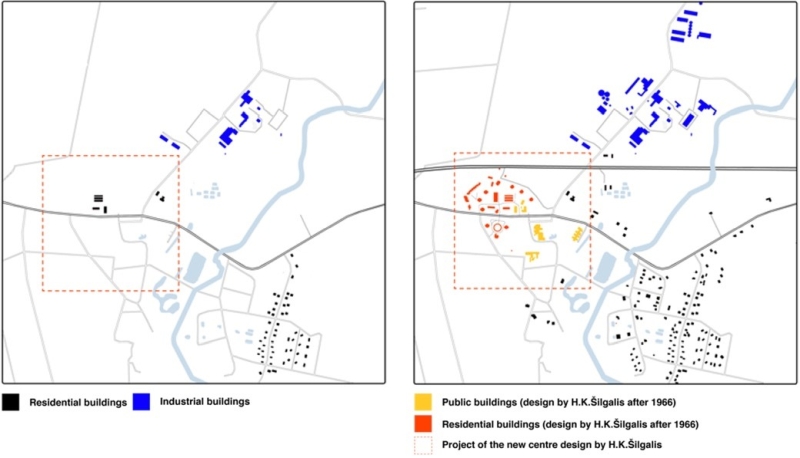
Fig.
4 - Masterplan scheme of the centre of the collective farm of Nākotne,
1966; yellow¬ – public buildings; black
–residential
buildings. Source: Glūda parish archive
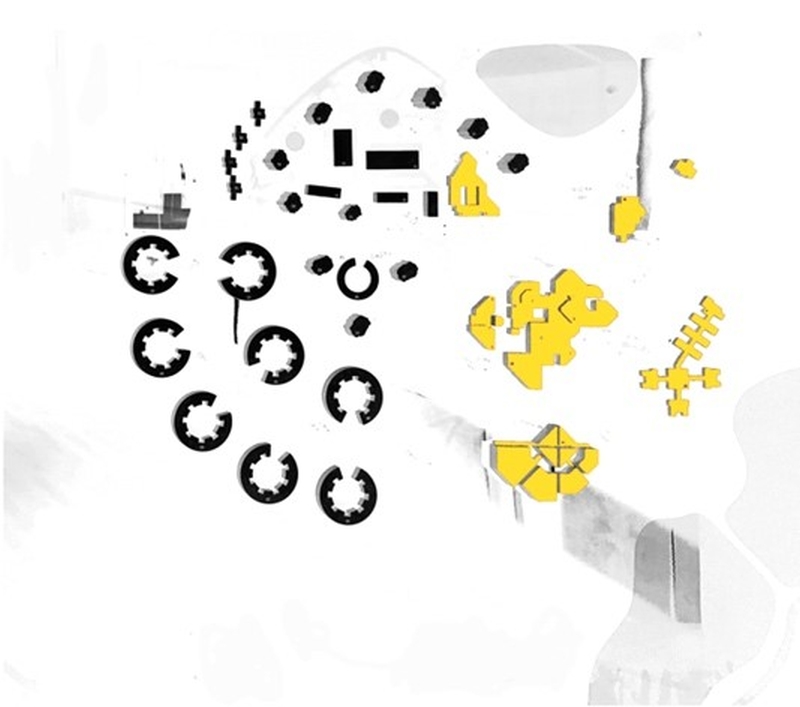
Fig.
5 - Henrikas Kestutis Šilgalis with the model of the Sports
and
Culture Centre, the drawing of masterplan of Nākotne in the background,
late 1960s (left); the model of the Sports and Cultural, 1968 (right).
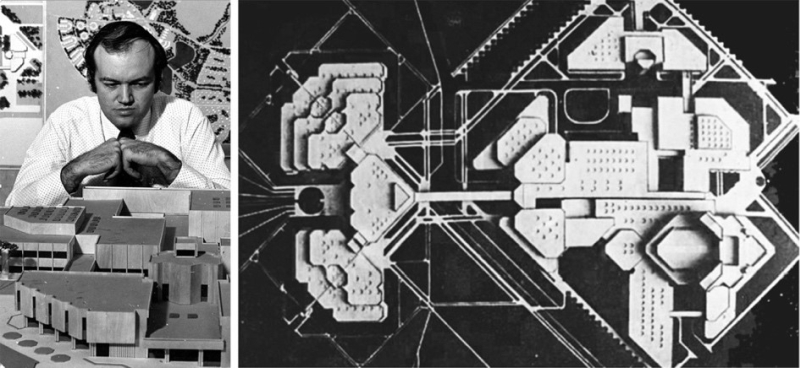
Fig.
6 - Redrawn scheme of Sports and Culture Centre designed by Algimantas
Mačiulis and Henrikas Kęstutis Šilgalis (1967); 1
Administration
Building; 2 Post Office; 3 Kindergarden and Library; 4 Ambulatory /
Hospital; 5 Sports Hall 35 * 18 m; 6 Swimming Pool; 7 Culture Palace; 8
Cafe and Canteen; 9 High School
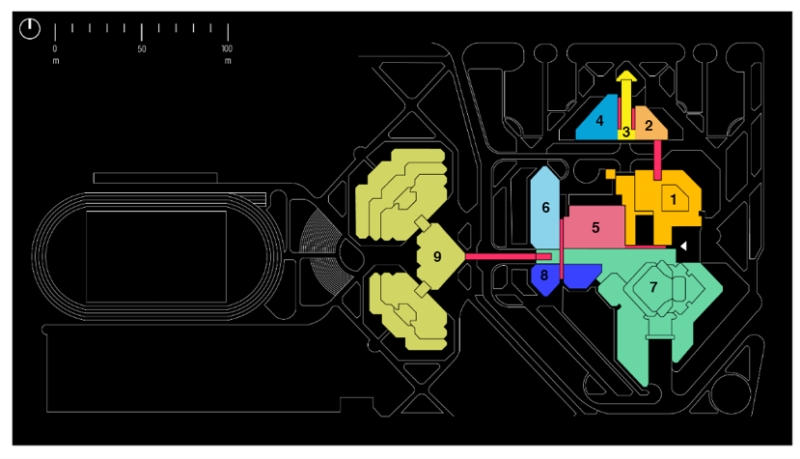
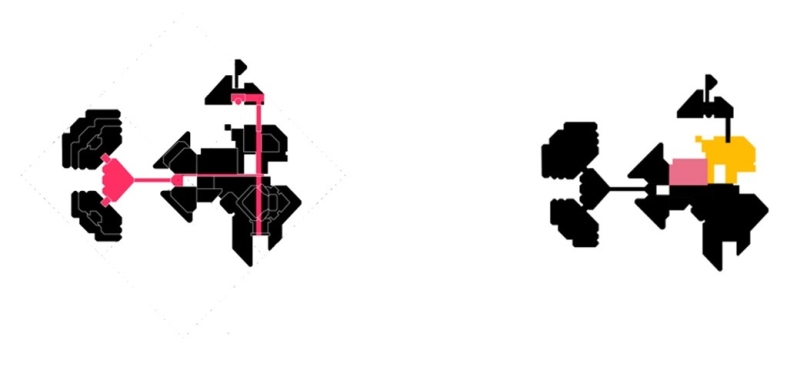
Fig.
7 - Scheme of the main axis of Sports and Education Centre (left);
constructed parts of sports hall (pink); administrative part currently
housing with the library and school (yellow) (right).
New collectivism of Soviet Latvia
Conventionally, the Soviet epoch is known as a time of
reformation. However, it cannot be denied that from the perspective of
unconventional conceptions which emerged in response to the ideological
request of the State it was the era of new formulations. This fact is
illustrated by a variety of innovative built forms. The phenomenon of a
collective farm, so-called kolkhoz, is in the
middle of this discourse. This typology is a bright example of Soviet
invention, rather than a result of gradual development, a physical
manifestation of the State's ideology written on the blank front of
unclaimed land.
Initially, the territory of Soviet Latvia was characterized by
the distinction between urban and rural. The outskirts of major cities
here were covered with single farmsteads (Bell et. al. 2019). However,
for the State, the claiming of the Latvian rural land was highly
promising from an economic perspective. Besides that, the introduction
of the collective farm in this context was both a tool to affirm Soviet
power and the outcome of it. At the physical level, the town and
countryside had to be brought to the common denominator, following the
standardization promoted by the Socialist principles (Drėmaitė 2017).
The collective farms, inserted into the countryside, were established
in a network around the large urban settings significantly changing the
rural landscape (Melluma 1994). Semi-urban settlements were created,
based on the needs of industrial production. However, the
standardization was operating also at the social level, following the
Marxist ideas[1]
(Meyer 1931). Thus, the collective farms were not planned to act as
“industrial apparatus”. Instead, introduced
settlements were considered a stage for new collectivism, where a sense
of belonging to the Socialist doctrines had to be established. In this
context, farmers were appropriating and activating the place. That
resulted in ambiguous conditions. On the one hand, growing repressions
made people “deliberately” join the kolkhozes. On
the other hand, to attract the owners of smallholdings, settlements
were designed with modern amenities for a comfortable life, often found
in the cities (Kalm 2009). Thus, the duality of the formation processes
resulted in the duality of the result. The urban settlements placed in
the middle of the agricultural landscape created a hermetic environment
in which a new form of collectivity was shaped. Therefore, the
collective farm was seen as both an urban form and a way of collective
living, which was mainly represented in the architectural dimension.
While it would be true to say that any invention requires a
decision, arguably also sacrifices, the question is if the outcome can
justify the action, once decontextualized from its specific position in
space and time.
At the time, the Soviet State established a system where
living and production were connected in a single cycle. The public
sector was crucial as a mediator between the two and served as a
principal scene for ideological formation. With the collapse of the
State, industrial and residential structures are still in demand.
However, the public building reflecting the concept of
“collective living” went to misuse or neglect.
Considering that the social sphere and the material forms are deeply
interrelated, it would be worth asking: from the contemporary
perspective, what lesson can be learned from the exemplary cases of
seemingly retrograde collectivist settings?
Chairman, innovative vision and the collective
farm Nākotne
The town of Nākotne was the first case of the collective farm
in Latvia. It was established in November 1946, 65km far from Riga,
following the efforts of the Latvia Soviet Socialist Republic (Būmane
1986). After the proclamation of independence in the Baltic Countries
in 1991, the settlement suffered stagnation. However, in terms of both
the layout and architecture of the settlement, Nākotne is a unique
example of the collective lifestyle. The exceptional nature of the
settlement is grounded in the refusal of conventional formal
standardization by the leaders of the farm.
The success of the settlement and the beginning of its urban
and economic growth can be traced back to 1966, with the appointment of
Arturs Čikste to the position of chairman of Nākotne. The family of
Čikste was one among 11 others establishing the Nākotne. Starting as a
houseboy Arturs’ Čikste eventually turned into a successful
public figure recognized at a variety of levels. In 1947, he was
elected leader of the Communist Youth League and in 1949, awarded the
title of Socialist Labor Hero. Consequently, in 1950, after becoming a
member of the Supreme Council of the Latvian SSR and the Supreme Soviet
of the USSR, he joined the Communist Party (Būmane 1986). These
acquired positions allowed relative freedom in managing the farm and
guaranteed access to experimental approaches in defining the setting of
the Nākotne.
The position of Arturs Čikste as the chairman of Nākotne has
never been neutral. Instead, it was based on the quintessence of
personal and professional experiences, driven by the desire to
innovate. Firstly, the disciplinary organization of the collective farm
was redirected. Čikste decided to step above the mere production of
agricultural crops, which was set as the only industrial activity of
Nākotne from 1946 to 1966. Even though expansion of the variety of
products was a risk, it ultimately justified itself in generating
significant economic growth and making the farm operate as a
diversified capitalist agriculture apparatus (Marsden et al. 1986).
Secondly, referring to the social perspective, a system tangential to
the one typical of the Soviet State was established. In contrast to
other collective farms, in Nākotne personal and cultural freedom was
not limited. Besides, the possibility of private property and a
sufficient salary were offered. It created a high demand for the
position in the settlement. Finally, with the consciousness of the
rules of strategic development, Arturs Čikste selected only the most
qualified candidates to join Nākotne. It largely contributed to the
innovation of local facilities, which started to be realized, combining
functionality and modern aesthetic vision.
In 1967, led by the search for further development ideas,
Arturs Čikste visited the exhibition of young Lithuanian architects in
Vilnius. The project of young yet experienced Henrikas Kęstutis
Šilgalis (1944-2007) raised the particular interest of the
chairman. Thus, he was invited to become the chief architect of Nākotne
(1968 to 1979) (Fig. 1).
As a rule, the collective farm was designed not only through
physical, but also political reality. The chairman was the executive
power of the Soviet State carrying the architecture and urban layout
capable of assuming explicit economic, productive, social, and
representative responsibility. In the case of Nākotne, the collective
farm was a physical manifestation of the design process dependent both
on the client and the implementor, due to a mutually respectful
collaboration between the chairman and the architect.
The dissident architect of the Nākotne
Henrikas Šilgalis was given an opportunity to
construct his projects at an early age with the help of Algimantas
Mačiulis (1931), the head of the Institute of Public Utility Design in
Vilnius (Mačiulis 2009). It had an important impact on the
Šilgalis formation, strongly influenced by modernist
architecture, particularly, the sculptural expressiveness of Le
Corbusier. Henrikas Šilgalis refused the technical
minimalism and the modernist spirit, which was the dominating
architectural doctrine in the Soviet Baltic Countries in the 1960s
(Dremaite 2017). He believed that this kind of minimal simplicity did
not allow to inter-relate in a single architectural layout the specific
functional programs closely linked to the architectural form. According
to his colleague, Leonardas Vaitys, Henrikas Šilgalis
postulated that public buildings had not only to suffice the functional
needs but also fulfill the representative and symbolic role of the
local community (Vaytis 2003).
The collective farm of Nākotne ultimately became a testing
ground for Šilgalis’ experimentation in
establishing a personal approach in the middle of the architectural
discipline. Given a larger artistic freedom in testing avant-garde
ideas, architect could ultimately define a personal style suitable for
the cultural context of his time (Fig. 2)
The masterplan of the centre of the collective
farm “Nākotne”
Šilgalis designed the master plan for the center of
Nākotne in the late 1960s when the collective farm had already existed
for 20 years. In this context, architecture was a result and catalyst
of the social and economic prosperity of the farm. Before the Soviet
occupation of Latvia in 1940, the area of Nākotne was characterized by
a network of single farmsteads in the context of overlapping urban and
natural systems such as the river Auce and clusters of forests. The
initial Soviet collectivization model, established in 1946, was not
focused on the internal organization of the settlement, but rather on
the fact of the establishment itself (Dremaite 2017). Soviet planning
did not create a unitary system. It resulted in a dispersed urban
pattern and stagnant development. Addressing the issues posed by the
setting, Šilgalis proposed the new residential and public
zone of the settlement. In the 1960s he proposed a circular spatial
organization as a new centrality (Figure 3), capable to unify the
pre-existing elements of the site. Once united by the introduced focal
point, the collective farm started to operate as a complete mesh of
relationships, where the elements could change but remained connected
in a system of meanings.
The proposed master plan (Fig. 4) for the central core of the
settlement was inspired by structuralist thought (Söderqvist
2010). The functional clusters of residential and public facilities
were set in a radial dialogue with each other, immersed in the
landscape. Living blocks were located in a separate zone, offering
ample private space. Thus, the community in Nākotne expressed itself in
a balance between privacy and collectivity. Each building of the scheme
was designed as a free-standing element within unprogrammed natural
matter. Thus, the public facility was not a physical, but meaningful
centrality of the spatial composition.
Sports and Culture Centre: a monumental dominant
of the settlement
In the context of the master plan proposed by
Šilgalis, the protagonist's role was given to the Sports and
Culture Centre (1967) (Fig. 5). Rather than mimetically adapting to its
surroundings, the intervention undertook a full representative role as
a monumental dominant. The structure consisted of self-sufficient
polyvalent units, creating two distinct environments: the
representative exterior and functional interior. The notion of
multifunctionality which served the community rendered the building the
social condenser. This concept was developed in the theoretical and
then practical work of the Russian constructivists in the 1920s
(Meriggi 2014). Meanwhile, according to this vision, the spatial
organization could be a dual catalyst of positive and negative aspects
of community and individuality. Later, the concept was also adopted by
Guido Canella, particularly in the design of public buildings, where
seemingly non-compatible functions were complementing each.
Importantly, these experimental layouts were generating a sense of
community and unexpected encounters (Chizzoniti 2020).
In the case of Nākotne Sports and Culture Centre,
multi-functionality was addressed purely through the architectural
composition of the complex. Here, social, cultural, and administrative
functions were not merely grouped in a relation to each other. Instead,
the functionality and accessibility were generated by the combination
of different units within the single structure (Fig. 6). Such a
building was characterized by an outstanding level of complexity,
performing both, as a tool for shaping a community and as an asset
responding to essential social needs, providing equal access to the
users. The general scheme was organized on a square plan rotated by 45
degrees with two main distribution axes (Fig. 7). All programmatic
activities are connected through the passages, which were guiding the
user flows. While the main axis is clearly outlined, the separate units
can be accessed from individual entrances. This autonomy was
predetermined by the intricate scheme of the Sports and Culture Centre
itself. Considering the unprecedented dimension of the complex, which
had to be constructed in several stages, each programmatic unit was
designed as autonomous.
The central block consists of interrelated functions such as
administration, cultural center, sports hall, swimming pool, and
canteen. The high school, kindergarten, post office, and ambulatory are
placed in separate units. This spatial separation suggests that the
unit is not universal but provisioned for a specific group of users.
The main axis is concluded with a design of the stadium with
semi-circular seating looking at the vast arable lands behind. It
creates a structure without a “backside”, but also
without the central square. Instead of a central gathering space,
several semi-courtyards have been carved as subtracts from the initial
square scheme. Thus, the outdoor space was permeating the building.
This suggests the total use of the spaces, rather than one focal point
for the activity within the building.
Post-Soviet: the
collective farm of Nākotne as an asset and a challenge
With the collapse of the Socialist State, the utopia of the
collective farm began to act as a heterotopia of collective living.
Nākotne was able to exist under the Soviet regime in Latvia where the
settlement and industry were merged into a single organism, providing a
type of self-sufficiency. With the change of the regime and subsequent
dissolution of the collective living in the periphery, structures such
as the Sports and Cultural Center of Nakotne have lost not only their
meaning but also strategic importance. The current tendencies
demonstrate that public services are concentrated in major urban
centers. It results in a two-fold problem. From one perspective, the
issues are related to urban-rural mobility. On the other, the current
economic system is rarely capable of running architectural objects of
this scale in the context of contemporarily isolated rural settlements
(Hatherley 2015).
While the collective farm was generally neglected as a
phenomenon related to specific manifestation and temporality, some
examples contain valuable historic lessons. The case of Nākotne
highlights the role of the client and architect in the development
process: it questions the relationship between those two actors in the
creation of prosperous architectural discourse. Henrikas
Šilgalis' vision was formulated after an in-depth
understanding of the program and requirements of the chairman, Arturs
Čikste. Consequently, the client provided knowledge of the social and
political context and financial support, as essential tools for
successful development. The core of this collaboration was grounded
around the clearly defined roles, personal contributions, and input of
each actor in the project. As a result, the exclusive system of
development was created, where architectural ideas aimed to support
collectivist thought were enhanced by the specificity of the
development processes. Thus, a specific precedent has been created,
where the neutrality in the combination between the ideology and the
formal shaping has been interrupted, as enriched by the innovative
architectural vision.
By refusing fashionable architecture doctrines of the time,
Henrikas Šilgalis established a role of individualist and
nonconformist whose design process was driven by a search for personal
handwriting (Vaytis 2003). The case of the collective farm
“Nākotne” proves that an issue of
“style” is as important as functional needs in the
contemporary architectural discourse. The combination of the two
aspects led to the creation of a unique built complex that shaped the
identity of the place and the community of Nākotne.
The recent healthcare crisis has pointed out the need for
inclusivity at both social and physical levels. The privatization of
the public space by different social groups has led to selective
exclusion practices. There is an emerging need in generating a broader
discussion over the strategic accessibility of the social space,
balanced between integration and diversification, which is at the core
of contemporary complexity discourse (Landman 2020). Meanwhile, the
society of urban lifestyles and amenities still longs for proximity to
nature to maintain mental and physical balance (Nigrelli 2021). In this
context, the complex building framework of the collective farm of
Nakotne could be relevant in the ability to orient the social behavior
through the programmatic setting of the natural and built structure.
Nakotne poses several site-specific open-ended questions. However, from
the contemporary perspective, it can be considered both a challenge and
an asset for the issues of architectural discourse.
Notes
[1]
Architecture was not considered «the art of
building», «not an act of composition dictated by
feeling», rather a science, «an act of premeditated
organization». «The building itself is not a work
of art. Its size is determined by the dimensions and functions of its
program and not by the shallow pathos of any trimmings». Only
the «diminution of the multiplicity of standard
elements» would guarantee the elevation of the discourse to
its “highest form» as an «indication of
the steady socialization of life in the mass».
References
BELL S., NIKODEMUS O., PENEZE Z. and KRUZE I. (2019) – Soviet era landscape change and the post-Soviet legacy in Latvia. SHS Web Conf. 63 07003, DOI: 10.1051/shsconf/20196307003.
BELL S., NIKODEMUS O., PENĒZE Z., et al. (2009) – Management of cultural landscapes: what does this mean in the Former Soviet Union: A case study from Latvia. Landscape Research, vol. 34, n° 4: 425-455. DOI: https://doi.org/10.1080/01426390903020328.
BUCHLI V. (1998) – Moisei Ginzburg’s Narkomfin Communal House in Moscow. Journal of the Society of Architectural Historians, 57(2).
BUMANE I. (1986) – Nākotne četrdesmitgades kalnā. Avots, Rīga.
CHIZZONITI D. (2020) – Space and Figuration of the School
Building in the Construction of the Metropolitan Periphery: The School
as a Social Emancipation Workshop. In: Della Torre, S.,
Bocciarelli, M., Daglio, L., Neri, R. (eds) Buildings for Education.
Research for Development. Springer, Cham.
https://doi.org/10.1007/978-3-030-33687-5_3.
DRĖMAITĖ M. (2017) – Baltic Modernism. Architecture and Housing in Soviet Lithuania. DOM Publishers.
HATHERLEY O. (2015) – Landscapes of Communism. Penguin Books Ltd, London.
HEYNEN H. and LOOSEN S. (2019) – Marxism and Architectural Theory across the East-West Divide. Architectural Histories, 7(1), p.21. DOI: http://doi.org/10.5334/ah.401.
INGERPUU L. (2019) – Comparing the socialist rural
architecture of the Baltic States: the past and the future of the
administrative-cultural centres of collective farms. SHS Web Conf. 63 11004 (2019). DOI: 10.1051/shsconf/20196311004.
KALM M. (2009) – ‘Does Urban Life Make Farmers Happy? The Central Settlements of the Collective Farms in the Estonian SSR’. Urban
Planning and the Pursuit of Happiness. European Variations on a
Universal Theme (18th–21st Centuries), Berlin: Jovis.
LÜCHINGER A. (1980) – Structuralism in Architecture and Urban Planning. Structuralism as An International Movement, Stuttgart.
LANDMAN K. (2020) – Inclusive public space: rethinking practices of mitigation, adaptation and transformation. Urban Des Int 25, 211–214. https://doi.org/10.1057/s41289-020-00136-4.
MAČIULIS A. (2009) – Kęstutis Pempė: architekto biografija. Archiforma 2:42-48.
MEYER H. (1931) – On Marxist Architecture. Union of Soviet Socialist Republics (USSR).
MARSDEN T., WHATMORE S., MUNTON R. and LITTLE J. (1986) – “The restructuring process and economic centrality in capitalist agriculture”. Journal of Rural Studies, Volume 2, Issue 4, Pages 271-280, ISSN 0743-0167, https://doi.org/10.1016/0743-0167(86)90026-4.
https://www.sciencedirect.com/science/article/pii/0743016786900264.
MELLUMA A. (1994) – Metamorphoses of Latvian landscapes during fifty years of Soviet rule. GeoJournal, vol. 33, n° 1: 55-62. DOI: https://doi.org/10.1007/bf00810136.
MURAWSKI M. and RENDELL J. (2017) – The social condenser: a century of revolution through architecture. 1917–2017. The Journal of Architecture, 22:3, 369-371, DOI: 10.1080/13602365.2017.1326680.
NIGRELLI F. (edited by) (2021) – Come cambieranno le città e i territori dopo il Covid-19: Le tesi di dieci urbanisti. Quodlibet, Macerata.
SÖDERQVIST L. (2011) – Structuralism in architecture: a definition. Journal of Aesthetics & Culture, 3:1, DOI: 10.3402/jac.v3i0.5414.
ŠIUPŠINSKAS M. and LANKOTS E. (2019) – Collectivist ideals and soviet consumer spaces: Mikrorayon commercial centres in Vilnius, Lithuania and Tallinn, Estonia.
In D. Hess & T. Tammaru (Eds.), Housing Estates in the Baltic
Countries. The Urban Book Series. Springer. 301-320.
https://doi.org/10.1007/978-3-030-23392-1_14.
VAITYS L. (2003) – Architektûra. Artseria, Vilnius.
ZVIDRINŠ P. (1998) – Changes in Living Standards and Depopulation in Latvia in the 1990s. Social Indicators Research, 43(1/2), 121–140. http://www.jstor.org/stable/27522302.
Interview with Gunārs Valentīns Segliņš, former head of
construction of the collective farm Nākotne. 15.11.2021, online. All of
the information is in possession of the author.
Interview with Juris Kaņepe, former agronome of collective farm
Nākotne, 18.12.2021, Nākotne. All of the information is in possession
of the author.
Interview with Silvija Zībarte, local librarian in Nākotne library.
21.12.2021, Nākotne. All of the information is in possession of the
author.