In-betweenness as destiny.
Paradigm shift in urban and architectural design of post-World War II
Belgrade
Zoran Dukanović, Nađa Beretić
Fig.
1 - Individuazione della città di Belgrado in relazione alle
diverse fasi storiche.
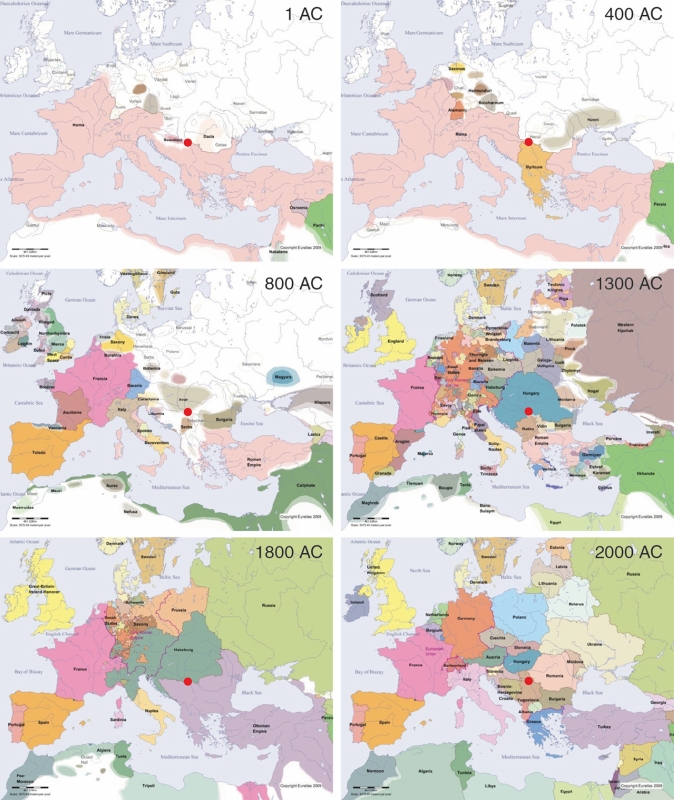
Fig.
2 - Nikola Dobrović, Piano regolatore della Grande Area di Belgrado,
1949. (Per gentile concessione dell'Istituto Urbano di Belgrado).
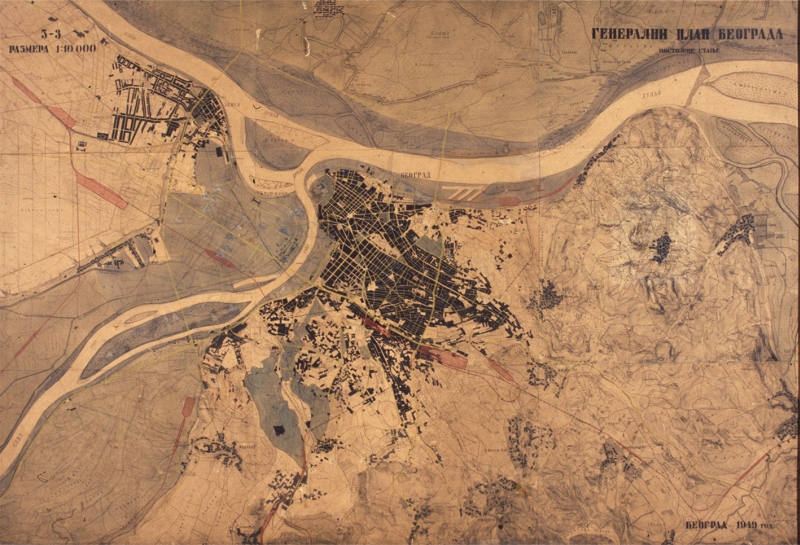
Fig.
2 - Rudolf Perco, Erwin llz and Erwin Bock, Singidunum Novlsslma,
Planimetria della proposta vincitrice del secondo premio, Concorso
Internazionale per il Piano Urbanistico Generale di Belgrado, 1922.
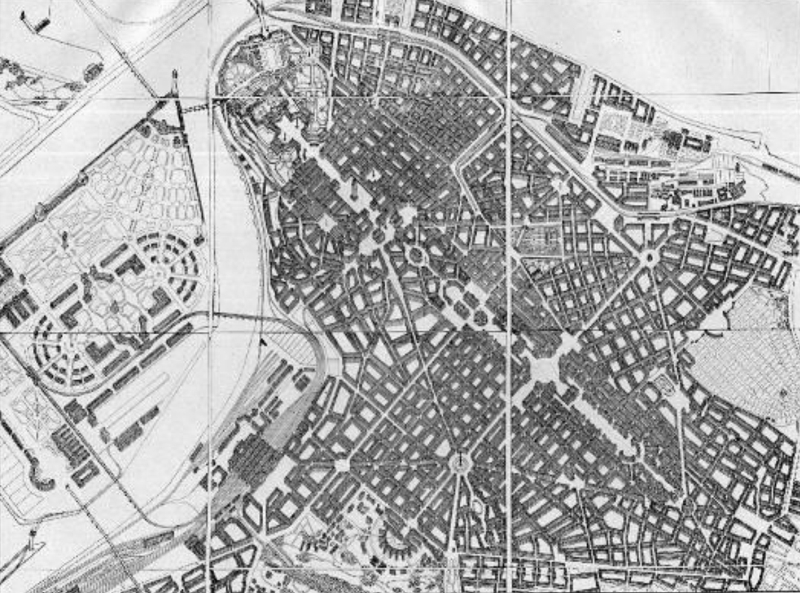
Fig.
4 - Đorđe Kovaljevski, Planimetria di Belgrado sulla riva sinistra del
Sava, Piano urbanistico generale, 1923.
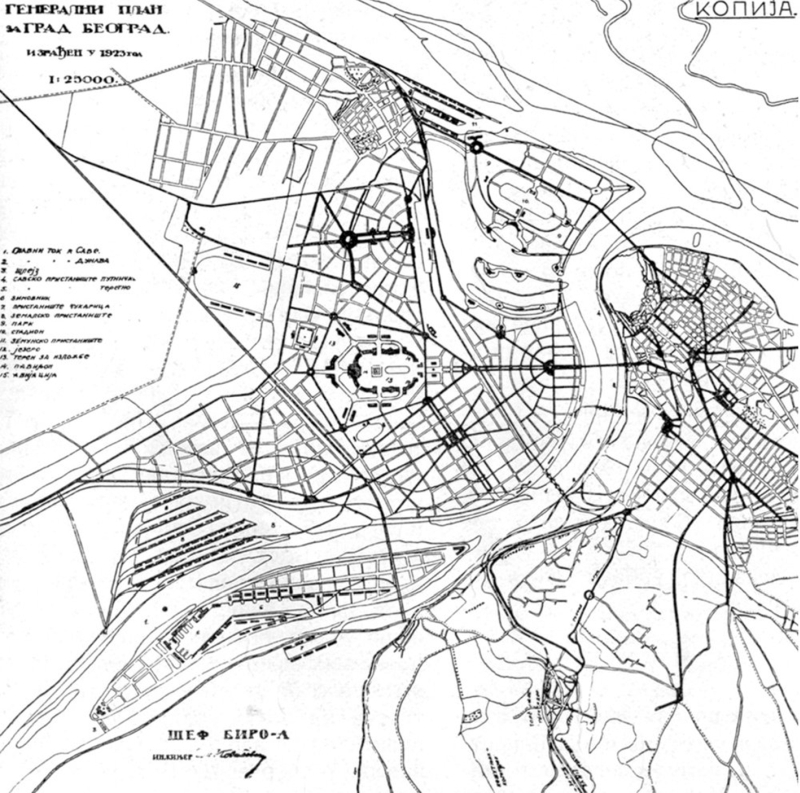
Fig.
5 - Nikola Dobrović, Schizzo del masterplan della Nuova Belgrado sulla
riva sinistra del fiume Sava, 1946.
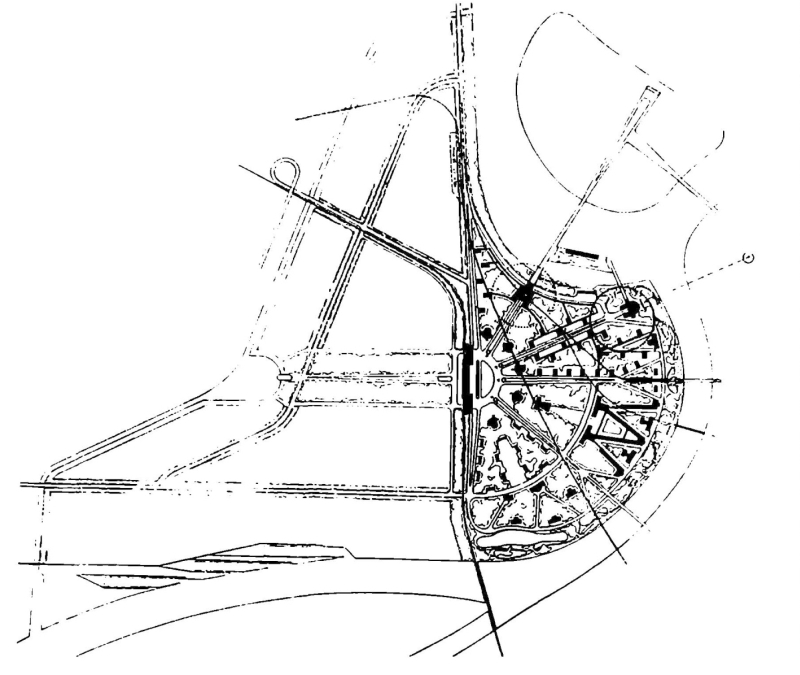
Fig.
6 - Nikola Dobrović, Il progetto di massima dell'area di Belgrado,1948.
Per gentile concessione dell'Istituto Urbano di Belgrado.
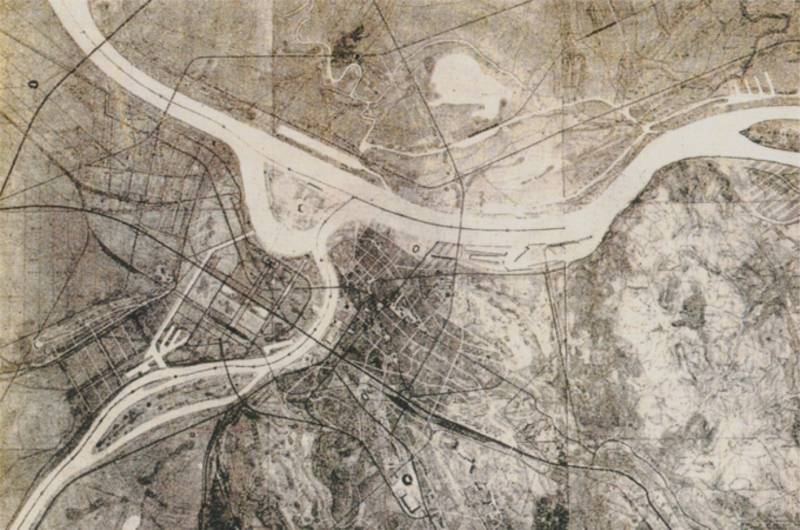
Fig.
7 - Presentazione della proposta finale del Piano Urbanistico Generale
di Belgrado al Presidente Josip Broz Tito, 1949.
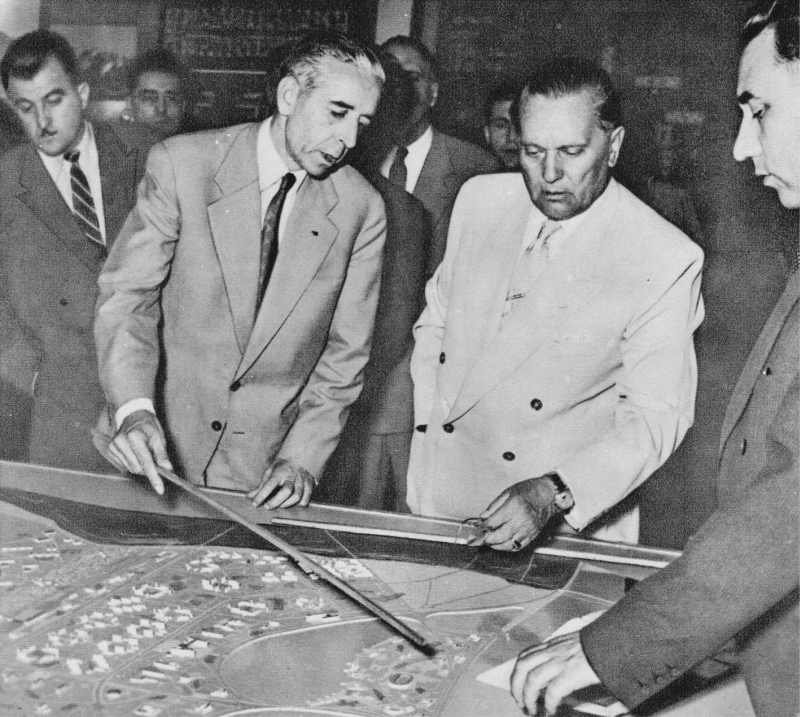
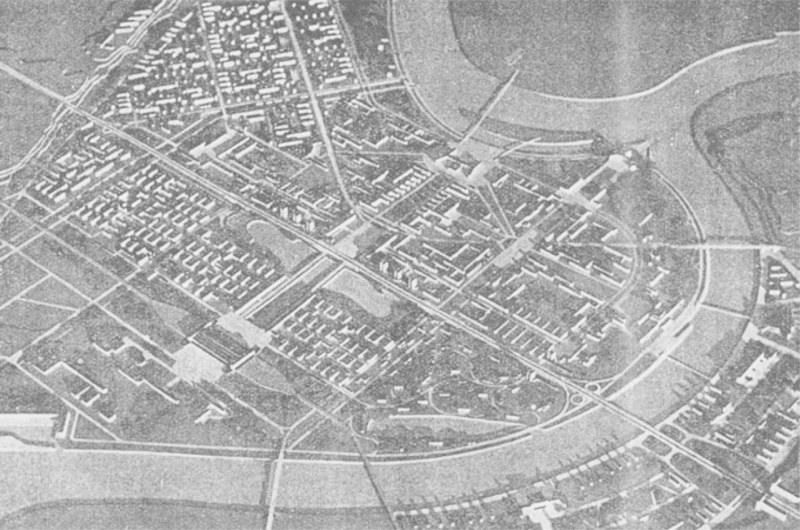
Fig.
8 - Nikola Dobrović e Milorad Macura, Concorso per il piano urbanistico
della Nuova Belgrad, 1948.
Introduction
Over the past few decades, since the fall of the Berlin Wall, there
has been a growing interest in the architecture and urbanism of the
eastern, former socialist countries. Although Serbia was not part of
the Warsaw bloc and remained a relatively open country, it has
attracted significant research interest. The curiosity about
architecture and urbanism in Serbia, particularly in Belgrade,
intensified after the end of the wars that ravaged the former
Yugoslavia in the 1990s.
Belgrade, with over two thousand years of history, has predominantly
existed on the fringes, positioned between different cultures, enduring
their influences. This historical context has given rise to multiple
interpretations of the same phenomena.
Today, while no longer situated at the edge of a state but on the
northern boundary of the Balkan Peninsula, Belgrade remains in-between
as the capital of Serbia. It is a small European country with uncertain
territorial and population dimensions, undergoing a comprehensive,
multilayered transition between the East and the West, autocracy and
democracy, socialism and capitalism, collectivism and individualism,
atheism and zealotry, isolation and globalization, and the contrast
between "honey and blood."
Belgrade represents a unique amalgamation, containing elements from
the East, West, South, and North, all coexisting in the same place.
Everything converges here: Belgrade with Zemun and New Belgrade; the
densely populated city with the uninhabited Great War Island, its
natural green heart; the rugged cliffs of the Belgrade ridge with the
shimmering surface of the rivers and the vast plains of Vojvodina;
modern glass high-rise buildings alongside bombed ruins; classicism and
art nouveau next to traditional Ottoman houses; trendy, fashionable
individuals alongside the homeless; Sachertorte with baklava; kebabs
with Wiener schnitzel; disco clubs with belly dance performances;
cigarettes with hookahs; Porsches with horse-drawn carriages; noise
blending with silence; and glory juxtaposed with defeat.
This eclectic mixture is evident not only in the etymological
origins of the names of various city areas but also in the vocabulary
of the Serbian language. Everything interlaces and overlays with
everything else, not only on a spatial level but especially on a
cultural and semiotic plane. To borrow from Calvino, discourse becomes
secretive, rules appear absurd, perspectives become deceptive, and
everything conceals something else. Due to its complexity, Belgrade
consistently and effectively evades being fully grasped (Calvino, 1972).
To comprehend Belgrade, one cannot be a passive observer. It
requires a deep engagement in a reciprocal process of sharing dreams
and fears, a desire to partake in and relish the contemplative unity of
the city. Throughout its history and continuing today, Belgrade has the
ability to offer something for everyone, precisely because it has been
shaped by everyone (Jacobs, 1961).
Between and betweenness
The complex betweenness in Belgrade is essential for understanding
urban processes, city life, and the city's development. The permanent
condition of being "in-between" requires a clear definition of terms.
The Oxford dictionary defines the term "between" in-between (adverb)
as a position in space (or time)—to be at, into, or across the
space (or time) separating two objects or regions or two points in
time. However, the term "in-betweenness" does not exist in that
vocabulary.
The Collins dictionary defines the term "betweenness" (noun) as the
condition of being between. Meanwhile, the Merriam-Webster dictionary
defines the same "betweenness" (noun) as the quality or state of being
between two others in an ordered mathematical set.
For us, betweenness is a process; it's a relational state
established among the subject and the two-surrounding otherness, which
requires the investment of resources in the realization of those
relations. In this context, the importance of establishing external
relations exceeds the concern of realizing internal relational
categories. Therefore, it involves compromise. Betweenness also means
being in a condition where two others could fade or even cease, but the
subject is still under the influence of both. Betweenness is a
transitional/hybridizing state in which the subject is always in
between the beginning and end, border and threshold, i.e., limes and
limen. It's a state of tension in which the gravitational forces of
surrounding otherness shape the essence of what is between them.
Betweenness means being far from the centers, on the periphery, or
beyond the horizon — remaining far away from strong interest but
not without any influence or interaction with the center (Beretić et
al., 2022).
In the open call for the conference "In-betweenness: spaces,
practices, and representations" (Sorbonne Nouvelle – Paris 3, May
29th, 2019), "in-betweenness" has been understood as a liminal space or
state that implies dynamics of continuity, separation, transition,
overlapping, and mobility. It involves issues related to territories,
practices, and representations. This concept can be studied in a range
of fields, including history, geography, sociology, anthropology,
political science, geopolitics, linguistics, translatology, literature,
and different types of art.
New Belgrade
At the end of World War II, Yugoslavia was a devastated country, and
its capital, Belgrade, was a city destroyed by multiple bombings and
brutal acts of war. Yugoslavia emerged from the war as one of the
victorious Allied countries, expanding its territory, abolishing the
kingdom, declaring a socialist revolution, and organizing the state
based on the Soviet model.
Total nationalization followed, involving all resources on the
entire state's territory, except for private houses with minimal plots
in villages (the so-called land minimum), thus becoming a
socially-owned state. Reconstruction began quickly in the first months
after liberation, adopting the Soviet development model of
industrialization and urbanization defined by five-year development
plans and centralized administration.
The reconstruction of the cities started instantly, and the
significant migration of people from the countryside to the resurrected
cities required the urgent, extensive construction of a large number of
new apartments as well as technical and social infrastructure
facilities. To meet these needs, all technical and social resources
were engaged, but they were not enough for the rapid recovery of the
country.
The destabilization of political factors in the environment caused
by Yugoslavia's refusal to fall under the strong influence of the
Soviet Union further complicated the already difficult situation.
Belgrade, as the capital of the new state, became a special focus of
the new government.
The reconstruction of Belgrade aimed to build a new magnificent
socialist capital for a new socialist state. This kind of
representation was intended to show and celebrate the success of the
achieved double victory over Nazism and capitalism. For this purpose, a
monumental, wide, flat, almost completely empty, spatially luxurious
scene—huge marshes on the opposite, left bank of the Sava river
in the total volume between Belgrade and Zemun, framed on both sides by
the Belgrade and Bežanja ridges and cut by a shining strip of the river
flow—was chosen for construction (Fig. 2).
With the task of planning a new city on the left bank of the Sava
River, experts were gathered, led by architect Nikola Dobrović
(Blagojević 2007). The experts were few but well-educated, having
studied at the best foreign schools and offices in Prague, Vienna,
Berlin, and Paris. Many of the employed architects had previously
worked in Le Corbusier's office or were supporters and followers of his
ideas (Pignatti 2019).
On the other hand, after breaking with the USSR, the ruling
political oligarchy, with the adopted CIAM architectural model,
additionally wanted to show a determined break with Stalin's political
ideas. Moreover, it was expected that this model could be an
appropriate tool for clearly expressing the will for a definitive break
with the royal and clerical traditions of the previous state. In this
regard, the CIAM declaration and Corbusier's ideas led to a successful
meeting of professional aspirations and political will. Tito personally
participated in these affairs by constantly monitoring and actively
participating in decision-making (Pignatti 2019).
The idea of building a city on the left bank of the Sava was not
entirely new. It appeared twenty years earlier, immediately after the
unification of the Kingdom of Yugoslavia, at the international
competition for the General Urban Plan of Belgrade, realized in 1922.
In the second award-winning work of the Viennese team of authors,
extensive construction was proposed for the first time in the area
where, decades later, New Belgrade would be created (fig. 3).
Although too ambitious and formal, this work left a strong mark
because it immediately initiated further reflections on this topic.
That initiation was already fruitful the following year in the General
Plan of Belgrade (1923), which also foresaw the expansion of the city
in this direction (Fig. 4). However, this idea also ended up only on
paper.
For centuries, Belgrade has looked at this space with longing and a
desire to enter it. Yet, the border, where the city was nestled,
between the two great world empires, Ottoman and Austro-Hungarian, was
an insurmountable obstacle to that historical undertaking. Finally, in
1937, four years before World War II starts, Belgrade Fair was built
across from the city center, on the left bank of the Sava River.
Nevertheless, in the post-war period, carried by a strong wave of
reconstruction and supported by the overall political, social, and
economic resources of the state, this idea finally got a chance to be
realized. The development of the new General Urban Plan of Belgrade
began in 1945, with the preparation of studies and the first spatial
sketches, already published in 1946. That year, Nikola Dobrović, the
leader of the design and planning team, published his first sketch
(Fig. 5).
The solutions proposed in this sketch are described as a garden-city
with buildings immersed in protective greenery, well connected by roads
and rails to other parts of the city. The complex is fully subordinated
to the realization of the political program aimed at creating a
monumental urban composition, the most significant in the future image
of the whole of Belgrade. The composition was supposed to be a center
of political power with prominent Government buildings, including a
complex for 20 ministries and the building of the Central Committee of
the Communist Party of Yugoslavia as the most eminent architectural
unit of this urban composition. These compositional criteria were also
part of the political decision expressed in an official document drawn
up by the Ministry of Construction of the Republic of Serbia, which was
in direct subordination to the state institutions of Yugoslavia,
including President Tito himself.
Later, the ideas from Dobrović’s sketch (1946) were elaborated
and strongly criticized. Ultimately, his solution was completely
rejected, and accordingly, he and his team created a new conceptual
sketch, which became the iconic basis for further planning and
construction of New Belgrade (Fig. 6).
Based on this sketch and further elaborations, in 1949, the final
proposal for the Master Plan of Belgrade was presented to the President
of the State, Josip Broz Tito (Fig. 7). After a positive opinion, the
proposed plan entered further verification procedures. Finally, in
1950, the preparation of the Master Plan of Belgrade was finished,
ending the phase of revolutionary enthusiasm to create New Belgrade as
a new spatial and ideological model of Yugoslav socialist society.
Verification of the Master Plan of Belgrade ended the era of innocence
of urbanism in the Yugoslav socialist city.
Conclusions
We posit that the condition of betweenness possesses the potential
to serve as a catalytic agent for instigating transformative processes.
It functions as both an instigator and an incentive, as well as a
mechanism for making choices that engender intricate relationships
within the spatial context. Additionally, it can function as an
instrument of control, as evidenced by the case of Belgrade and New
Belgrade. Subsequently, the ensuing discourse endeavors to elucidate
several plausible interpretations of betweenness and the intricate
relational dynamics that can be established during the
conceptualization, inhabitation, and comprehension of New Belgrade as
an urban system.
Between external and internal:
A crucial characteristic of betweenness is the external relationship
with the world. For instance, the relationship with the developed
European countries had overflow effects on the internal social and
spatial fields. There were only a few architects, and most of them were
educated abroad, bringing back internationally gained experiences to
Yugoslavia. Despite this noble idea of knowledge transfer, the process
is beyond the control of architects. It depends on the cultural
capacity of society, not solely on the knowledge and skills of
architects. This process was often stuck between progressive cultural
experiments and re-traditionalization.
Life between two discontinuities:
Belgrade, like the Balkans, is in a permanent state of
discontinuity. Experiencing 115 wars (Nurden 2009) on its territory in
two thousand years of history means that Belgrade and its citizens face
a war every 17.5 years. In other words, for centuries, there has not
been a single generation without a direct experience of war, at least
once in their life. In the same period, Belgrade was razed to ashes 44
times (Nurden 2009), implying that every 45 years, we rebuilt our
beloved city almost from scratch. In this lens, New Belgrade is not
such a significant undertaking to construct.
Between to have and to be:
Betweenness enables the emancipation of choice in which the state,
as the owner of social property, has rights over all resources. It
ensures, or at least tries to ensure, equality in the distribution of
those resources. Among the best examples of how that principle works is
the production of apartments by society, social ownership of the
housing stock, and the distribution of apartments based on the criteria
of equality. Another example is the inalienable right to use the
apartment, but not to privatize it because a flat is a social good. New
Belgrade was conceived and built as a socially-owned city (Blagojević
2007). Another possible reading: Between top and down. This implies
establishing relationships along the vertical lines of social
organization and hierarchy, but also between an individual and the
community—the establishment of social and spatial relations
horizontally.
Between Utopia and Pragmatism:
Socialist architecture in Yugoslavia, as a pragmatic field, between
Corbusier and Marx, existed between utopian, ideological, and dogmatic
fields, with Tito as a mediator (Pignatti 2019). The position of the
architect, in this case, could take on the role of interpreter and
articulator of all four fields (pragmatic, ideological, dogmatic, and
utopian), leading to the dangerous demiurge position of the supreme
priest of the new order who knows what people need better than
themselves. Even Dobrić could not resist this challenge, neither could
Corbusier, but Tito did.
Life between the rigid centers of political power and the vibrancy
of everyday life: A life between real needs and the ability to satisfy
them.
The heroic environment is not suitable for the average person's
life. In a heroic setting, the nearest kindergarten or supermarket is
often located in another part of the city or on the other side of the
river. This was the danger of the original idea in New Belgrade.
However, private initiatives quickly intervened, furnishing the basic
necessities of life, and the weak technical potential of the
construction industry to complete heroic ideas. "Ambitious plans to
create a new city on the left bank of the Sava were not accompanied by
adequate technical equipment," while "construction based on craft
production was unprepared for such high goals and expectations"
(Đukanović 2015). When, over time, the technical potential grew to the
limit of realizing the heroic idea, the city was already finished, the
war began, and the state-investor dissolved.
Between modernization (as a process) and modernity (as a goal): That
is, architecture between modernism and modernization. Discussions about
contested modernism (Blagojević 2007) and unfinished modernization
(Mrduljaš, Kulić 2012) show that modernism was not the ultimate
goal, and modernization was realized only to the extent that local
society was ready to modernize.
Bibliography
CALVINO I. (1972) – Le
città invisibili, Giulio Einaudi Editore,
Turin.
ĐUKANOVIĆ Lj. (2015) – Typology
and Valorization of Building Structure of Residential Buildings of
Belgrade from the Standpoint of Living Comfort, Doctoral
Dissertation, University of Belgrade, Faculty of Architecture, Belgrade.
JACOBS J. (1961) – The
Death and Life of Great American Cities, Random House, New
York.
MRDULJAŠ M., and KULIĆ V. eds. (2012) – Unfinished Modernisations:
Between Utopia and Urbanism, Croatian
Architects’ Association, Zagreb.
NURDEN R. (2009) – “Belgrade has risen from the
ashes to become the Balkans party city”. The Independent, 22
marzo 2009.
PIGNATTI L. (2019) – Modernità
nei Balcani: da Le Corbusier a Tito, LetteraVentidue
Edizioni Srl, Siracusa.
URBEL: Urban planning
Institute of Belgrade, website,
http://timeline.urbel.com/en/.
BERETIĆ N., ĐUKANOVIĆ Z. and CAMPUS G. (2022) – Plural city: layered
singularities and urban design: case of Belgrade City
(RS). City, Territory and Architecture. Disponibile a
<https://doi.org/10.1186/s40410-022-00154-5>.
BLAGOJEVIĆ Lj. (2007) – Novi
Beograd: Osporeni Modernizam, Zavod za udžbenike,
Arhitektonski fakultet Univerziteta u Beogradu, Zavod za
zaštitu spomenika kulture grada Beograda, Belgrade.